Ditu Migniulellu, or Mignola
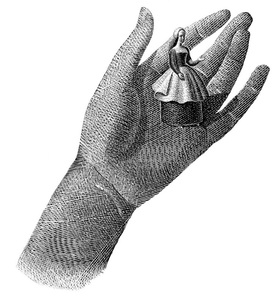 Image by Alenka Sottler
There
was a woman who had been married for many years, but despite all her wishes
and prayers and fertility remedies, she could not have children. One day she said, “Oh, if I
could have a little girl, I would be so happy! It would be enough even
if she was only as big as my pinky finger.”
“WIthin nine months you will be satisfied,” replied a voice that seemed to come out of the roof or down the chimney.
"Who said that?” said the astonished woman. “If it is a genie that brings me such good news, it is blessed.”
But she saw and heard nothing more of the genie. Nine months afterwards she had a little girl. No one had ever seen a baby more beautiful or more minuscule. She was the size of her mother’s pinky fingers, so they called her simply Pinkie Finger, or Ditu Migniulellu; Pinkie or Mignola for short. The midwife was barely out of the bedchamber when the mother looked up and saw four beautiful and powerful fairies standing around her.
The first fairy came forward. "I will make Ditu Migniulellu so beautiful that nowhere in the world could anyone find a more beautiful maiden.”
The second fairy added, “And I give her a singing voice so sweet and so agreeable that everybody else will sing along in admiration."
“But before she sings, she must learn speak,” said another fairy. “So she will speak fluently from this moment forward.”
"Thank you, my lady, thank you," replied the little baby.
But there was one more fairy in the room. The mother turned toward her. “And you, beautiful fairy, what gift do you bring?”
“I will give her nothing yet, but I will come to her aid whenever she needs me.”
The fairies then vanished, leaving the woman alone with her newborn daughter, who began to look around and chatter excitedly.
“You’re so pale, mama! You must be tired.” She noticed the brand new baby clothes, of a size meant for a normal baby, laid out nearby and squealed. “Is that bonnet with pink ribbons for me? Can I wear it?”
“Certainly, my daughter,” said the woman. She tried to place the bonnet, sized for a normal baby girl, on the girl’s head, but Ditu Migniulellu was completely covered up and began to cry and kick.
And as the mother took off the bonnet carefully, she thought to herself, “Why couldn’t the fairies have made her bigger? Oh, why didn’t I ask the fairy to make her a little larger? But she’s less than a day old. I must be calm. In a year or two, surely she’ll be the same size as other children her age.”
But Ditu Migniulellu never grew to normal size. By the time she was sixteen years old, she was still only the size of a finger, although perhaps a larger middle finger. Still everyone called her Mignola, though. Her mother, now widowed and having to work twice as much, began to resent her and then to fret a lot about her.
“What can I do with her?” she said. “She can’t garden, she can’t clean, she can’t cook. She’d literally drown to death in a glass of water.”
When it came time to go to market shopping for groceries one day, the mother’s heart was filled with shame and anger, not to mention the pressure. Ditu Migniulellu worked merrily in the garden, trying to pull up weeds as tall as she was, and talking to all of the flowers and the bees. She was so busy talking that she didn’t even hear her mother sneaking up behind her until it was too late. A terracotta flower pot came down over her, closing her in what was to her an unbreakable prison.
“You’ll be safe in there until I get back,” said her mother, and walked away.
Ditu Migniulellu shrieked and pounded her tiny fists against the inside of the pot. “Mama! Let me out at once! You can’t leave me here!”
But her mother was already gone grocery shopping. When the tiny girl realized that she was stuck until her mother returned, she made up her mind to be patient. To entertain herself, she began to sing.
As luck would have it, the king’s and queen's only son happened to be passing by. You just can't keep up a prince cooped up in his room, especially during adolescence. He heard her singing.
“Who could that be?” he asked. “I swear that if it's a woman I will marry her.”
He entered the garden and searched for the singer. The tiny girl continued to sing:
I am a girl
Singing, singing,
I am a girl
Singing, singing,
“What a sweet melody! You sing so well that anyone would be glad to hear it.”
Mignola shook her head and sang,
My stressed-out mother
put me in here;
My stressed-out mother
put me in here.
“Where are you? I’ll die if I don’t find you.”
It is not far
to the beautiful young girl,
It is not far
to the beautiful girl.
"Can it be? There is nothing that will prevent me from finding you.” The prince began to search, but quickly grew frustrated.
Blushing, Mignola continued to sing.
She's at your feet,
The charming girl;
She is at your feet,
The charming girl.
The prince looked down and immediately flushed with anger. "But there’s nothing here but this ugly old plant pot!” With that, he kicked the pot and shattered it into large shards.
Mignola shook off the dust and said politely, “How are you today, good sir?”
“I’m doing quite well; but who was that person who was singing just now? Have you seen her?”
“It was me, Ditu Migniulellu, but you can call me Mignola,” she bragged. “Isn’t my voice clear and pure? It has no equal in this kingdom.”
“It was you singing?” He laughed. “Really, you must be joking.”
“No, no, I do not deceive you. I was bored and I started to sing. Do you really think me such a little nothing? You’ll see quickly that . . .”
“You’re very talkative,” he said. “I don’t wonder that you were bored, trapped in a pot with no one to talk to . . . But sing a little, and we’ll see if you’re right.”
Ditu Migniulellu cleared her throat and began to sing more sweetly than ever.
Yes, it's me
The beautiful girl;
Yes, it's me
The beautiful girl
Who sang in the pot,
who sang in the pot.
“You are right,” said the prince in awe. “I have never heard such a voice as yours.”
“So you see that I did not deceive you!” the girl said triumphantly.
“Oh, hush, you little chatterbox. Tell me, what am I supposed to call you?”
“Like I said before, everyone calls me Ditu Migniulellu, but you can call me Mignola.”
“Well, Ditu Migniulellu, I am the king's and queen's only son, and I gave my word that I would marry you.”
“Then I am to be queen? Thank you, your highness, thank you. I don’t deserve such an honor. You may be certain, my prince, I’ll always—”
“Yes, yes, of course.” So the prince put Mignola in his shirt pocket and went back home. As he walked, the little girl was bounced up and down and squeezed in the folds of cloth, deafened by his pounding heartbeat, and it wasn’t long before she cried out, “I’m suffocating in here! Please take me out!”
So he took her out of his pocket and carried her in his hand the rest of the way to the castle. He took her straight to his mother the Queen and said, “Good Mother, this is the maiden I have chosen as my wife. I would like to celebrate the wedding as soon as possible.”
“What? That little dolly will be the next queen? What can you mean by this, my son? You can’t possibly marry her.”
“To tell you the truth, I’m not happy about it; but I promised her that I would be her husband.”
“Well! Keep her, I suppose, as she will not take up much space.”
The prince did so; but his new little friend was so small that she could not go out to dances or deer hunts or dinners. The prince quickly grew bored with her. On a day which was even slower and duller than any that had gone before, he became exasperated.
“What good is it to be a prince, if I have to be bored like everyone else? I want to give a ball which lasts three days. Then I can meet all the most beautiful marriageable women of this kingdom and beyond.”
In all directions went messengers blowing on trumpets and banging on drums, announcing the feast given by the king and queen to find a bride for their son. On the appointed day, fine gentlemen and charming ladies flooded in great crowds to the feast.
The feast was in the summer residence, on the other side of town from the palace. Richly dressed and prepared for the feast, the prince left the palace and prepared to mount his finest horse. As he was about to leave, he heard a high voice and looked down to see Mignola down at his feet.
“Take me with you. I want to go to the ball, too, please!”
“Leave me alone; what would I do with you at a ball?”
“I’d behave myself. You wouldn’t even know I was there.”
“Go back to your room. I’m in a hurry.”
“No, I want to go with you!”
“Ah! This is how you obey me?” And the prince threatened her with the bridle that he held in his hand. Crying as if her heart would break, the tiny girl ran back into the palace. And the prince galloped away on his horse on his way to the ball.
Mignola reached her room and continued to cry. But her tears were interrupted when a bright light shone from the ceiling of the closet and began to sink slowly towards her. As it neared her, she saw that it was a beautiful fairy, the one who had not given her anything at her birth.
“What is wrong, little one? What do you wish?”
“Oh, my lady, I want to go to the ball more than anything! You can’t imagine how much I want it! If I could just—”
“No more tears, child. I am the fairy who at your birth, was responsible for your happiness. If you want to go to the ball, then you shall go.” With a wave of her wand, the fairy godmother transformed Ditu Migniulellu into the most beautiful maiden-sized girl imaginable. She was tall, slender and dressed in golden silks.
She waved her wand once more, and they were immediately transported into a golden coach drawn by beautiful butterflies. The coach raced off to the ball and they arrived within minutes.
The good fairy said, “If you need me, you have only to clap your hands three times and I will come; you can also make yourself as small as before by saying, ‘Let me again become Ditu Migniulellu.’”
The girl thanked the fairy gratefully and then went into to the ball. The crowd murmured in astonishment at the sight of her and she held her head higher at the sound.
“Ah,” said the prince, already weary of shallow partners, “never has there been a more beautiful creature than this girl. I must make her my wife.”
He approached her with a deep bow. “How beautiful you are! Are you of this kingdom? I have never seen you in court before.”
“That’s not surprising, my lord, for I am not from your country,” said the girl demurely.
“Then what country do you call home? Please, I must know.”
An idea occurred to the girl, and with a smirk in the corner of her mouth she answered, “From the kingdom of Bridle.”
“Listen, the violins are beginning to play. Would you do me the honor of dancing the first waltz with me?”
“It is I who am honored, your highness,” said the girl. But in the middle of the dance, with people all around them, she became flustered and thought, “Let me again become Ditu Migniulellu.”
In a flash she dwindled down to her former size, slipped between the feet of the dancers and disappeared. The astonished prince sought the lovely foreigner everywhere, but without any success. Yet no one had seen her leave. Then Mignola quickly ran to her room where she undressed down to her undershirt, waiting for the prince to return soon.
“How was your evening, my love? Did you enjoy yourself?”
“Leave me in peace!” snarled the prince, exhausted and cranky.
“Why are you angry? Did something bad happen?”
“Will you soon be finished?”
“Ah! I am very sorry to see you in such a bad mood. Will you say nothing?”
“What do you want me to say, you nasty chatterbox?”
“I see you are sad. I’ll be silent, since you wish it; but I’d willingly give my own blood to bring a little happiness into your eyes. You seem tired. You must be worn out from too much dancing. Tomorrow, I beg you, take care of yourself a little; you could be seriously ill and then I would be—”
“If you say one more word, I’ll strangle you,” hissed the prince. “Go, tell the servants to scour the library. Find every map and book of geography in the palace. I must find the kingdom of Bridle.”
Now Mignola went to wake the queen, who arrived a few moments later laden with books from the royal library.
“I have never heard of such a country as Bridle,” the queen complained, but the lovestruck prince spent the whole night in the library searching every volume from beginning to ending. He questioned the courtiers and scholars but none had ever heard of the kingdom of Bridle.
He fretted all night and all day, but as soon as evening fell and it was time for the second ball, he was merry and forgot the ache in his tired eyes, and threw on his finest robes and ran to his horse. He was on the verge of mounting when Ditu Migniulellu ran up to his feet and the hooves of his steed.
“I beg you,” she cried, “let me see the ball just this once.”
“No, go away!”
The determined Mignola leapt up to catch his stirrup, but he pushed her away so abruptly with his spurs that she went rolling across the floor. She stood in blood and tears and went to her room. Once there, she wiped her eyes dry and clapped three times.
The good fairy appeared. “What troubles you now, child?”
“I want to go to the ball again tonight; please, let me be as tall and as beautiful as I was yesterday.”
The fairy touched her with the wand, and the girl was immediately as tall as before, dressed in a gown the color of roses, crowned with a rose wreath, and holding a rose bouquet. A few moments later she entered the ballroom and found the young prince waiting impatiently. As soon as he saw her, he ran to her.
“I hoped to find you again! Ah, madam, you deceived me last night. Why did you lie? Oh, it’s not important, just tell me the truth, where are you from?”
Laughing, the maiden answered, “From the kingdom of Spurs.”
As they began to dance, the prince went on, “I intend to go to your kingdom and ask your parents for your hand in marriage. In the meantime, please, accept this ring as a token of my love for you.”
She looked down at the touch of something cold, and saw that he had slipped a glittering golden ring onto her left ring finger. A huge diamond, a gemstone the size of a cherry, flamed with light.
She admired it for a moment but then frowned. “But, prince, you can’t propose to me. Aren’t you already married?”
“Well, I did promise to marry Ditu Migniuellu, but we haven’t even celebrated our wedding yet.”
The maiden tilted her head. “And you’ll leave her, after letting her believe that you would marry her?”
He hummed and hawed and spun her around to the music. “It’s not like that. She sings so beautifully, the world’s never heard such a marvel. But you’re the one I love with all my heart. We can keep Ditu Migniulellu around to amuse us from time to time, as a pet. You have never heard such a voice.”
“I have to go,” said the maiden.
“Please don’t leave so soon! Stay at least a little while longer.”
Without replying, she whispered, “Let me be again Ditu Migniulellu.” And she disappeared instantly. Once more she looked around to see what had become of her, but he saw more. He began to despair and then to fume.
A once more tiny Mignola met him once more at the gate. The gem on her ring had now dwindled to poppyseed size. “Have you been happier tonight? You still look so angry. What hap—”
“Shut up! Go! Get me all the books and all the scholars who are in this palace!”
The scholars soon began to arrive, and the prince asked them in the library, “Has no one heard of the Kingdom of the Spurs?”
No one answered; no one was aware of such a country existing. The prince distributed the books and ordered everyone to search. They looked all night, but found not even a single note of any kingdom, county, province, or town known as Spurs or anything of that ilk.
The prince made a plan. “The third night of the ball is tonight. The beautiful girl is sure to return. I’ll surround the ballroom with soldiers. I’ll hold tight to her. She will not escape me again!”
That night, having sent soldiers ahead to guard the gates, he dressed more handsomely than ever and mounted his fiery steed.
At that moment Ditu Migniulellu appeared, in her usual pocket size. “Twice now you have refused me. This is the last night of the ball. I will ask one last time—take me to the ballroom. Show me this one kindness.”
“I have no time for you,” he said. “If I’m late, I’ll miss the beautiful stranger.”
She protested loudly. In his impatience, the prince lashed out at her, “I’m sick of your talking! Go!” He struck her with his riding whip in his haste and then galloped out of the courtyard.
He was not there to watch Mignola jump up and run to her room without crying at all, and of course he could not know how she closed herself in her room and clapped her hands three times.
For the third time, the good fairy appeared. “You still wish to go to the ball?”
“Yes, my good fairy.” The girl instantly became once more a tall and beautiful young lady, dressed in a rich cobalt blue gown with a diamond necklace and a matching diamond belt.
“Never will the world see anyone as beautiful as you are,” said the fairy. “Now hurry quickly to the ball. Everyone is expecting you.”
Shortly afterwards, Ditu Migniulellu entered the ballroom to general admiration. Her royal suitor was at the door to meet her.
“Here you are,” he said. “You’re late this evening. But please tell me, why did you mislead me? Why did you run away from me? Why did you not tell me your true homeland?”
“The Kingdom of Whiplash,” she said. “I am from the kingdom of Whiplash. I was just teasing you before.”
“Dare I believe it? You've already deceived me twice . . . But what happiness! You’re wearing the ring I gave you yesterday? Thank you, thank you so much!”
They danced for one hour before the maiden vanished. The prince searched for her on all sides. When he asked the soldiers who guarded the gates, they had noticed nothing, and certainly not a tiny girl running past their feet.
The prince promised a huge reward to anyone who could locate the kingdom of Whiplash. They looked, they asked, they searched, but no one had heard of it. The prince had lost his beloved stranger forever, and fell seriously ill. At first his mother thought he was only sulking, but she found that he was deathly white and refused to eat or drink. The physicians all tried their best, but nothing could rouse him.
Finally Mignola herself arrived. “Let me make a cake for you. If you promise to eat it, I’ll find the woman you seek.”
“Leave me in peace,” said the prince. “All my scholars and all my soldiers have not been able to find her. What can you do?”
“Do not worry about it. Promise me, just eat the cake that I bring you.”
“Fine,” he said. “But I’ll kill you if I find out you’re trying to play a trick on me.”
Ditu Migniulellu asked for flour and water and sugar, and then fashioned a beautiful little brioche that she baked in the ashes. But before she baked it, she carefully wrapped the prince’s diamond ring, now grown with fairy magic to normal size (with the cherry-sized diamond) inside. When all was ready, the girl sent a servant to deliver the cake, and then she went to her room. The prince began to eat eagerly. When he had reached the middle, he clutched his throat, face turning blue. A vigorous pat on the back and a coughing fit later, he brought up and found the ring, which he quickly recognized. He began to yell out, “Mother! Mother!”
The queen thought that he must have been poisoned, and ran to strike Ditu Migniulellu. “Do you hear? My son is delirious. What did you do to him?”
“I didn’t do anything. Let me be!”
“Mother, Mother!” the prince continued to shout.
“There, there; I’m coming right away. "And the queen ran to see her child, whom she found so joyful he was completely well again and was practically dancing.
“Look, I have found the ring that I gave to the beautiful stranger. She must be somewhere in the palace. Give orders to search everywhere!”
But just then, in a flash, Mignola was transformed by the fairy and stood before the prince, tall as a normal maiden and beautiful again. She was wondrous to see.
“It is her—what happiness!” the prince exulted, and he fell on his knees before her. “I beg you, my love, do not abandon me again.”
But the maiden frowned. “Then you love me, my dear prince?”
“Do I love you!”
“And yet you rejected me many times. You even struck me.”
“I struck you?”
“Yes, you threatened me with your bridle, and then threw me down with your spurs, and finally hit me with the riding whip in your hand.”
“But then . . . you are Ditu Migniulellu!”
At last the maiden smiled. “That’s right, I am she. Slightly changed, it is true, but I don’t think that size will displease you.”
“And you sing as well as ever?”
“Yes, I still sing well.”
Imagine the joy of the prince to have a bride so beautiful, so clever, and so accomplished. That very same day, they celebrated their wedding and invited all the people of the neighbouring towns.
But as for me, I arrived too late and had to sit under the table, where I received only the scraps. What did you do that day?
“WIthin nine months you will be satisfied,” replied a voice that seemed to come out of the roof or down the chimney.
"Who said that?” said the astonished woman. “If it is a genie that brings me such good news, it is blessed.”
But she saw and heard nothing more of the genie. Nine months afterwards she had a little girl. No one had ever seen a baby more beautiful or more minuscule. She was the size of her mother’s pinky fingers, so they called her simply Pinkie Finger, or Ditu Migniulellu; Pinkie or Mignola for short. The midwife was barely out of the bedchamber when the mother looked up and saw four beautiful and powerful fairies standing around her.
The first fairy came forward. "I will make Ditu Migniulellu so beautiful that nowhere in the world could anyone find a more beautiful maiden.”
The second fairy added, “And I give her a singing voice so sweet and so agreeable that everybody else will sing along in admiration."
“But before she sings, she must learn speak,” said another fairy. “So she will speak fluently from this moment forward.”
"Thank you, my lady, thank you," replied the little baby.
But there was one more fairy in the room. The mother turned toward her. “And you, beautiful fairy, what gift do you bring?”
“I will give her nothing yet, but I will come to her aid whenever she needs me.”
The fairies then vanished, leaving the woman alone with her newborn daughter, who began to look around and chatter excitedly.
“You’re so pale, mama! You must be tired.” She noticed the brand new baby clothes, of a size meant for a normal baby, laid out nearby and squealed. “Is that bonnet with pink ribbons for me? Can I wear it?”
“Certainly, my daughter,” said the woman. She tried to place the bonnet, sized for a normal baby girl, on the girl’s head, but Ditu Migniulellu was completely covered up and began to cry and kick.
And as the mother took off the bonnet carefully, she thought to herself, “Why couldn’t the fairies have made her bigger? Oh, why didn’t I ask the fairy to make her a little larger? But she’s less than a day old. I must be calm. In a year or two, surely she’ll be the same size as other children her age.”
But Ditu Migniulellu never grew to normal size. By the time she was sixteen years old, she was still only the size of a finger, although perhaps a larger middle finger. Still everyone called her Mignola, though. Her mother, now widowed and having to work twice as much, began to resent her and then to fret a lot about her.
“What can I do with her?” she said. “She can’t garden, she can’t clean, she can’t cook. She’d literally drown to death in a glass of water.”
When it came time to go to market shopping for groceries one day, the mother’s heart was filled with shame and anger, not to mention the pressure. Ditu Migniulellu worked merrily in the garden, trying to pull up weeds as tall as she was, and talking to all of the flowers and the bees. She was so busy talking that she didn’t even hear her mother sneaking up behind her until it was too late. A terracotta flower pot came down over her, closing her in what was to her an unbreakable prison.
“You’ll be safe in there until I get back,” said her mother, and walked away.
Ditu Migniulellu shrieked and pounded her tiny fists against the inside of the pot. “Mama! Let me out at once! You can’t leave me here!”
But her mother was already gone grocery shopping. When the tiny girl realized that she was stuck until her mother returned, she made up her mind to be patient. To entertain herself, she began to sing.
As luck would have it, the king’s and queen's only son happened to be passing by. You just can't keep up a prince cooped up in his room, especially during adolescence. He heard her singing.
“Who could that be?” he asked. “I swear that if it's a woman I will marry her.”
He entered the garden and searched for the singer. The tiny girl continued to sing:
I am a girl
Singing, singing,
I am a girl
Singing, singing,
“What a sweet melody! You sing so well that anyone would be glad to hear it.”
Mignola shook her head and sang,
My stressed-out mother
put me in here;
My stressed-out mother
put me in here.
“Where are you? I’ll die if I don’t find you.”
It is not far
to the beautiful young girl,
It is not far
to the beautiful girl.
"Can it be? There is nothing that will prevent me from finding you.” The prince began to search, but quickly grew frustrated.
Blushing, Mignola continued to sing.
She's at your feet,
The charming girl;
She is at your feet,
The charming girl.
The prince looked down and immediately flushed with anger. "But there’s nothing here but this ugly old plant pot!” With that, he kicked the pot and shattered it into large shards.
Mignola shook off the dust and said politely, “How are you today, good sir?”
“I’m doing quite well; but who was that person who was singing just now? Have you seen her?”
“It was me, Ditu Migniulellu, but you can call me Mignola,” she bragged. “Isn’t my voice clear and pure? It has no equal in this kingdom.”
“It was you singing?” He laughed. “Really, you must be joking.”
“No, no, I do not deceive you. I was bored and I started to sing. Do you really think me such a little nothing? You’ll see quickly that . . .”
“You’re very talkative,” he said. “I don’t wonder that you were bored, trapped in a pot with no one to talk to . . . But sing a little, and we’ll see if you’re right.”
Ditu Migniulellu cleared her throat and began to sing more sweetly than ever.
Yes, it's me
The beautiful girl;
Yes, it's me
The beautiful girl
Who sang in the pot,
who sang in the pot.
“You are right,” said the prince in awe. “I have never heard such a voice as yours.”
“So you see that I did not deceive you!” the girl said triumphantly.
“Oh, hush, you little chatterbox. Tell me, what am I supposed to call you?”
“Like I said before, everyone calls me Ditu Migniulellu, but you can call me Mignola.”
“Well, Ditu Migniulellu, I am the king's and queen's only son, and I gave my word that I would marry you.”
“Then I am to be queen? Thank you, your highness, thank you. I don’t deserve such an honor. You may be certain, my prince, I’ll always—”
“Yes, yes, of course.” So the prince put Mignola in his shirt pocket and went back home. As he walked, the little girl was bounced up and down and squeezed in the folds of cloth, deafened by his pounding heartbeat, and it wasn’t long before she cried out, “I’m suffocating in here! Please take me out!”
So he took her out of his pocket and carried her in his hand the rest of the way to the castle. He took her straight to his mother the Queen and said, “Good Mother, this is the maiden I have chosen as my wife. I would like to celebrate the wedding as soon as possible.”
“What? That little dolly will be the next queen? What can you mean by this, my son? You can’t possibly marry her.”
“To tell you the truth, I’m not happy about it; but I promised her that I would be her husband.”
“Well! Keep her, I suppose, as she will not take up much space.”
The prince did so; but his new little friend was so small that she could not go out to dances or deer hunts or dinners. The prince quickly grew bored with her. On a day which was even slower and duller than any that had gone before, he became exasperated.
“What good is it to be a prince, if I have to be bored like everyone else? I want to give a ball which lasts three days. Then I can meet all the most beautiful marriageable women of this kingdom and beyond.”
In all directions went messengers blowing on trumpets and banging on drums, announcing the feast given by the king and queen to find a bride for their son. On the appointed day, fine gentlemen and charming ladies flooded in great crowds to the feast.
The feast was in the summer residence, on the other side of town from the palace. Richly dressed and prepared for the feast, the prince left the palace and prepared to mount his finest horse. As he was about to leave, he heard a high voice and looked down to see Mignola down at his feet.
“Take me with you. I want to go to the ball, too, please!”
“Leave me alone; what would I do with you at a ball?”
“I’d behave myself. You wouldn’t even know I was there.”
“Go back to your room. I’m in a hurry.”
“No, I want to go with you!”
“Ah! This is how you obey me?” And the prince threatened her with the bridle that he held in his hand. Crying as if her heart would break, the tiny girl ran back into the palace. And the prince galloped away on his horse on his way to the ball.
Mignola reached her room and continued to cry. But her tears were interrupted when a bright light shone from the ceiling of the closet and began to sink slowly towards her. As it neared her, she saw that it was a beautiful fairy, the one who had not given her anything at her birth.
“What is wrong, little one? What do you wish?”
“Oh, my lady, I want to go to the ball more than anything! You can’t imagine how much I want it! If I could just—”
“No more tears, child. I am the fairy who at your birth, was responsible for your happiness. If you want to go to the ball, then you shall go.” With a wave of her wand, the fairy godmother transformed Ditu Migniulellu into the most beautiful maiden-sized girl imaginable. She was tall, slender and dressed in golden silks.
She waved her wand once more, and they were immediately transported into a golden coach drawn by beautiful butterflies. The coach raced off to the ball and they arrived within minutes.
The good fairy said, “If you need me, you have only to clap your hands three times and I will come; you can also make yourself as small as before by saying, ‘Let me again become Ditu Migniulellu.’”
The girl thanked the fairy gratefully and then went into to the ball. The crowd murmured in astonishment at the sight of her and she held her head higher at the sound.
“Ah,” said the prince, already weary of shallow partners, “never has there been a more beautiful creature than this girl. I must make her my wife.”
He approached her with a deep bow. “How beautiful you are! Are you of this kingdom? I have never seen you in court before.”
“That’s not surprising, my lord, for I am not from your country,” said the girl demurely.
“Then what country do you call home? Please, I must know.”
An idea occurred to the girl, and with a smirk in the corner of her mouth she answered, “From the kingdom of Bridle.”
“Listen, the violins are beginning to play. Would you do me the honor of dancing the first waltz with me?”
“It is I who am honored, your highness,” said the girl. But in the middle of the dance, with people all around them, she became flustered and thought, “Let me again become Ditu Migniulellu.”
In a flash she dwindled down to her former size, slipped between the feet of the dancers and disappeared. The astonished prince sought the lovely foreigner everywhere, but without any success. Yet no one had seen her leave. Then Mignola quickly ran to her room where she undressed down to her undershirt, waiting for the prince to return soon.
“How was your evening, my love? Did you enjoy yourself?”
“Leave me in peace!” snarled the prince, exhausted and cranky.
“Why are you angry? Did something bad happen?”
“Will you soon be finished?”
“Ah! I am very sorry to see you in such a bad mood. Will you say nothing?”
“What do you want me to say, you nasty chatterbox?”
“I see you are sad. I’ll be silent, since you wish it; but I’d willingly give my own blood to bring a little happiness into your eyes. You seem tired. You must be worn out from too much dancing. Tomorrow, I beg you, take care of yourself a little; you could be seriously ill and then I would be—”
“If you say one more word, I’ll strangle you,” hissed the prince. “Go, tell the servants to scour the library. Find every map and book of geography in the palace. I must find the kingdom of Bridle.”
Now Mignola went to wake the queen, who arrived a few moments later laden with books from the royal library.
“I have never heard of such a country as Bridle,” the queen complained, but the lovestruck prince spent the whole night in the library searching every volume from beginning to ending. He questioned the courtiers and scholars but none had ever heard of the kingdom of Bridle.
He fretted all night and all day, but as soon as evening fell and it was time for the second ball, he was merry and forgot the ache in his tired eyes, and threw on his finest robes and ran to his horse. He was on the verge of mounting when Ditu Migniulellu ran up to his feet and the hooves of his steed.
“I beg you,” she cried, “let me see the ball just this once.”
“No, go away!”
The determined Mignola leapt up to catch his stirrup, but he pushed her away so abruptly with his spurs that she went rolling across the floor. She stood in blood and tears and went to her room. Once there, she wiped her eyes dry and clapped three times.
The good fairy appeared. “What troubles you now, child?”
“I want to go to the ball again tonight; please, let me be as tall and as beautiful as I was yesterday.”
The fairy touched her with the wand, and the girl was immediately as tall as before, dressed in a gown the color of roses, crowned with a rose wreath, and holding a rose bouquet. A few moments later she entered the ballroom and found the young prince waiting impatiently. As soon as he saw her, he ran to her.
“I hoped to find you again! Ah, madam, you deceived me last night. Why did you lie? Oh, it’s not important, just tell me the truth, where are you from?”
Laughing, the maiden answered, “From the kingdom of Spurs.”
As they began to dance, the prince went on, “I intend to go to your kingdom and ask your parents for your hand in marriage. In the meantime, please, accept this ring as a token of my love for you.”
She looked down at the touch of something cold, and saw that he had slipped a glittering golden ring onto her left ring finger. A huge diamond, a gemstone the size of a cherry, flamed with light.
She admired it for a moment but then frowned. “But, prince, you can’t propose to me. Aren’t you already married?”
“Well, I did promise to marry Ditu Migniuellu, but we haven’t even celebrated our wedding yet.”
The maiden tilted her head. “And you’ll leave her, after letting her believe that you would marry her?”
He hummed and hawed and spun her around to the music. “It’s not like that. She sings so beautifully, the world’s never heard such a marvel. But you’re the one I love with all my heart. We can keep Ditu Migniulellu around to amuse us from time to time, as a pet. You have never heard such a voice.”
“I have to go,” said the maiden.
“Please don’t leave so soon! Stay at least a little while longer.”
Without replying, she whispered, “Let me be again Ditu Migniulellu.” And she disappeared instantly. Once more she looked around to see what had become of her, but he saw more. He began to despair and then to fume.
A once more tiny Mignola met him once more at the gate. The gem on her ring had now dwindled to poppyseed size. “Have you been happier tonight? You still look so angry. What hap—”
“Shut up! Go! Get me all the books and all the scholars who are in this palace!”
The scholars soon began to arrive, and the prince asked them in the library, “Has no one heard of the Kingdom of the Spurs?”
No one answered; no one was aware of such a country existing. The prince distributed the books and ordered everyone to search. They looked all night, but found not even a single note of any kingdom, county, province, or town known as Spurs or anything of that ilk.
The prince made a plan. “The third night of the ball is tonight. The beautiful girl is sure to return. I’ll surround the ballroom with soldiers. I’ll hold tight to her. She will not escape me again!”
That night, having sent soldiers ahead to guard the gates, he dressed more handsomely than ever and mounted his fiery steed.
At that moment Ditu Migniulellu appeared, in her usual pocket size. “Twice now you have refused me. This is the last night of the ball. I will ask one last time—take me to the ballroom. Show me this one kindness.”
“I have no time for you,” he said. “If I’m late, I’ll miss the beautiful stranger.”
She protested loudly. In his impatience, the prince lashed out at her, “I’m sick of your talking! Go!” He struck her with his riding whip in his haste and then galloped out of the courtyard.
He was not there to watch Mignola jump up and run to her room without crying at all, and of course he could not know how she closed herself in her room and clapped her hands three times.
For the third time, the good fairy appeared. “You still wish to go to the ball?”
“Yes, my good fairy.” The girl instantly became once more a tall and beautiful young lady, dressed in a rich cobalt blue gown with a diamond necklace and a matching diamond belt.
“Never will the world see anyone as beautiful as you are,” said the fairy. “Now hurry quickly to the ball. Everyone is expecting you.”
Shortly afterwards, Ditu Migniulellu entered the ballroom to general admiration. Her royal suitor was at the door to meet her.
“Here you are,” he said. “You’re late this evening. But please tell me, why did you mislead me? Why did you run away from me? Why did you not tell me your true homeland?”
“The Kingdom of Whiplash,” she said. “I am from the kingdom of Whiplash. I was just teasing you before.”
“Dare I believe it? You've already deceived me twice . . . But what happiness! You’re wearing the ring I gave you yesterday? Thank you, thank you so much!”
They danced for one hour before the maiden vanished. The prince searched for her on all sides. When he asked the soldiers who guarded the gates, they had noticed nothing, and certainly not a tiny girl running past their feet.
The prince promised a huge reward to anyone who could locate the kingdom of Whiplash. They looked, they asked, they searched, but no one had heard of it. The prince had lost his beloved stranger forever, and fell seriously ill. At first his mother thought he was only sulking, but she found that he was deathly white and refused to eat or drink. The physicians all tried their best, but nothing could rouse him.
Finally Mignola herself arrived. “Let me make a cake for you. If you promise to eat it, I’ll find the woman you seek.”
“Leave me in peace,” said the prince. “All my scholars and all my soldiers have not been able to find her. What can you do?”
“Do not worry about it. Promise me, just eat the cake that I bring you.”
“Fine,” he said. “But I’ll kill you if I find out you’re trying to play a trick on me.”
Ditu Migniulellu asked for flour and water and sugar, and then fashioned a beautiful little brioche that she baked in the ashes. But before she baked it, she carefully wrapped the prince’s diamond ring, now grown with fairy magic to normal size (with the cherry-sized diamond) inside. When all was ready, the girl sent a servant to deliver the cake, and then she went to her room. The prince began to eat eagerly. When he had reached the middle, he clutched his throat, face turning blue. A vigorous pat on the back and a coughing fit later, he brought up and found the ring, which he quickly recognized. He began to yell out, “Mother! Mother!”
The queen thought that he must have been poisoned, and ran to strike Ditu Migniulellu. “Do you hear? My son is delirious. What did you do to him?”
“I didn’t do anything. Let me be!”
“Mother, Mother!” the prince continued to shout.
“There, there; I’m coming right away. "And the queen ran to see her child, whom she found so joyful he was completely well again and was practically dancing.
“Look, I have found the ring that I gave to the beautiful stranger. She must be somewhere in the palace. Give orders to search everywhere!”
But just then, in a flash, Mignola was transformed by the fairy and stood before the prince, tall as a normal maiden and beautiful again. She was wondrous to see.
“It is her—what happiness!” the prince exulted, and he fell on his knees before her. “I beg you, my love, do not abandon me again.”
But the maiden frowned. “Then you love me, my dear prince?”
“Do I love you!”
“And yet you rejected me many times. You even struck me.”
“I struck you?”
“Yes, you threatened me with your bridle, and then threw me down with your spurs, and finally hit me with the riding whip in your hand.”
“But then . . . you are Ditu Migniulellu!”
At last the maiden smiled. “That’s right, I am she. Slightly changed, it is true, but I don’t think that size will displease you.”
“And you sing as well as ever?”
“Yes, I still sing well.”
Imagine the joy of the prince to have a bride so beautiful, so clever, and so accomplished. That very same day, they celebrated their wedding and invited all the people of the neighbouring towns.
But as for me, I arrived too late and had to sit under the table, where I received only the scraps. What did you do that day?
Sources
Les contes populaires de l'île de Corse by Jean-Baptiste Frédéric Ortoli, published 1881. Retold by Marie Ortoli, d’Olmiccia-di-Tallano.


