lunes, 13 de julio de 2020

THE PECKING ORDER - BARATHEON SAGA EXCERPT

"I have never known boys or girls whose greatest pleasure arose from tormenting others, not in this life. I have known no one like that in this life. These guardians would not allow such a child near me." 

Cosseted, sheltered Rainer never imagined children could be so cruel and inherit prejudices of rank. Those lordlings. He'd heard time and again about the pecking order at Lichterfelde, the finest cadet college in the land, but when he got to know it first hand... It was unfair. 

Though he was so eager, from the moment he got the prospectus with the timetable...

------------------------------------------------------


‘The way he goes on with his studies. He does everything he would do at Lichterfelde, and at exactly the same time that they do it.’
‘Bayonet practice you mean?’
‘Everything. He got the prospectus with their timetable straight away when he thought he was going. He gets up at six and salutes the Kaiser's picture – he can’t do proper reveille because he hasn’t got a bugle – but then he has his cold bath and does his exercises and then he has a kit inspection. He inspects everything and if something isn’t absolutely clean he polishes it. Then he does drill – all before breakfast – and then he arranges his tin soldiers on the carpet; he sets up a different battle every week. At the moment he’s doing the campaigns of Frederick the Great. . .’ All in a day's work: the fencing lesson, the horse riding, the shooting practice. . . ‘And he has to do everything himself. 
Rainer's twelfth birthday present that spring took a long time to unwrap; inside the embossed paper was a leather box with the monogram Zwingli and Hammerman, goldsmiths to the president of Switzerland, stamped on the side. Inside the box were several layers of green felt, and inside that was a statuette, in pure silver, of General von Moltke on his horse.
The next two weeks were spent in getting him ready for Lichterfelde. This was not a simple matter. Now Rainer had a list of the things he had to have and they were many.
‘I shall need two dress uniforms and a new pair of riding boots and a uniform hard hat with a badge and my own pistol. . . and a double-breasted greatcoat with wide lapels. . . and six pairs of white kid gloves . . .’
Count Johann-Jakob von Lännister, his brother-in-law and a teacher at the cadet college, had been telling him about the things that were not on the official list but everybody had to have if they were not to become a laughing stock, like slippers made of deerskin and silver toothbrush mugs inscribed with the family crest. Since the Baratheons were commoners (although wealthy steel barons), Rainer was given a von Lännister toothbrush mug.
How much he longed to go to a place which sounded to others like a kind of prison. The boys had to sleep forty to a room -where there was enough space for all forty- on iron beds, they marched everywhere to military commands, and the punishments were awesome. They were obliged to obey their officers and march from dawn to dark, and the punishments were dreadful.
‘Sometimes they handcuff a disobedient boy’s hands to his feet or give him ten lashes.’
‘But wouldn’t you be terrified?’
‘No, because I won’t be disobedient. I’m going to win the Sword of Honour, you’ll see. And when I come out I’ll be an officer in a cavalry regiment with two horses of my own, and if there’s a war I’ll defend the Fatherland and win the Iron Cross.’
(Little did he know that, at the moment of truth, he would go down in flames like a phoenix, riding a pegasus of steel and propellers).
Because Rainer had to be measured for new clothes and boots, they had to drive to Sturmende town in his guardian brother Robert's new horseless carriage, Ilona (he had named the Benz after his lost lenore, but that is another story).
Their brother-in-law accompanied Rainer to the tailor, where his new attire, his dress tunics, were gradually taking shape.
The fitting took a rather long time, because the Count had told him that in spite of what it said on the prospectus for the college, the cadets were now wearing the collars of their uniform jackets at least two centimetres higher than the measures that were indicated in the prospectus diagram. This annoyed the tailor, who said that such a collar would scratch the young gentleman’s chin, but von Lännister had already written that a sore chin was regarded at Lichterfelde as a sign of manhood, even that friction blisters underneath the chin were regarded as the crowning sign of manhood, and the tailor was overruled and had to give in.
The following week Rainer left for Lichterfelde. Picture yourself the sight of him in his travelling clothes – the military cape, the peaked cap with the brass insignia of the college, the little swagger stick that cadets were supposed to carry so as to get used to handling them when they were commissioned officers – before he was driven to Sturmende Railway Station.
The little lad had asked that the staff could be assembled in the courtyard so that he could make a proper farewell speech. He knew that this was what the future master of the house was supposed to do, but the ceremony fell rather flat. Wenzel the coachman-turned-chauffeur was too deaf to hear a word that Rainer said without the ear trumpet, and the new maids hadn’t been there long enough to understand what an important occasion it was.
All the same, Rainer did well, asking the staff to give his guardians the loyal service they would have given him if he hadn’t been going away. Then Wenzel brought the carriage round, and they had driven off.
.............................................................
The huddled figure straightened itself and stepped out on to the cobbles.
It was Laurent Tyrell. Not in uniform with the cap and the swagger stick and the shiny boots . . . in pyjamas, a completely normal cotton-cloth jacket and trousers, with a woollen cap deeply pulled over his forehead. He looked pale and ill and sickly, and, as Rainer embraced him, he turned away.
‘Lau---rent?! What has happened? Why are you here?’
The half-French boy did not answer, and now Rainer saw that he was trembling from crown to toe. Nevertheless, he stepped down to the lower bunk bed and kept on clasping Laurent, stroking his golden curls like one would pet a fraidy kitten and humming "Nous n'irons plus au bois, les lauriers sont coupés" to reassure him.
The next day at classes, the Baratheon lad chanced to eavesdropp on two gentlemen in uniform: a captain with a weather-beaten face and the ribbon of the Iron Cross hanging in a ribbon from the uniform jacket on his chest, and a young lieutenant who turned and spoke to a third person, to someone huddled.
The huddled figure straightened itself and stepped out on to the cobbles.
It was Laurent Tyrell. Not in uniform with the cap and the swagger stick and the shiny boots . . . in pyjamas, a completely normal cotton-cloth jacket and trousers, with a woollen cap deeply pulled over his forehead. He looked pale and ill and sickly, and, as Rainer embraced him, he turned away.
‘Lau---rent?! What has happened? Why are you here?’
The half-French boy did not answer, and now Rainer saw that he was trembling from crown to toe. There were dark circles under his eyes and he was very thin. 
‘What is it?’ the younger officer asked the same that young Baratheon thought to himself. ‘Is he ill?’
The captain bent his head. ‘Yes, you could say that. It would be the kindest way of putting it. It is sadly so, but we have to expel him. He is not suitable for Lichterfelde.’
‘Not suitable! What are you saying? He has thought of nothing but the army all his life.’
‘Nevertheless he is quite unsuited to army life. I’m afraid, and it pains me that I need to say it, that the boy is a coward and a weakling. There will be a written report from the headmaster which we will send to Hautjardin. But there are absolutely no circumstances under which we would allow him to return to Lichterfelde.’
Rainer gasped --- saw Laurent in his mind's eye being fitted for a dreary black cassock and having to lay out a vow of chastity --- even pictured himself the Tyrell matriarch dying of a stroke in response to her favourite grandson's expulsion when he returned to their estate a broken lad --- he would prove the higher-ups wrong. That resolve would never falter, for the career and the reputation of someone who was more than a friend were at stake!
The two of them met on the terrace, where he stood upright, staring sightlessly at the lake.
‘Lau---, I can’t believe this. You wanted nothing except to be an officer, all your life.’
The blond cadet turned his head. There were still dark circles under his eyes and he was very thin. 
'René... I mean Rainer... you are and were the only one who tried to help me, when the others at school were cruel towards me. Since I didn't know what kind of toothbrush mugs I had to bring to this place, and besides having none being a half-French commoner, it was you who gave me your own mug to share, two toothbrushes in a silver von Lännister mug.'
Silence and afterthought, something quite rare for a young Baratheon, in response.
'When I first came, one evening already in the beginning, the other boys, the lordlings, pushed me on to the ledge outside the dormitory window and shut me out, shutting the window behind me. It was very a narrow ledge, and very high up – three floors. They required that I had to stand there all night and not make a sound. It was some kind of test... an initiation ritual. But after a few hours I got giddy, all light-headed, and I was sure, or rather afraid I was going to fall... and I called out and shouted for help, and a teacher came and let me in again. After that none of the other boys would speak to me. Except for... you.' This was the first time he said 'toi' instead of 'vous' to young Baratheon.
'How dare they use your fear of heights against you?' the dark-haired cadet balled his fists, veins bloodshot in his azure eyes.
'And then when you're gone away... the others used to amuse themselves by hanging me up from the hooks on the cloakroom wall and pretend to charge at me, or to stab me, with their bayonets.’
But that will nevermore happen again --- now that we are roommates and I will not let my guard down, Baratheon goes with Tyrell!
No more hearing 'Go eat frogs back to your country?'
'Pas du tout. I can picture myself all of Sierck and Hautjardin, all of Lorraine, hailing their latest hero like in a Dumas novel. Within five years he would ride in at his gates and into the courtyard, a freshly-examinated fully commissioned officer, and Grand-mère would hand him, and he would receive from her hand, the keys to his kingdom. Lieutenant Laurent Tyrell, the future master of Hautjardin and its villages and forests and fields (though at present only the spare, given the lecturer brother and the colonel brother who are next in line).'
'Easy on the flatterie! Some of it, but not too much... And what about you?'
'I have never known boys or girls whose greatest pleasure arose from tormenting others, not in this life. I have known no one like that in this life. These guardians would not allow such a child near me.'
Cosseted, sheltered Rainer never imagined children could be so cruel and inherit prejudices of rank. This was a military academy for the sons of the nobility, and future courtiers were not keen in rubbing shoulders with those of 'upstart' descent. Those lordlings. He'd heard time and again about the pecking order at Lichterfelde, the finest cadet college in the land, but when he got to know it first hand... It was unfair, no, far beyond unfair... It could not be this way. Even worse for Laurent, who was half-French on top of being a commoner.

'Sometimes I want to leave it all and take care of the estate and the mill at Sturmende instead of becoming a lieutenant and finishing these studies... but then I think of what the lordlings would do to you and how much it would hurt without my presence. It is your weakness that gives me strength...'

'And that strength of yours will give me strength to conquer my fear of heights and disregard the lordlings!" Laurent replies, sparkles in his eyes, as the two of them swear to stay together until the end of their studies, maybe being assigned to different provinces, do them part.

The taller cadet's mouth was firm and warm and at first clumsy and then assured, and he had one hand on that soft white chin, and his eyes were still wide open, Laurent realised, as his own closed. And Rainer seemed to have a hand in that cascade of golden hair, gently pulling the other cadet closer. As for the Tyrell boy... His knees were no longer weak but buckling. The temperature had, inexplicably, risen by at least ten degrees. "Oh," Laurent said, when he had a chance, and then Rainer tilted his head and they were kissing again, and why had Laurent Tyrell not thought of this before? It was the best of ideas, it was amazing, it was like breathing champagne instead of air. He made an wordless noise to try and indicate his approval of the whole situation.

For both of them, it seemed like all the air in their lungs was escaping out.
Silence ensued; a silence during which they did not break eye contact the slightest; looking one another straight in the eyes, blue on mossy green, ocean on hazel. Not even when Laurent smiled. Not even when he gradually began to step forwards. He had had no idea his neck was that sensitive. There were stars behind his eyes.
He only lost sight of Rainer's eyes when he shut his own as their lips touched. Quite slowly, quite slowly, without tearing himself from his grasp, his hand touched the dark one's, resting light as a feather, lily fingers entwining with knotty ones.
Seizing the leader's blond curls, Rainer Baratheon dragged Laurent Tyrell's head up and kissed him again, harder. After that first kiss, there came a second. 
Then a third.
Then a fourth one.


They gave one another so many kisses that, if all of them were poured together into the same flagon, it would be impossible to know how many kisses they exchanged throughout that evening and night.

With Rainer Baratheon's encouragement, and thanks to their friendship, Laurent Tyrell was not expelled.

-.........................................-

And of course Laurent had seen Rainer and been able to trust him... Aged eleven, diving into the pool, aged twelve, sneaking into a blanket bivouac that was cruelly interrupted by the hall guards, aged thirteen, sweetly embarrassed by his breaking voice, aged fourteen, growing into the size of his hands and the breadth of his shoulders, aged fifteen, consciously naked at the hot springs, an image that had replayed itself over and over in shameful repetition behind closed eyelids. Aged sixteen, laughing, aged seventeen, in uniform. Their first swords, the first time they tried to cook, the first time... Aged nineteen, now, Laurent sleeps on Rainer's lap on the train to Sierck, both of them lieutenants, golden locks petted no longer like a fraidy kitten, but like someone far more confident.


viernes, 3 de julio de 2020

SIBLINGS AND STATIC SHOCK


https://rorymuses.wordpress.com/2020/06/28/healin-good-%e2%99%a1-precure-episode-13-static-electricity/#more-73894
https://www.angryanimebitches.com/2020/06/healin-good-precure-episode-13/

MY OWN HUMBLE OPINION:
As an only child I am more or less a stranger to sibling dynamics.
This being said this was the typical Achilles episode where a character is about to defect from the group and focus on themselves until an unexpected attack on a loved one makes them return... The only thing that changes is that the focus/limelight is on Hinata Hiramitsu and our catgirl TRULY SHINES AS A LEADER!!
And OH YEASSSSSSSS THE PUTTING ON ICE STOPPED AND THE SHOW WAS DEFROSTED!!

sábado, 27 de junio de 2020

Prince et Princesse - C'est l'heure des contes... illustrés


Drottningholm, près de Stockholm, Suède


C'est l'heure des contes à Saint-Remy de Provence revient,

Grâce au travail de l'association "C'est l'heure des contes". 
Deux fois par semaine du 2 Juin au 14 Juillet,
Téléchargez, contez, partez et voyagez dans la féérie des contes d'ici et d'ailleurs.


Que nous réserve la "Reine des Neiges" cette fois-ci ? 
Il sera question de "Prince et Princesse" car ... que ... est devenu prince !


C’est l’heure des contes ….illustrés

La Reine des Neiges 
Quatrième Histoire : Prince et Princesse 

Hans Christian Andersen 

Traducteur inconnu

Philippe Schumacher (édition)

(A partir de 6 ans – 16’20’)


- Est-ce qu’il habite chez une princesse ?

Oui, écoute, ...

...

Dans ce royaume où nous sommes habite une princesse d’une intelligence extraordinaire, mais il est vrai qu’elle a lu tous les journaux qui existent au monde (elle a tout oublié du reste), tellement elle est intelligente.


L’autre jour qu’elle était assise sur le trône – ce n’est pas si amusant d’après ce qu’on dit – elle se mit à fredonner une chanson : « Pourquoi ne pas me marier ? » - Tiens cela me donne une idée ! s’écria-t-elle.

Et elle eut envie de se marier, mais elle voulait un mari capable de répondre avec esprit quand on lui parlait, un mari qui ne se contenterait pas d’avoir l’air distingué – car c’est très ennuyeux.

Elle convoqua toutes les dames de la cour et lorsqu’elles eurent entendu de quoi il en retournait, elles furent enchantées. - Cà, çà me plait, dirent-elles, j’y avais déjà pensé.

Chaque mot que je dis est la pure vérité. J'ai une fiancée qui se promène librement dans le château, c’est elle qui m’a tout raconté.


Tout de suite les journaux parurent avec une bordure de cœurs et l’initiale de la princesse.

On y lisait que tout jeune homme de bonne apparence pouvait monter au château et parler à la princesse et, celui qui lui parlerait de façon à ce que l’on comprenne tout de suite qu’il était bien à sa place dans un château, que celui enfin qui parlerait le mieux, la princesse le prendrait pour époux.

Oui ! oui ! tu peux me croire, c’est aussi vrai que me voilà !

Les gens accouraient , quelle foule, quelle presse, mais sans succès le premier, ni le second jour.
- Ils parlaient tous facilement dans la rue, mais quand ils avaient dépassé les grilles du palais, vu les gardes en uniformes brodés d’argent, les laquais en livrée d’or sur les escaliers et les grands salons illuminés, - ils étaient tous déconcertés, ils se tenaient devant le trône où la princesse était assise et ne savaient que dire sinon répéter le dernier mot qu’elle avait prononcé, - et çà elle ne se souciait nullement de l’entendre répéter.

On eût dit que tous ces prétendants avaient avaler du tabac à priser et étaient tombés en léthargie – jusqu’à ce qu’ils se retrouvent dehors, dans la rue, alors ils retrouvaient la parole.

Il y avait queue depuis les portes de la ville jusqu’au château, je l’ai vu moi-même.


Quand ils arrivaient au château, ils avaient faim et soif mais on ne leur offrait même pas un verre d’eau tiède.

Les plus avisés avaient bien apporté des tartines, mais ils ne partageaient pas avec leurs voisins, ils pensaient :
- S’il a l’air affamé, la princesse ne le prendra pas.

- Mais...  Était-il devant tous ces gens-là ?

- Patience, patience, nous y sommes.

- Le troisième jour arriva un petit personnage, sans cheval ni voiture. Il monta d’un pas décidé jusqu’au château, ses yeux brillaient, il avait de beaux cheveux longs, mais ses vêtements étaient bien pauvres.

Il avait un petit sac sur le dos.


Ma fiancée m’a dit que lorsqu’il entra par le grand portail, qu’il vit les gardes en uniforme brodés d’argent, les laquais des escaliers vêtus d’or, il ne fut pas du tout intimidé, il les salua en disant :
- Comme cela doit être ennuyeux de rester sur l’escalier, j’aime mieux entrer.

Les salons étaient brillamment illuminés, les Conseillers particuliers et les Excellences marchaient pieds nus et portaient des plats en or, c’était quelque chose de très imposant.

Il avait des souliers qui craquaient très fort, mais il ne se laissa pas impressionner.

Oui, pour craquer, ils craquaient, mais, plein d’assurance il avança jusque devant la princesse qui était assise sur une perle grande comme une roue de rouet.

Toutes les dames de la cour avec leurs servantes et les servantes de leurs servantes, et tous les chevaliers avec leurs serviteurs et les serviteurs de leurs serviteurs, qui eux-mêmes avaient droit à un petit valet, se tenaient debout tout autour, et plus ils étaient près de la porte, plus ils avaient l’air fier. Le valet du domestique du premier serviteur qui se promène toujours en pantoufles, on ose à peine le regarder tellement il a l’air fier, debout dans la porte.


- Çà doit être affreux. Mais est-ce-que le petit personnage a tout de même eu la princesse ?

- Il a, paraît-il, parlé aussi bien que je parle dans ma langue, c’est ma fiancée qui me l’a dit.
Il était décidé et charmant, il n’était pas du tout venu en prétendant, mais seulement pour juger de l’intelligence de la princesse, et il la trouva remarquable…et elle le trouva très bien aussi.

- Oh ! conduis-... au château…

- C’est vite dit, mais comment ? ...  il faut bien que je ... dise qu’un... ne peut pas entrer là régulièrement.
 - Si, j’irai, ... Quand ... là, il sortira ...
- Attends moi là près de l’escalier ! Elle secoua le tête et s’envola.

Il faisait nuit noire quand ... revient.

Ma fiancée te fais dire mille choses et voici pour ... un petit pain qu’elle a pris à la cuisine. Ils ont assez de pain là-dedans ...
- Il est impossible que tu entres au château – ... – les gardes en argent et les laquais en or ne le permettraient pas, mais ..., tu vas tout de même y aller.
- Ma fiancée connaît un petit escalier dérobé qui conduit à la chambre à coucher et elle sait où elle peut en prendre la clé.

Alors ... s’en allèrent dans le jardin, dans les grandes allées où les feuilles tombaient l’une après l’autre, puis au château où les lumières s’éteignaient l’une après l’autre et ... conduisit ... jusqu’à une petite porte de derrière qui était entrebâillée.


Les voilà dans l’escalier où brûlait une petite lampe sur un buffet, au milieu du parquet se tenait ...

...

- Voulez-vous tenir la lampe, je marcherai devant. Nous irons tout droit, ici nous ne rencontrerons personne ;
- Il me semble que quelqu’un marche juste derrière nous.

Quelque chose passa près d’eux en bruissant, sur les murs glissaient des ombres : chevaux aux crinières flottantes et aux jambes fines, jeunes chasseurs, cavaliers et cavalières.

- Rêves que tout cela. Ils viennent seulement orienter vers la chasse les rêves de nos princes, nous pourrons d’autant mieux les contempler dans leur lit.
- Mais autre chose : si vous entrez en grâce et prenez de l’importance ici, vous montrerez-vous reconnaissante ?

Ils entrèrent dans la première salle tendue de satin rose à grandes fleurs, les rêves les avaient dépassés et couraient si vite que ... ne put apercevoir les hauts personnages.

Les salles se succédaient, l’une plus belle que l’autre, on en était impressionné…et ils arrivèrent à la chambre à coucher.

Le plafond ressemblait à un grand palmier aux feuilles de verre précieux, et au milieu du parquet se trouvaient, accrochés à une tige d’or, deux lits qui ressemblaient à des lis, l’un était blanc et la princesse y était couchée, l’autre était rouge et c’est dans celui-là que ...

... écarta quelques pétales rouges et aperçut une nuque brune.
Les rêves à cheval bruissaient dans la chambre.
Il s’éveilla, tourna la tête vers ...

Le prince ne lui ressemblait que par la nuque, mais il était jeune et beau.

...

- Pauvre petite, s’exclamèrent le prince et la princesse.

Ils louèrent grandement les ..., déclarant qu’ils n’étaient pas du tout fâchés mais qu’ils ne devaient tout de même pas recommencer. Cependant ils voulaient leur donner une récompense.
- Voulez-vous ... librement ? demanda la princesse, ou voulez-vous avoir la charge de ... de la cour, ayant droit à tous les déchets de la cuisine ?

Les deux ... firent la révérence et demandèrent une charge fixe ; ....

Le prince se leva de son lit et permit à ... d’y dormir. Il ne pouvait vraiment faire plus.

...

« Comme il y a des êtres humains ... qui sont bons. »

Le lendemain, on ... vêtit de la tête au pied de soie et de velours, ... fut invitée à rester au château et à couler des jours heureux mais ... demanda seulement une petite voiture attelée d’un cheval et une paire de bottines. ... voulait repartir de par le monde ....

On lui donna de petites bottines et un manchon, on l’habilla à ravir et au moment de partir, un carrosse d’or pur attendait devant la porte.

Les armes du prince et de la princesse y brillaient, cocher, domestiques et postillons – car il y avait aussi des postillons – portaient des livrées brodées de couronnes d’or.


Le prince et la princesse ... firent eux-mêmes monter en voiture et ... souhaitèrent bonne chance.

...


Le carrosse était bourré de craquelins sucrés, de fruits et de pains d’épice.

- Adieu ! Adieu ! criaient le prince et la princesse.

... les premières lieues passèrent aussi, ...

... aussi longtemps que fut en vue la voiture qui rayonnait comme le soleil lui-même.


SUR LES ILLUSTRATIONS QUI J'AI CHOISI

  • La jeune lectrice vient du livre "Frauen, die lesen, sind gefährlich."
  • L'initiale est celle de J.S. Bach.
  • Le château est toujours Drottningholm, en Suède.
  • Le carrosse doré appartient aussi à la Couronne suédoise.
  • Les tarots sont de l'Aquarian Tarot.
  • L'illustration qui montre le petit personnage en entrant dans la salle du trône et en avançant jusque devant la princesse est "At the Court" de Christian Birmingham.
  • Les pains d'épice sont d'une photo faite en Bavière.
Merci beaucoup!

Bientôt je vais détailler ce qui passe au carosse et à cocher, domestique et postillons... ça sera après vendredi prochain, le 3 juillet!

viernes, 5 de junio de 2020

Les Mis the Musical vs. Les Misérables the Book

Two Four Six Oh Fun-Les Mis the Musical vs. Les Mis the Book


It’s no secret that I am a huge Les Mis fan, or “Mizzie”. I have every single official English language recording of the show (Original London, Original Broadway, Complete Symphonic, Tenth Anniversary, Twenty First Anniversary, Twenty-fifth Anniversary, and Movie Deluxe Soundtrack) and I have official recordings in seven other languages as well. (French, Spanish, Japanese, German, Polish, Israeli, and Swedish). I dramaturged my production of it because of my extensive Les Mis knowledge, and memorized it to the point that during rehearsal I filled in for missing cast members without skipping a beat. (Not to mention entertaining/annoying my cast members with a series of two four six oh puns. I kept it up for the entire two four six oh run. I think towards the end there I started to get two four six oh shunned-but that wouldn’t stop my two four six oh fun).
DSC_0362
(My Production. Photo credit to Andrew Richmond).
However, my love for Les Mis doesn’t end there. I’ve made it a life goal to immerse myself in every rendition of this story available. So far I’ve been fairly successful, I have six movie adaptations under my belt, seven if you count the 2012 movie-musical version, and I’ve watched all the episodes of the Les Mis anime Shoujo Cosette. (Japanese for A Girl Named Cosette). Back in secondary school, I even took it upon myself to read the original novel by Victor Hugo. (Two four six oh-UN-abridged). The book, or the brick, as so many people refer to it since the book is about the same size and shape of a brick, is the novel that started it all, and the original source material for every adaptation, and is one of my personal favorite book of all time.
Photo courtesy of Barnes and Noble
So, I’m pretty versed in both the original story and various adaptations of it as well. During my time doing the show, I had several conversations with people about the differences in various adaptations. Over a year after the show closed *sobs* this continued with my fellow theatre people. It was during Mary Poppins, talking to a couple of cast mates on closing day about the book, that it occurred to me “this would be a good topic for my theatre blog!”
Since this is a theatre blog, I will mainly be writing about the differences and similarities between the musical and the book, but I will also be touching on other versions as well. So before we start, here are the versions besides the original book and/or musical that I personally am familiar with and a brief description.
2012 film
Courtesy of IMDB
Courtesy of IMDB
This is arguably the most well-known version, and certainly the most recent film version (at least that I know of!). It is the only one based on the musical rather than the book. (Yes, I’m aware there are the concert versions of the show you can buy on DVD, but those are filmed stage productions rather than motion pictures). What I love about this version is that includes a lot of things that were in the book, but not in the musical. (Eponine dying to save Marius, the chase scene with Javert, Valjean and little Cosette, etc.)
Shoujo Cosette
corenbilli
The Les Mis anime. Pretty darn close to the original novel. Major differences are that it puts Cosette as the main character rather than Valjean, and it’s aimed at a younger audience so a few of the darker elements are removed. (For more on Shoujo Cosette, check out this video done by the brilliant Jess Daniels. Also worth checking out is a series of Shoujo Cosette videos paired to music from the musical.)
Les Miserables manga
Courtesy of readerswonderland.com
Just like it sounds, a manga adaptation of the novel. Of every adaptation, I would say this one is the most faithful because it unapologetically came from Hugo’s text. Obviously it’s condensed, but the overall story and characterization is extremely faithful. My only real complaint is that you don’t see much of Gavroche.
Clear as mud? Okay, let’s dive in! I’ve divided the major differences into sections. Some of them overlap, so I jump around a bit, but I did my best to make it all make sense. If anything is unclear, feel free to drop a comment and I will answer to the best of my ability.
Courtesy of theguardian.com
The Revolution/The Barricade Boys
tumblr_nahe0xwy5B1tabnb6o1_500
Okay, for starters, the revolution that takes place in Les Mis is the June Rebellion, not The First French Revolution. (Seriously!)
dostthoucomprehend
The June Rebellion took place after the First French Revolution, and after Napoleon for that matter too. (In fact, several characters, including Sgt. Thénardier and Marius’s father fought under Napoleon at the Battle of Waterloo-more about that later). This portion of the book was inspired by Victor Hugo’s experience with the real June Rebellion that took place between June fifth and sixth in 1832. Hugo was actually there for that, so some of the stuff he writes about the barricade boys is based on truth. We’ll never know for sure what parts are real and what’s fiction, which is both mesmerizing and frustrating as heck.
willyoutakeyourplacewithme
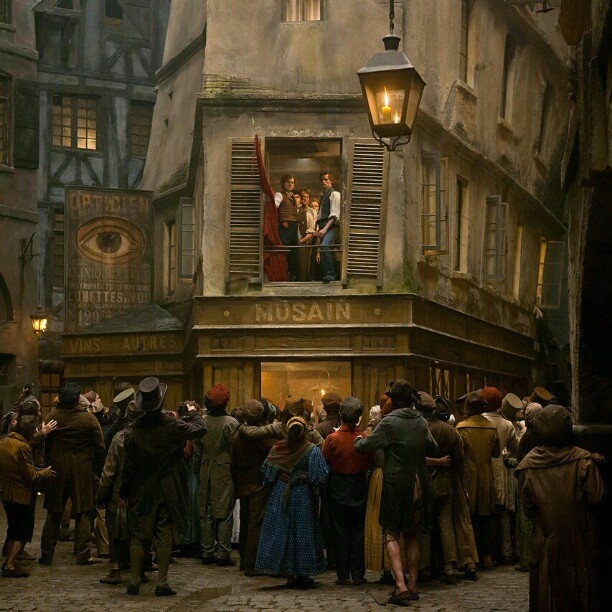
In the book, Victor Hugo takes an extensively long time giving the reader a history lesson of all the French history along with some social commentary. I’ll give you the brief version. French Revolution tried to abolish the monarchy. After Napoleon is defeated, the monarchy makes a return and brings social collapse with it, leaving the majority of the population….well, miserable. So the barricade boys decide to protest the monarchy, ergo the barricade. In real life, as in the book, as in the musical, they decide to take action at the funeral of General Lamarque. (Yes, he’s real!) Lamarque was loved by everyone, and the only true person in power who was an ally to the poor, so the barricade boys attack at his funeral, and then make a barricade outside the Café Musain, their meeting place. That would have been pretty hard to stage so Lamarque’s funeral isn’t in the musical, but it does make it to most film versions. Obviously this isn’t as clear in the show since people over and over try to say that it happened during the French Revolution. (But then again, the musical is already three hours long, so I guess Schönberg didn’t want to take the time to explain everything as the book did).
Also in the book, the barricade boys are much more developed and well written, with page long descriptions accompanying each one. As a group, they are referred to as a whole as either the Les Amis, ABC (pronounced abaissé) Society, or the barricade boys by the fandom. They meet in the Café Musain with the purpose of raising up the underdogs, specifically the poor and underrepresented in society. Hugo talks about them being a group “which barely missed becoming historic”, and I couldn’t agree more. Much like in the musical, they are led by Enjolras (It’s no secret that he’s my favorite)…
tothebaricade
…who is described as “a charming young man who was capable of being a terror”. (Here is a video of the marvelous Aaron Tveit, who played Enjolras in the 2012 film explaining how to say his name).
). From there we have Combeferre (Cowm-fair) who assists Enjolras as the logic of the group, and Courfeyrac (Coo-Feh-Rawk) as the emotional core of the group. Together, they are the triumvirate of the leader, spiritual guide, and emotional centre. This is hinted at in the show, but not taken into fruition. The rest of the group consists of Jean Prouvaire (Jawn Proe-vair) the romantic, often just known as Prouvaire, Feuilly (Few-ee) the fan maker, and the only one in the group not a student,  Bahorel (Bah-ore-elle) the go-between for the ABC to other groups, Lesgle (Lay-glay) the bald one who can’t catch a break (also referred to as Bossuet, (Baw-soo-eh)), Joly (Joe-lee), the medical student and hypochondriac (and he happens to be my favorite beside Enjolras), and finally Grantaire (Grawn-tear), the drunken cynic. Notice that I don’t include Marius…..here’s why.
don'taskme
In the musical, it portrays Marius as buddies with Enjolras and very much a member of the group. That’s not how it goes down in the book. In the brick, Marius is actually much closer to Courfeyrac, who he meets after he cuts himself off from his grandfather and is living on his own for a while. Courf lets Marius stay with him for a time, and when learning about Marius’s dissatisfaction with the bourgeoisie system, decides to bring him to a meeting of the ABC society. Marius comes back a few times with Courfeyrac, but is never really accepted as a member of the pack. In fact, Enjolras and Marius get into several arguments, mostly about Napoleon. (Enjolras hates him, Marius loves him. There’s a lot more there concerning Marius, so he gets his own section later on). Despite this, almost every version portrays Marius as a central member of the group, and the nineties version even has him as the leader instead of Enjolras. This version, as well as several others, are also very guilty of glossing over the revolution and not really explaining it. (More to come on Marius’s involvement with the ABC society and the barricade).
tumblr_n4guwbktLY1tv8tzzo1_500
Gavroche isn’t as much a part of the ABC Society in the book as in the musical. He shows up at the barricade, and the whole time he’s there, Enjolras is trying to get him to leave. Marius does this as well, getting Gavroche to leave by delivering his letter to Cosette as pictured in the 2012 movie.
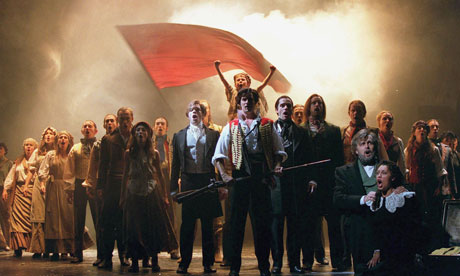
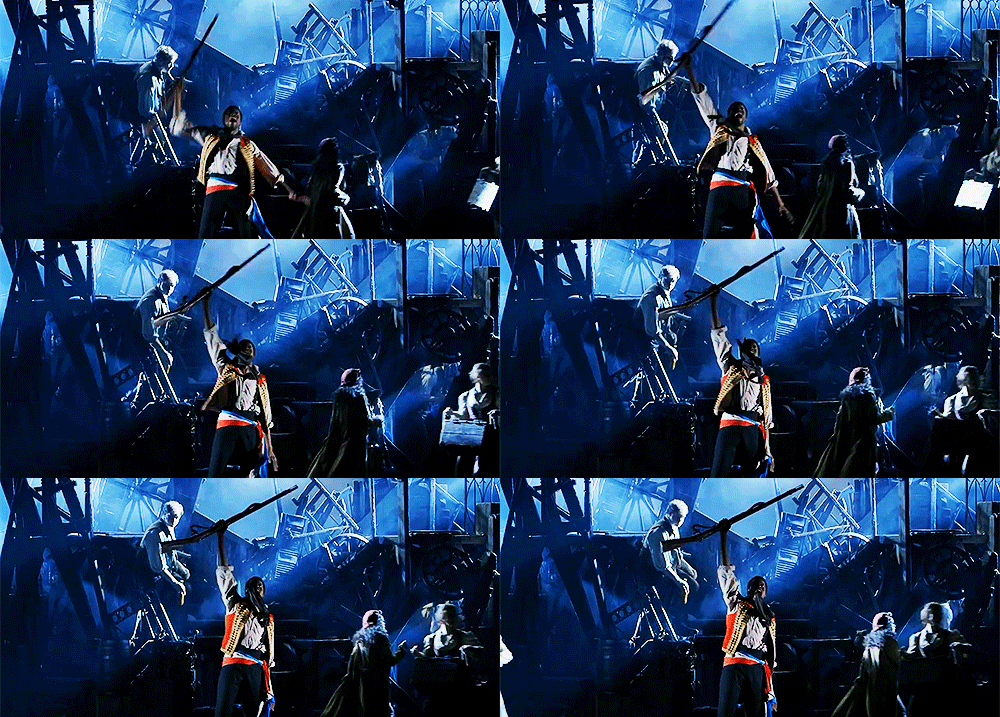
In every version, everybody dies except for Marius who is taken away by Valjean. However in the musical, they all die on the barricade, with Enjolras doing that famous fall backwards. In the book, they try to retreat into the Café Musain, only to be followed by the soldiers. The last one standing is Enjolras, until Grantaire, who is awaken from a drunken stupor, awakes and joins Enjolras, and the two die together. The 2012 film did a beautiful job of combining both versions of the demise of Enjolras and the gang. (And ripping my heart out in the process.)
tumblr_n145jqqpCO1szlqbso7_250
Marius
imdongeverythingallwrong
In the musical, we meet Marius with Enjolras as a fellow revolutionary. In the book, he is first interested a rich boy living with his aristocratic maternal family. He has cut off ties with his leftist colonel father, but hears news that is father is dying, so Marius returns to him once more. Unfortunately, he doesn’t make it to see him before his father passes away. Slowly, Marius starts learning why he never had much contact with his dad growing up. Marius’s maternal grandfather was a supporter of the royal family and aristocratic way of life, and so was his maiden aunt; while his father was a young man who fought for Napoleon as mentioned earlier. Marius’s grandfather therefore disowns his son-in-law, but agrees to take little Marius in and give him a good life and good education. All of this comes as a shock to poor Marius, who then decides to cut off ties with his rich grandfather and maiden aunt, and make it on his own.
So he gets the tiny room next to the Thénardier family, and gets by as lawyer and translator. His grandfather tries several times to offer him money and get him to come back, but he refuses each time. (We get tastes of this in the 2012 film).
He starts taking walks in the Luxembourg gardens, where he first sees Cosette (in the company of an older gentleman - her guardian of course). They eye each other, but never have an actual conversation there. At one point Valjean leaves his handkerchief with his fake initials on it, U.F. (Ultime Fauchlevant) and thinks it belongs to Cosette. Marius, being Marius, jumps to conclusions and reasons that she has “U” name so he starts referring to her as Ursule. Eventually Valjean stops taking Cosette to the gardens because he’s suspicious of Marius and his borderline stalking. At the end, he finds “Ursule” and her foster father again, and has Éponine tell him where they live.
Marius leaves Cosette a love letter, and she knows it’s from “Him”. The next day he comes again and officially has his first conversation with Cosette….and he learns her actual name. They meet every night in the garden of Cosette’s home for a couple of weeks until Cosette tells him that they are leaving for London, England. She begs Marius to come with her, but Marius has no money for a passport or for travel. So she agrees to leave him a way to reach her, which she does, except Éponine steals it. But he gets it anyway, they reunite, and they marry and all that jazz. However, they don’t get married for a few months. (February to be precise). Marius’s grandfather takes him back in, and blesses the marriage (Which he previously hadn’t before Marius went to the barricade). Marius finds out about Valjean’s past, which at first makes him distrustful of Valjean until he gets the truth from Thénardiers (before the latter move across the pond to start their new lives as southern cotton barons).
As I said earlier, Marius really isn’t a huge part of the ABC Society. As I said, he isn’t there for the formation of the barricade, and doesn’t even know about it until Éponine disguised as a boy tells him. By then he thinks Cosette has left him for London without any notification, so he goes, deciding to give up his life since he can’t be with Cosette.
I have yet to see a version that doesn’t include Marius-and rightly so. He’s the tie between the story of Valjean and the story of the June Rebellion. He’s always there as the handsome love interest that Valjean rescues, but rarely does his backstory with his grandfather (and even more rarely maiden aunt) make it in, which I suppose makes sense, cause in the grand scheme of the story, it’s not the most important part.
Cosette
So first off, Cosette isn’t her real name. Her real name is Anne-Euphrasia, Cosette is a childhood nickname given to her by Fantine that kind of sticks.
A lot of people in the fandom don’t like Cosette. I don’t hate Cosette: but I do hate the way she is portrayed in almost every version. But I love book Cosette. Most of the time she’s portrayed as just this sweet little ingénue with no real depth. Uh-uh, I ain’t about that. In the brick, Cosette actually has some substance to her. She is genuinely a kind-hearted person who was thoroughly traumatized by her time with the Thénardiers and growing up without the presence of real parents. (There’s actually a fantastic scene in the book where she runs into her biological dad, Felix Tholomeyes, but had no idea who he is and thinks he’s just terrible. That part always makes me chuckle.)
She’s the symbol of goodness and light in the book, and we get to see a lot more of her in the book that we did in the musical. After Valjean takes Cosette away from the Thénardiers, they live together for a time, in Paris, until they run into Javert and have to run. It’s there that they run into Fauchlevant-the fellow Valjean rescued from under the cart while he was the mayor of Montreuil. After ruining his leg he can no longer do his job, so Fauchlevant relocated to Paris to become a gardener for the convent. He insists on repaying his debt to Valjean, and does so, but letting Valjean and Cosette pretend to be related to him. Valjean works with Fauchlevant as a gardener, and Cosette attends the convent’s school. Years pass, Cosette grows into a young, beautiful woman, and Fauchlevant dies.  After he dies, Valjean, under the name Ultime Fauchlevant, leaves with Cosette and they start a new life in Paris. Valjean buys three different places for them to live, and they move between this there places with their maid, Toussaint, so that Javert will have a harder time tracking him down. Which works…for a while……
Other than that (and other details I’ve mentioned) Cosette in the musical is very much the same-although somewhat underdeveloped. Furthermore, since the musical portrays her falling in love with Marius within a day instead of him looking for her and then them meeting at night, their love usually feels forced to me, which is why I think so many people (including me before I read the book) are so anti-Cosette and pro-Éponine. (Yes, I love 'ponine too, but to be fair she does try to get Marius killed in a lapse of judgement.)