Mostrando entradas con la etiqueta courferre. Mostrar todas las entradas

martes, 18 de agosto de 2026

YEAR OF GREAT MEDLARS: THE LOCKET

In El semen de los ahorcados, to be more precise its play-within-the-fic The Year of Great Medlars, the young and queer tragic hero, Dauphin Francis (played by Courfeyrac), wears a golden, heart-shaped locket for half of the play. The real locket is at the British Museum, and he wears a really realistic replica:


The locket, of solid gold inlaid with pearl and rubies (the original; what we see on stage is only a replica), and what happens to it, are central to the play: it highlights both his fear of commitment and the vagaries of fortune.

On both sides, the locket has the word toujours, "forever," in inlaid ruby letters. The obverse (front) side has the Tudor Rose and the Granada (pomegranate) of the Catholic Royals growing on entwining bushes, while the reverse side has the initials H (for Henry VIII) and K (for Katherine of Aragón) tied together with a Gordian knot - the symbols of the Dauphin's future in-laws; he is betrothed to the future Bloody Mary.

The teenage crown prince of France is supposed to wear the locket for at least one month, and then cut a lock of his dark hair and place it inside the locket, which will be shipped to England as confirmation of the betrothal... Francis and Mary were already betrothed as infants in the cradle, but he is afraid of commitment and he has discovered that he prefers men to women (sexually). So he refuses to place the lock of his hair inside, but wears the locket at court, to keep up appearances. Then, suddenly, the betrothal is annulled (due to Mary's parents' divorce and her being declared a bastard, unfit to marry a crown prince), and the empty locket is shipped back to England... The conversation that comes after is what it all hinges upon:

FRANCIS (Courfeyrac): I can't believe I've got such good luck! That bloody Mary is now declared a bastard, unfit to tie the knot with me! Toujours my arse (pardon my French)!

SEBASTIAN (Combeferre): Really? How come, Your Grace?

FRANCIS: Her Papa just divorced and remarried that court lady, what's her name, Anne Boleyn; and her mother now lives as a nun in a convent. So Mary is a bastard now, they're expecting a male heir instead...

SEBASTIAN: You're not wearing the locket... 

FRANCIS: As soon as I heard the news, I had it shipped back to England. Empty, without a lock of my hair inside. You see, she was totally unfit... No matter how many languages she speaks, or how well she plays the harpsichord, or if she has been educated by Lluís Vives himself; I don't care at all! That portrait of her I saw was pretty scary, with that flaming red hair and those piercing eyes... but now I've thought of something that you must listen to.

SEBASTIAN: I'm all ears. What have you thought of, Your Grace?

FRANCIS: Until right now, I was completely carefree. I had endless freedom and no one, no king or courtiers, to hold me back. But being completely carefree just meant that there was no one to care FOR, and no one who cares FOR YOU. All I've found myself wanting to do... was to be by your side, to tell you about all of it... Every detail, every curiosity... I want to share all of it with my favourite person. So I found myself coming back to you more and more often. I am no longer afraid of commitment, for I have found someone I can commit to, finally... 

SEBASTIAN: And that means?

FRANCIS: It was very unlike me. For the first time in forever, I want to stay in one place. Have someone to come home to, someone who can quench my thirst. Not only for drink, but also that thirst for something I have always been missing.

SEBASTIAN: For love?

FRANCIS: Love? Maybe, even if love between two men is forbidden and star-crossed. We'll disguise it as friendship between a prince and his secretary/squire/cupbearer. The court and the army will only see two good friends... You could use my help more than ever; and I am happy to oblige you!

SEBASTIAN: Why?

FRANCIS: You manage your responsibilities, and I contribute mine. We get along splendidly. We're two halves of a whole, you're the ice to my fire, the part of me that I have always missed... So much talking has put a tickle in my throat, couldn't you pour me a cordial on the rocks?

SEBASTIAN: Now I am the one who is happy to oblige you! (He leaves and then returns with a carafe of cordial on ice and two glasses, which he pours to the dauphin and to himself. Francis drains his glass at one gulp, while Sebastian only sips). You should not drink so quickly, Your Grace; you will catch a cold.

FRANCIS: But my throat was on fire! I'll remember it for the next time. By the way... What do you put in that cordial that makes it taste so good?

SEBASTIAN: Ice from the Alps... and it's infused with cinnamon, ginger, cardamom, and elder flowers. And a huge dash of sugar! But what counts the most is the secret ingredient: it's made above all with love. I always think of you and of how much you will enjoy both the coolness and the taste, as I make all my cordials.

FRANCIS: And now I am thirsty for something more... can you embrace this poor sinner and kiss his lips, until his thirst is quenched?

SEBASTIAN: I am once more happy to oblige. (Both hide behind a pillar, embrace, and kiss passionately). 


martes, 5 de mayo de 2026

TV Tropes - the Mad Matchmaker (yours truly)

 The Mad Matchmaker: This fan (in a fandom) is marked by an obsession with romantic relationships in a work that was never intended to be a romance. They're the kind of person who, instead of criticizing the tacked-on romantic subplot, criticize the alien invasion for getting in the way of the sideplot, and when called on it they refuse to take "It's not a soap opera" for an answer. They will pitch a fit - possibly even flounce from fandom - if their One True Pairing is jossed (this was a major pain in the keister with Jaime and Brienne in canon - I simply left GOT --but not entirely-- when Jaime was killed and Brienne survived and was made Lady Commander; my OTP could not even be Together in Death! Luckily all fics I write are AUs!!!). They may be a fanatical fan of one character or one pairing, or they may just have an uncontrollable desire to Pair the Spares - or just the entire goddamn cast with little logical reason. They take crack pairings seriously and will never shut up about it. Either way, there is no situation where romance is too frivolous, inappropriate, or downright creepy for them. Long story short: A fan of romance to the exclusion of all else in non-romantic works.

This is me when it comes to any romantic subplot: Jaimienne, Enjoltaire, the Prince and Princess in the Snow Queen, the Hendon Hall subplot (Miles and Hugh Hendon and Edith)... any romantic subplot is for me put front and centre. And then there's crack/crossover shipping like Elsabela or Courferre (or any other crack pairings of the non-Enjoltaire Amis)...

When it comes to queer pairings (Yukakira, Enjoltaire, Renloras, KunZoisite, Kurofai, Yukitouya, etc) I am a combination of Mad Matchmaker and Yaoi Fangirl. 

A female otaku who enjoys anime and manga featuring handsome men engaged in homoerotic relationships. The main difference between a Yaoi Fangirl and Guy-On-Guy Is Hot is that the former are interested in homoromantic/homoerotic fiction and/or fanfiction and/or Shipping, whereas the latter enjoy watching live gay men make out. You can pretty much assume that all yaoi fangirls think Guy-On-Guy Is Hot, but not all women who think Guy-On-Guy Is Hot are yaoi fangirls.

The Japanese term used for a yaoi fangirl is fujoshi, which is a reclaimed term based on a homophonic pun. (There are two characters that are pronounced "fu", with one meaning "respectable woman" and the other meaning "fermented or spoiled"; the usage of fujoshi here translates loosely to "rotten girl", i.e. a woman unfit or "spoiled" for marriage as a result of consuming fictional gay content.) The word is often misused to mean "female otaku," causing female otaku who are not fujoshi (and know the meaning of the word) to correct people everywhere. The male equivalent is called a fudanshi (loosely, "rotten man"), but oddly enough, a lot of fudanshis are straight or bi. 

Some Yaoi fans are likely to think that Het Is Ew and many of them tend to be guilty of Die for Our Ship and Ron the Death Eater as a result. They may also indulge in Ukefication. In series where Yaoi Fangirls are seen, at least one joke will be made that involves the Yaoi fangirl's dirty imagination and at least one of the male characters in-universe. This often goes hand in hand with said yaoi fangirl having a (usually rare for females) Nosebleed. 


viernes, 19 de diciembre de 2025

LES MIS DnD AU (Vox Machina Style)

THIS AU IS ONLY VOX MACHINA OR MIGHTY NEIN STYLE - THINK OF IT AS A DND UNIVERSE IN GENERAL

I think of this story as kind of Journey to the West or Wizard of Oz - a group of companions with different personalities (a balanced party) going on a quest (likewise, leaving their homeland in the East to find some sacred texts in the West). Also a lot of inspiration from the Holy Grail mythos (especially, but not only, the Monty Python versions!). This is actually a fanfic epic written by Courf in the Hogwarts AU El semen de los ahorcados!

At first only the Main Five are on that quest, being chosen by the gods to find the Sacred Texts, then I'll add Marius, Éponine, and other secondary characters who don't join the party (Ranger Éponine and her little brother Gavroche are guest star party members). Their main characterizations are from El semen de los ahorcados (Hogwarts AU) and from Eleven Moons Duology (Aritsar AU), but in a DnD universe. 

Same pairings as always: Enjoltaire, Courferre, Éposette, etc. Like in these other AUs, characters from other universes like Count Jean de Satigny, Eugénie Danglars and Louise d'Armilly, Éloïse de Villefort, even Josuke, Koichi, and Okuyasu... and many others will show up.

THE CORE FIVE

Enjolras / Paragon Enjolras: human paladin, only child from a very conservative and religious family. Aroace... or is he? Takes up the role of Tripitaka, being the pure-hearted leader who is given the quest in a vision by the gods

Combeferre / Jules-François Combeferre: halfling artificer, quite the Renaissance person (alchemist, gunsmith, electrician, robot maker, you name it). Takes up the role of Sha Wujing (Sandy, the merman), being the most level-headed, though he can give in under pressure. One of the four chosen guardians.

Courfeyrac / Sejanus Cassio de Courfeyrac: catboy (nekomata) rogue/ninja, from a noble family but now a Goliard on the fringes of the law (personality-wise, somewhat like Naruto mixed with Josuke), Combeferre's matesprit. Like Nepeta Leijon, speaks in kitty puns (says for instance "mew" instead of "you"). Takes up the role of Sun Wukong (Monkey King), being the trickster who questions authority and tricks everyone, on a redemption quest - used to be the King of Thieves, but lost his throne on a bet against Montparnasse, and is now a mercenary. One of the four chosen guardians.

Grantaire / René "Grand R": half-elf half-human Cobalt Soul monk/drunken master (lots of inspiration from both Okuyasu and Rock Lee), also a Goliard, Enj's matesprit (though at first Enj won't realize it). Expelled from his order for breaking his vow of chastity. Takes up the role of Zhu Wuneng (Pigsy), being the most self-indulgent member of the party. Another mercenary. One of the four chosen guardians.

Jehanne Prouvaire: elf bard, only child, trans girl, modest offstage but flamboyant on stage, more of a Celtic bard vibe. Takes up the role of Yulong (Dragon Horse) more or less, being the most modest yet the most powerful member, whose magic is only used as a last resort. Also for being gender fluid (Yulong turns more than once into a human woman to seduce/distract opponents). The last of the four chosen guardians.

MINOR CHARACTERS.

Éponine Thénardier: half-drow ranger, dragon rider, guest star party member - in unrequited love with Cosette ('tis a pity she's straight...)

Gavroche Thénardier: youngest of the Thénardiers and team pet (somehow), fully human... or so it seems. Is also a hybrid, though it doesn't manifest until puberty

Azelma Thénardier: the middle child, aspiring rogue, fully human. Becomes Montparnasse's right-hand woman and partner, the Queen of Thieves

Bahorel: berserker, human

Henriette: berserker, dwarf, Bahorel's partner

Jo-Lee: human alchemist/healer, hypochondriac

Lesgles "Bossuet": human (black) necromancer

Musichetta: half-elf bard, more of a classical musician vibe than Jehanne Prouvaire (with Lesgles and Jo-Lee, these three form a trio of mercenaries)

Marius Pontmercy: half-elf scholar (translator) and gunslinger, raised by his human aristocratic maternal family, rediscovering his elven heritage. The kouhai/maknae of most characters.

Cosette: half-elf cleric, raised in a convent. Very conscious of breaking her religious vows. In love with Marius (and vice versa: they even become fiancés)

Jean Valjean: human druid, Cosette's stepfather/guardian, gardener

Étienne Javert: half-drow paladin, Valjean's partner, Cosette's other stepdad

Montparnasse / Caractacus Montparnasse: blue-skinned tiefling (half-oni) rogue, "King of Thieves," Éponine's ex and Enj's kismesis

jueves, 4 de septiembre de 2025

KNOCK KNOCK! WHO'S THERE?

 In El semen de los ahorcados, there are numerous gags based upon Enjolras' unfamiliarity with Muggle pop culture, like these:

Courfeyrac (of Lesgles): Scary, black, bald... Looks somewhat like Sam L. Jackson.

Enjolras: Who's that?

Courfeyrac: Ever seen a Star Wars prequel?

Enjolras: No siree.

Courfeyrac: Or Pulp Fiction?

Enjolras: Neither have I.

Courfeyrac: Snakes on a Plane?

Enjolras: (Shakes his head) Wait a little... Are all those Muggle "flims?" 

,........

Courfeyrac: KNOCK KNOCK 

Enjolras: Who's there?

Courfeyrac: The

Enjolras: The Who? (looks puzzled)

Courfeyrac: KNOCK KNOCK 

Enjolras: Who's there?

Courfeyrac: Doctor 

Enjolras: Doctor Who? (Even more puzzled, tilts his head)

Courfeyrac: KNOCK KNOCK 

Enjolras: Who's there?

Courfeyrac: Horton Hears a

Enjolras (screaming): Horton Hears a Who??? Is this another of your references to Muggle pop culture?

Courfeyrac: It's a storybook and an animated film. Or "flim." The Who are a rock band, and Doctor Who is a series about time travel.

Enjolras: Has he got a Time Turner?

..........

Lesgles (at the Masked Ball, as Mace Windu): What do you think, friends? Did I make the right choice in not cosplaying as Nick Fury?

Courfeyrac (as Puss in Boots): Completely. You are the most badass Jedi this side of the galaxy! Though you would have rocked that eyepatch...

Lesgles: Let's not forget either that Nick Fury was originally white. They changed that when they cast Sam Jackson... And anyway both Star Wars and Marvel are now owned by Disney!

Enjolras (as Apollo): That Sam Jackson chap once more... But what on Earth is Marvel?

------------

(Upon being asked to join the Quidditch team, since he is such a daredevil flyer)

Grantaire (in 4th year, Book 1): No, thanks. Teamwork is not my cuppa tea. I fly solo, like Han Solo.

Eugénie Danglars (captain/keeper and prefect for Gryffindor): Who on Earth is Hans Ollo??

viernes, 8 de agosto de 2025

THE YEAR OF GREAT MEDLARS

In The Seed of Hanged Men, Final Conflict, Book 5 ----- corresponds to the "barricade subplot and nearly everyone dying" part of canon. Everyone returns to the Seed universe's Earth and a final course begins; an anti-war play is staged at Hogwarts, The Year of Great Medlars, written by Courfeyrac (his first and only tragedy) and starring him as Dauphin Francis of Valois, Combeferre as Count Sebastian de' Montecuccoli, James Norrington (Hufflepuff) as Prince Henri of Valois, and Musichetta as Caterina de' Medici. And Cosette as Chiara de' Montecuccoli, the cupbearer's half-sister, who is also Caterina's handmaid. Lady Alistair marries Count de Satigny and his personal troupe puts on a separate production of The Year of Great Medlars at the Satigny estate. After the play (the Hogwarts performance), Enjolras loses his cool being provoked by Montparnasse, tearing off his prefect badge and claiming back the prefecture of Slytherin by force, leading to a declaration of war... The Xeniades Club, the pack of werewolves who turned Grantaire, and the Condesce's army storm Hogwarts, leading to the last stand of AS-SORTED. Grantaire has, while drugged with the Draught of Living Death, a dream inspired by the Lamb Lies Down, from the Chamber of 32 Doors onwards, with himself as Rael and Enj as John, before waking up and dying at the end of the battle, holding Enj's hand... Lunar eclipse.

On the cover of the script of The Year of Great Medlars there is a quatrain written by Courfeyrac in the style of Nostradamus, that spoils the whole play:

A thirsty prince in the August sun...
A cupbearer seized is never fun...
A sister-in-law ruled by envy and greed...
A wish for peace that came true indeed.

The play is significant because it's Courfeyrac's first and only tragedy, in which the author expresses his uncertainties about going to war and about coming of age. Due to taking place in the Renaissance, amongst royalty, the play is written and performed in the style of Shakespeare, though with an exaggerated bent similar to Shakespeare's plays-within-plays (The Murder of Gonzago, Pyramus and Thisbe, et al.) and to the Ember Island Players. In fact, the author of the whole fic saga (StrixAlluka) names Shakespeare and the Ember Island Players as the primary inspirations. As well as the historical event (the Montecuccoli affair, in Tournon-sur-Rhône, August 1536) whose characters mirror those in The Seed and in Les Misérables canon who star in Medlars.
The fruit from which the play takes its title is the German medlar (NOT the Japanese medlar), known in France in the Renaissance as mêle (term used by Rabelais, the first chapter of whose saga Count Sebastian reads aloud to Dauphin Francis --the pentalogy is being written by Rabelais and proofread by the royal cupbearer as the story is taking place, and the characters are avatars of the people the author knows, the heroic prince Pantagruel being a counterpart of Dauphin Francis, and his bromantic pal, the well-read Panurge, of Count Sebastian de' Montecuccoli, the whole epic novel --or fic-- having a pacifistic and free-thinking ideology... Rabelais was writing a real-person fanfic, that became an AU after the tragic deaths of the people who inspired his heroes!--), and still today (the German medlar) as trou du cul (anus, "asshole") and in Shakespeare's English as open-arse (term most famously used by Mercutio --don't forget that StrixAlluka was once Freddie Mercutio!--). 
The shape of the German medlar, Mespilus germanica, suggests a dilated anus. In turn, mêle evokes mela (apple in Italian, German medlars being closely related to roses and to apples), and thus, the Forbidden Fruit of Eden: Rabelais' medlars are also described as "easy on the eyes and pleasant to the taste," like the Forbidden Fruit in Genesis. 
The whole read about the Great Medlars may sound like a big-lipped-alligator moment, but it is actually a statement that evokes a lost Golden Age, without the courtly intrigues, wars, and poisonings that the characters have to endure (and that lead to their deaths, this being in Courf's own words "a queer Romeo and Juliet", both dauphin and cupbearer being, though praised and popular, called "queer" --in both senses of the word-- behind their backs, and this also leading to their downfall; remaining single at 18 while there are a lot of prospective fiancées, most prominently Bloody Mary, definitely raised suspicions... both leads being, in the play and in real life, doomed to die young, single, and childless, and the peace between France and the Habsburg Empire being signed at the cost of the lives of both queer star-crossed lovers... The play starts with the arrival of Count Sebastian and Caterina de' Medici and Lady Chiara in Marseille and Caterina's wedding to Henry, spare to the throne... and ends with the rise to power of Henry and Caterina --who poisoned her brother-in-law and blamed his cupbearer lover-- after the violent deaths of both star-crossed leads). 
The Year of Great Medlars is, thus, the utopia of a Lost Golden Age, when Lent didn't take place in March, the Kalends were found in the Greek calendars (look up "Greek Kalends" on Google; well, it means the same as "when pigs fly;" the kalends were the first day of months in the Latin calendar, but they don't exist in the Greek calendar), one week had three leap Thursdays (Catalan "la setmana dels tres dijous" means the same as "Greek Kalends") due to the Sun having taken a few missteps, the Moon left her orbit and rose in the sky far above the usual, and even the stars were changing their places, for instance Spica moved from the hand of Virgo to the scales of Libra (Courf's own Sun sign). 
The ground watered with the pure blood of Abel gave rise to oversized fruits, including watermelon-sized (Quaffle-sized) German medlars (three of which could fill a bushel), easy on the eye and pleasant to the taste (just like the Forbidden Fruit), that caused their eaters to swell in various body parts and start lineages of "endowed" superhumans (the polar opposite of the tasteless but lethal arsenic consumed after the tennis match, that causes the tragic hero to waste away). This Golden Age is contrasted with both the Renaissance in which Medlars the play takes place... and with the war-torn Hogwarts at the last year of everyone in The Seed; Courf having foretold his own death (in battle, not by poisoning) and revealing his inner self full of uncertainty about the future.

AN EXCERPT FROM THE PLAY
CATERINA (MUSICHETTA): "For years I played chess, day after day, with Pope Clement. He taught me all the strategies... Throughout their lives, all my guardians have seen me as a simple-minded pawn. But they all overlooked the most important thing about pawns..."
SEBASTIAN (COMBEFERRE): That a pawn might become a queen?
CATERINA (nods): Exactly... I was so disappointed when I found out that I had married the wrong prince, who, moreover, is in love with another. A lady old enough to be his mum, and as tall as a giraffe, who happens to have a trick up his sleeve...
SEBASTIAN: What "trick"? I barely know Mme. Diane de Poitiers...
CATERINA: She suctions him. She has a very muscular pussy, which she uses to suck his member, with her nether mouth. No other woman can do that. Anyway, when life gives you lemons, you have to take advantage of the situation... Fix someone's drink, get them out of the picture. A Medici of Florence, even if she is a little maiden, knows what to do. Before this summer and this war are over, that person will get thirsty and consume the wrong drink... and we will have our way.
SEBASTIAN: Do you mean Diane... or do you mean him? Let me tell you something I have been fearing to tell you: all this time I have joined his entourage as the mole you wanted... and gotten to know him. Now I am his squire, his cupbearer, and his secretary. And his confidant, who keeps all his secrets. I am His Royal Highness's right-hand man. And we have become friends, maybe more than friends... there is something more.
CATERINA (stroking her poison ring): Then, I'll have to put you two out of the picture... Single and childless at 18, and that reveal... He may die single and childless at 80, but I prefer him to disappear the sooner the better, this very summer to be more precise. I am so sorry, Sebastian, but I did never expect you to be a turncloak... I will have to change my strategy, change it so that you two (strokes her poison ring) will be out of the way - forever. You will never see this pawn soon to be crowned the new queen...


domingo, 18 de julio de 2021

why after lützen (efter lützen) is a promising ficseries

You already know from El semen de los ahorcados that Courfeyrac had an ancestor who fought in the Thirty Years' War (and whom he dressed up as for a masquerade -  before the rewrite, in which Courf dresses as Puss in Boots instead). Well, his story is about to be expanded upon, as a StrixAlluka 30YW AU with the Amis as Swedish Army deserters turned guerrilla soldiers of fortune is underway. It will be in Swedish and called "Efter Lützen". Enj is Prussian landed gentry and R a Moor by way of Marseille (Schönherr Engelhart and Razi/René)... most of the cast will remain French though with a few more exceptions (Musichetta, Leslie - Lesgle, Joellll - Jolllly)... Furthermore, Gustavus Adolphus will play the role Napoleon played in canon Les Mis!

The idea or bunny came partly from that reference to the musketeer Baron de Courfeyrac in El semen, partly from a mention of Lützen in Les Misérables canon, Colonel Pontmercy having fought in the Napoleonic battle. But I could not shake the idea of the 30YW battle off my head and wondered what if Les Mis had been set in that period and all the Amis sans Marius had been killed in that seventeenth-century war. And of course Colonel Pontmercy would have fought in a Swedish-French alliance and been killed at Lützen...

Schönherr Engelhart and Jules Combeferre + Hercule-Joffrey de Courfeyrac. There you have the rittmeister and his two lieutenants respectively, who keep the ranks they held in the Swedish military. The young Prussian of the landed gentry and his French teacher's son, who has a plan to sort out all flora and fauna a century before Linnaeus, both joined the Swedish military in their late adolescence in order to fight for freedom of worship. The young Gascon baron and lieutenant of musketeers came to the heart of Europe as an envoy to the Swedish camp, representing the Cardinal (Richelieu), with a certain Moor by way of Marseille (R, aka Razi, aka René) for a valet (and cupbearer, and squire...).

Razi (René), the Moor who never has laid eyes on his parents' birthplace of Castellón, started out with his widowed mother Miriam (Marie) on the docks of Marseille; her husband having been killed in a street fight on those same docks. He became a petty servant in Courfeyrac's entourage, and then the Baron's confidant, thanks to circumstances beyond his control

The Álvarez (actually Thénardier) family - camp followers, confidence tricksters, and corpse plunderers, whose wagon home can always be found when an engagement has just taken place. Cosette's former guardians, who pretend to be Spanish nobles (according to the Thénardiers themselves, he's from Barcelona ---Fawlty Towers reference!--- and she's from Santiago de Compostela). Éponine alone, their firstborn, is not supporting this elaborate confidence trick; unlike her younger siblings Azelma and Gavroche - although the latter joins Engelhart's company alongside his eldest sister, as per canon

Cosette, Marius, and Valjean "the snowy owl..." Innocent orphan adolescent Fantine was, in this era, ravaged by a thirtyish officer when her home village was raided; she entrusted her daughter to the Thénardiers just like in canon for the same reasons and became a worker in a uniform cloth factory in Wallenstein's province of Friedland, with Valjean for an overseer - his backstory is also just like in canon (older sister and fatherless nephews, bread theft, prisoner camp... lock stock and barrel - only sans kindly bishop and with Wallenstein instead).

Musichetta - here she is a North Italian (Ferrarese) opera singer who was soubrette until a while ago to fairytale collector and primadonna her southern friend Adriana Basile (who compiled the Pentamerone alongside her brother Giambattista!). Not long ago, they parted ways when she decided to move up north into the war torn heart of Europe with the half of the company that preferred opera buffa to opera seria - in order to bring smiles to the regions with commedia-dell'arte style plots and gags.

viernes, 19 de marzo de 2021

A LES MISÉRABLES ARITSAR / RAYBEARER AU? WHY NOT!

 Oluwan and Swana bring his drum; nse, nse 

Dhyrma and Nyamba bring his plow; gpopo, gpopo 

Mewe and Sparti see our older brother dance— 

Black and gold, isn’t he perfect! 

Quetzala sharpens his spear; nse, nse 

Blessid Valley weaves his wrapper; gpopo, gpopo 

Nontes and Biraslov see our older brother dance! 

Black and gold, isn’t he perfect? (In Enjolras' case, blue and gold).

Djbanti braids his hair; nse, nse 

Moreyao brings his gourd; gpopo, gpopo 

Eleven moons watch our older brother dance: 

Black and gold, isn’t he perfect?


When you meet Egungun, will you have your eyes-o?

Tell me, will you hear him, if you have no ears-o?

Dead man, dead man, fell like a coconut

Round head rolling

on the red hard ground. (Execution song)


Of what use—Tell us!

Of what use is an empty throne?

We have found someone worthy—Have you found someone?

Aheh, Kunleo is worthy to fill it—Yes, Kunleo is worthy to fill it. (Coronation Song)


“ODODO the hunter, UKPOPO, UKPOPO, more handsome than princes; aheh, no lie!”


Eleven danced around the throne, 

Eleven moons in glory shone, 

They shone around the sun. 

But traitors rise and empires fall, 

And Sun-Ray-Sun will rule them all, 

When all is said-o, all is said 

And done-heh, done-heh, done...

But traitors fall and empires rise,

And Sun-Ray-Sun will rule the skies,

When all is said-o, all is said

And done-heh, done-heh, done...

Arit folk songs.


The title of StrixAlluka's newest AU/crossover is still to be debated - Eleven Moons Aligned or Eleven Moons Eclipsed - it's actually the Eleven Moons Diptych, with each half sporting either title... but anyway, while waiting for her Aritsar take on the cast of Les Mis, here is a little dramatis personae:


The Oba's Council - noteworthy members:

Oba Mace (Mace Windu) - ruler of the Arit Empire, Raybearer. Currently comatose with his council as regency until he finally dies and his son becomes the next oba - or not?

High Priestess Nadia Satrinava - Dhyrma, death by contagion / hallow of seeing visions:

High Lord General Connor McLeod - Mewe, death by bleeding / hallow of invulnerability:

(Late High Lady General Morga Eirsdottir - Biraslov, death by mauling / hallow of unmatched speed):

(Late High Priest Bienvenu Myriel - Nontes, death by contagion / Hallow of not being able to say no to a request)

High Lady Magus Yan Lin: Moreyao, death by hexes / hallow of bilocation/astral projection:

High Lady Ambassador Cvetka Akulova (here Crown Prince Enjolras' mother) - Biraslov, death by suffocation / hallow of creating cold and ice:

High Lady Archdean Klytemnestra, my OC Elena the netmender's twin sister (Spare Prince Montparnasse's mother) - Sparti, death by organ failure / hallow of summoning fire and explosions

High Lord of Harvests Jean Valjean - Nontes, death by battery / hallow of superhuman strength:

High Lord Judge Javert - Nyamba, death by drowning, hallow of forcing people to tell the truth

High Lady of Castles Aidana (single mother, drunken and addicted to marijuana and kuso-kuso as an analogy to bonding sickness) - Quetzala, death by poisoning, hallow of "insanity" / seeing the worst in other people


The Crown Prince's Council:

Oloye/Crown Prince Enjolras; son of the oba and High Lady Ambassador Cvetka, heir to the throne, raybearer

High Lord Archdean Combeferre - Djbanti, death by poisoning / hallow of eidetic/photographic memory

High Lord General Courfeyrac - Nontes, death by battery / hallow of optimism inducement and happiness inducement

High Lord Laureate Grantaire - Sparti (cabin boy), death by bleeding / hallow of slowing down and taking away entropy (which works like the Stand Crazy Diamond)

High Priestess Cosette Valjean - Biraslov (half-Nontish half-Biraslov isoken), death by gluttony / hallow of glowing in the dark, a different colour based upon her mood

High Lady of Castles Éponine Thénardier - Swana (one-quarter-Nontish one-quarter-Blessid half-Swanian isoken), death by burning / hallow of lie detection

High Lord Judge Marius Pontmercy-Ghàilenor - Mewe (half-Nontish half-Mewish isoken), death by drowning / hallow of giving/taking away hallows

High Lord Ambassador Feuilly - Quetzala (realmless -ie stateless- orphan isoken dreamcatcher maker, origins unknown), death by suffocation / hallow of speaking and understanding every human language

High Lord Magus Jo-Lee Lin - Moreyao (born in Songland, Redemptor adopted by the Lins), death by contagion, hallow of healing illnesses and injuries and transferring them to himself

High Lord Treasurer Lesgle "Bossuet" - Nyamba, death by organ failure / hallow of giving good luck at the cost of suffering bad luck himself (he does so by shaking hands or having a kiss blown his way, alluding to the lyrics of "Chim Chim Cheree")

High Lord of Husbandry Bahorel - Dhyrma, death by mauling / hallow of unstoppable righteous anger-trance (think Cú Chulainn or the Incredible Hulk)

High Lady of Harvests Jehanne Prouvaire - Blessid Valley (half-Nontish half-Blessid isoken; trans girl), death by hexes, hallow of making plants grow by petting them and singing to them (her power is even seen to affect fungi, but half as much as plants).


The Ghàilenors of Faye's Crossing

Lleu Ghàilenor - the clan patriarch, Marius' maternal grandfather

Arianrhod Ghàilenor - Marius' maternal grandmother

Aoife Ghàilenor - Marius' maternal maiden aunt and tutor

Saoirse Pontmercy, née Ghàilenor (deceased) - Marius' mother, died in childbed due to heavy bleeding, married to a Nontish commander allegedly "killed in battle" at Gaelinagh as a volunteer


The Satrinavas

Nasrin Satrinava - Nadia's mother, governor of Dhyrma

Namar Satrinava - Nadia's father, consort of Dhyrma

Nafizah Satrinava - Nadia's firstborn sister, next-in-line governor of Dhyrma, a mystic

Nazali Satrinava - Nadia's secondborn sister, a powerful healer

Navra Satrinava - Nadia's thirdborn sister, a life-of-the-party

Nahara Satrinava - Nadia's fourthborn sister, a badass

Nasmira Satrinava - Nadia's fifthborn sister, a nurturer

Natiqa Satrinava - Nadia's sixthborn sister, a chatty cathy


The Lins of the Silver Dragon Inn (and a certain young woman from Songland):

Chen Lin - Hay Lin's father and son to Yan Lin

Jo-An Lin - Hay Lin's mother and in-law to Yan Lin

Chou Khan - Jo-An's father, wealthy tea merchant, against marriage to the Lins, still stern and a tad at odds with Yan

Hay Lin - foster sister to Jo-Lee, a creative and eccentric, artistic soul / Hallow of controlling air

Ye-Seul (Jo-Lee's real mother from Songland) - a high-ranking Songland court lady, unwilling to send her child to the underworld


Others:

Elena the netmender - Sparti (island of Star Point), R's (Grantaire's) biological single mother, unhallowed, outsider since her own shipwreck-widowed-mother Leda died

(Lucio Montagu Morgasson - deceased commander, Biraslov; son of Morga and her consort, husband of Nadia, killed in estate fire - a sociopath who physically, verbally, and emotionally abused his wife)

Montparnasse - spare prince of Aritsar, son of the oba and High Lady Archdean Klytemnestra, prospective usurper - hallow of giving entropy (not the same as accelerating already existing entropy, which his mum has!)

Clovis and Hannah Prouvaire - Jehanne's parents, an average though interracial couple in a semi-nomadic village society in a campsite in Blessid Valley

Sgt. and Mme. Thénardier, Azelma and Gavroche - Éponine's parents and younger siblings, innkeepers on the outskirts of a Swanian market town by a clear lake, a salt lake where lots of flamingos stop on their migration

Rollan, Aidana's son, raised in a Quetzalan orphanage, with the Hallow of becoming rubber and squeezing through tight spaces

Fleur Delacour, Nontish noble girl, with the Hallow of breathing underwater, Courfeyrac's fiancée

Gabrielle Delacour, Fleur's little sister, unhallowed

Cecily Alistair, Mewish noble girl, with the Hallow of super realistic art, bisexual, Marius' fiancée 

(Some of these, including Hay Lin, make up Montparnasse's Council in Eleven Moons Eclipsed)

....

Both oloyés (crown princes), Enjolras and Montparnasse, were born of different races and different mothers, but both with the Ray, on the same day, when there was a conjunction of all eleven moons. There could only be one heir. And it is Enj, in spite of his lilywhite skin and the rumour around the court that he may be a bastard. Still, Parnasse, the spare, has not given up and is ready for a coup d'état. When this occurs at last, when all eleven moons eclipse the Sun, together with the young people he recruited as children after seeing them in his dreams, Crown Prince Enjolras has to prepare for civil war all over Aritsar... 


viernes, 5 de junio de 2020

Les Mis the Musical vs. Les Misérables the Book

Two Four Six Oh Fun-Les Mis the Musical vs. Les Mis the Book


It’s no secret that I am a huge Les Mis fan, or “Mizzie”. I have every single official English language recording of the show (Original London, Original Broadway, Complete Symphonic, Tenth Anniversary, Twenty First Anniversary, Twenty-fifth Anniversary, and Movie Deluxe Soundtrack) and I have official recordings in seven other languages as well. (French, Spanish, Japanese, German, Polish, Israeli, and Swedish). I dramaturged my production of it because of my extensive Les Mis knowledge, and memorized it to the point that during rehearsal I filled in for missing cast members without skipping a beat. (Not to mention entertaining/annoying my cast members with a series of two four six oh puns. I kept it up for the entire two four six oh run. I think towards the end there I started to get two four six oh shunned-but that wouldn’t stop my two four six oh fun).
DSC_0362
(My Production. Photo credit to Andrew Richmond).
However, my love for Les Mis doesn’t end there. I’ve made it a life goal to immerse myself in every rendition of this story available. So far I’ve been fairly successful, I have six movie adaptations under my belt, seven if you count the 2012 movie-musical version, and I’ve watched all the episodes of the Les Mis anime Shoujo Cosette. (Japanese for A Girl Named Cosette). Back in secondary school, I even took it upon myself to read the original novel by Victor Hugo. (Two four six oh-UN-abridged). The book, or the brick, as so many people refer to it since the book is about the same size and shape of a brick, is the novel that started it all, and the original source material for every adaptation, and is one of my personal favorite book of all time.
Photo courtesy of Barnes and Noble
So, I’m pretty versed in both the original story and various adaptations of it as well. During my time doing the show, I had several conversations with people about the differences in various adaptations. Over a year after the show closed *sobs* this continued with my fellow theatre people. It was during Mary Poppins, talking to a couple of cast mates on closing day about the book, that it occurred to me “this would be a good topic for my theatre blog!”
Since this is a theatre blog, I will mainly be writing about the differences and similarities between the musical and the book, but I will also be touching on other versions as well. So before we start, here are the versions besides the original book and/or musical that I personally am familiar with and a brief description.
2012 film
Courtesy of IMDB
Courtesy of IMDB
This is arguably the most well-known version, and certainly the most recent film version (at least that I know of!). It is the only one based on the musical rather than the book. (Yes, I’m aware there are the concert versions of the show you can buy on DVD, but those are filmed stage productions rather than motion pictures). What I love about this version is that includes a lot of things that were in the book, but not in the musical. (Eponine dying to save Marius, the chase scene with Javert, Valjean and little Cosette, etc.)
Shoujo Cosette
corenbilli
The Les Mis anime. Pretty darn close to the original novel. Major differences are that it puts Cosette as the main character rather than Valjean, and it’s aimed at a younger audience so a few of the darker elements are removed. (For more on Shoujo Cosette, check out this video done by the brilliant Jess Daniels. Also worth checking out is a series of Shoujo Cosette videos paired to music from the musical.)
Les Miserables manga
Courtesy of readerswonderland.com
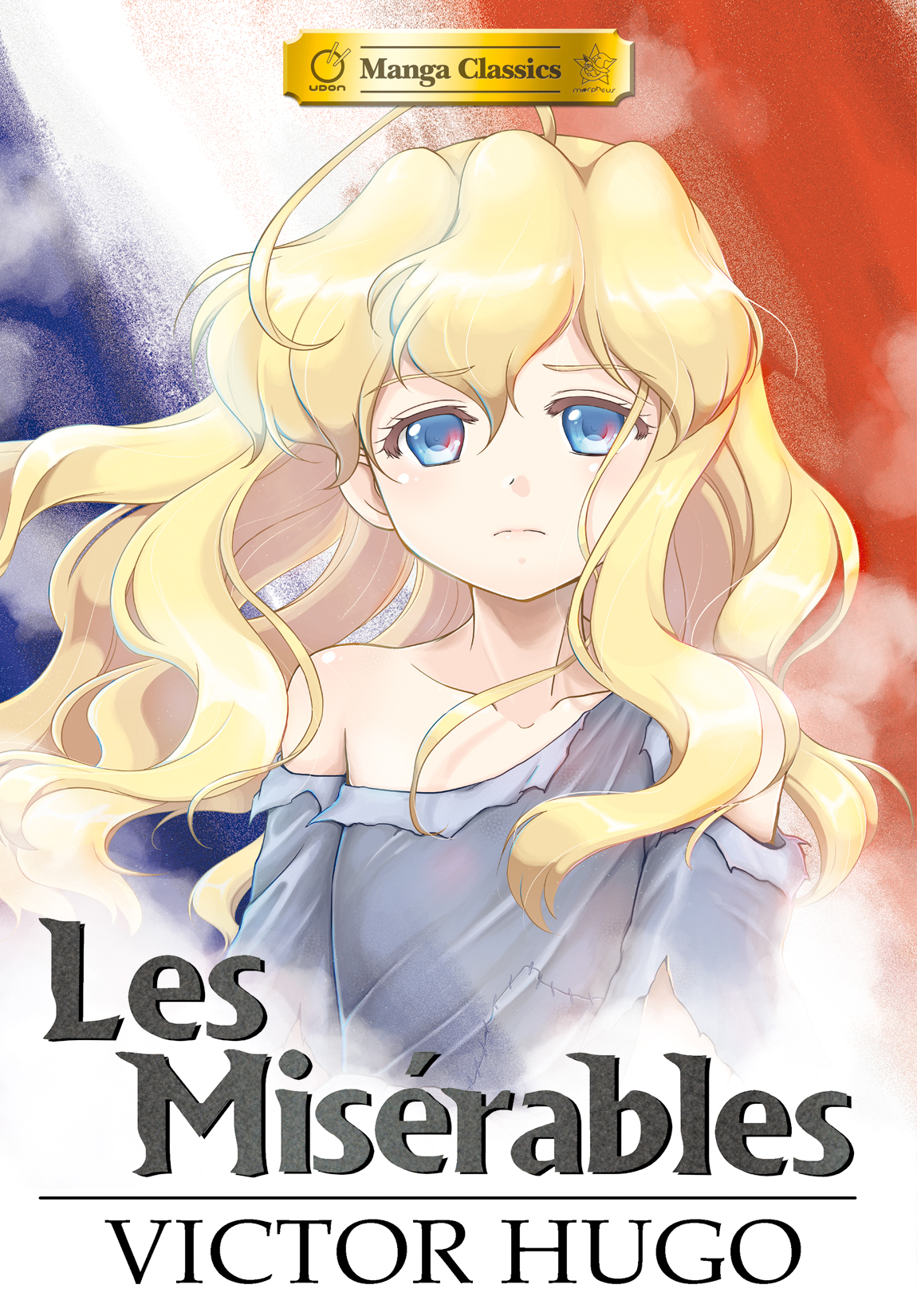
Just like it sounds, a manga adaptation of the novel. Of every adaptation, I would say this one is the most faithful because it unapologetically came from Hugo’s text. Obviously it’s condensed, but the overall story and characterization is extremely faithful. My only real complaint is that you don’t see much of Gavroche.
Clear as mud? Okay, let’s dive in! I’ve divided the major differences into sections. Some of them overlap, so I jump around a bit, but I did my best to make it all make sense. If anything is unclear, feel free to drop a comment and I will answer to the best of my ability.
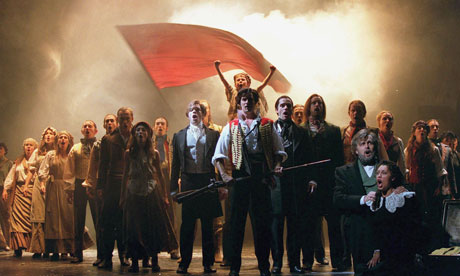
Courtesy of theguardian.com
The Revolution/The Barricade Boys
tumblr_nahe0xwy5B1tabnb6o1_500
Okay, for starters, the revolution that takes place in Les Mis is the June Rebellion, not The First French Revolution. (Seriously!)
dostthoucomprehend
The June Rebellion took place after the First French Revolution, and after Napoleon for that matter too. (In fact, several characters, including Sgt. Thénardier and Marius’s father fought under Napoleon at the Battle of Waterloo-more about that later). This portion of the book was inspired by Victor Hugo’s experience with the real June Rebellion that took place between June fifth and sixth in 1832. Hugo was actually there for that, so some of the stuff he writes about the barricade boys is based on truth. We’ll never know for sure what parts are real and what’s fiction, which is both mesmerizing and frustrating as heck.
willyoutakeyourplacewithme
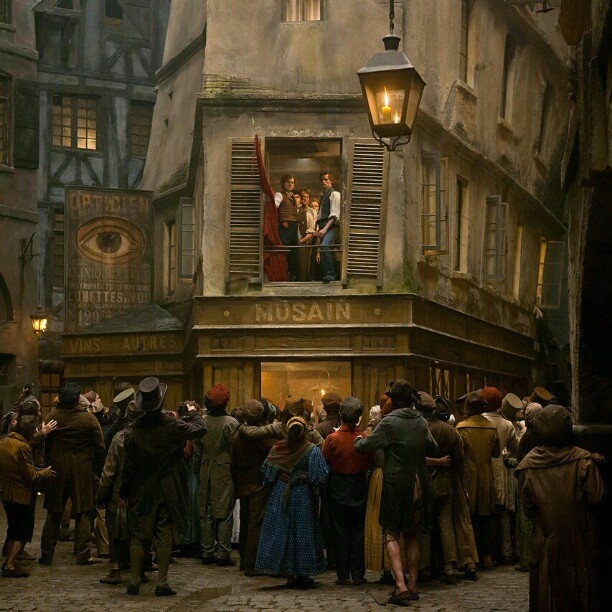
In the book, Victor Hugo takes an extensively long time giving the reader a history lesson of all the French history along with some social commentary. I’ll give you the brief version. French Revolution tried to abolish the monarchy. After Napoleon is defeated, the monarchy makes a return and brings social collapse with it, leaving the majority of the population….well, miserable. So the barricade boys decide to protest the monarchy, ergo the barricade. In real life, as in the book, as in the musical, they decide to take action at the funeral of General Lamarque. (Yes, he’s real!) Lamarque was loved by everyone, and the only true person in power who was an ally to the poor, so the barricade boys attack at his funeral, and then make a barricade outside the Café Musain, their meeting place. That would have been pretty hard to stage so Lamarque’s funeral isn’t in the musical, but it does make it to most film versions. Obviously this isn’t as clear in the show since people over and over try to say that it happened during the French Revolution. (But then again, the musical is already three hours long, so I guess Schönberg didn’t want to take the time to explain everything as the book did).
Also in the book, the barricade boys are much more developed and well written, with page long descriptions accompanying each one. As a group, they are referred to as a whole as either the Les Amis, ABC (pronounced abaissé) Society, or the barricade boys by the fandom. They meet in the Café Musain with the purpose of raising up the underdogs, specifically the poor and underrepresented in society. Hugo talks about them being a group “which barely missed becoming historic”, and I couldn’t agree more. Much like in the musical, they are led by Enjolras (It’s no secret that he’s my favorite)…
tothebaricade
…who is described as “a charming young man who was capable of being a terror”. (Here is a video of the marvelous Aaron Tveit, who played Enjolras in the 2012 film explaining how to say his name).
). From there we have Combeferre (Cowm-fair) who assists Enjolras as the logic of the group, and Courfeyrac (Coo-Feh-Rawk) as the emotional core of the group. Together, they are the triumvirate of the leader, spiritual guide, and emotional centre. This is hinted at in the show, but not taken into fruition. The rest of the group consists of Jean Prouvaire (Jawn Proe-vair) the romantic, often just known as Prouvaire, Feuilly (Few-ee) the fan maker, and the only one in the group not a student,  Bahorel (Bah-ore-elle) the go-between for the ABC to other groups, Lesgle (Lay-glay) the bald one who can’t catch a break (also referred to as Bossuet, (Baw-soo-eh)), Joly (Joe-lee), the medical student and hypochondriac (and he happens to be my favorite beside Enjolras), and finally Grantaire (Grawn-tear), the drunken cynic. Notice that I don’t include Marius…..here’s why.
don'taskme
In the musical, it portrays Marius as buddies with Enjolras and very much a member of the group. That’s not how it goes down in the book. In the brick, Marius is actually much closer to Courfeyrac, who he meets after he cuts himself off from his grandfather and is living on his own for a while. Courf lets Marius stay with him for a time, and when learning about Marius’s dissatisfaction with the bourgeoisie system, decides to bring him to a meeting of the ABC society. Marius comes back a few times with Courfeyrac, but is never really accepted as a member of the pack. In fact, Enjolras and Marius get into several arguments, mostly about Napoleon. (Enjolras hates him, Marius loves him. There’s a lot more there concerning Marius, so he gets his own section later on). Despite this, almost every version portrays Marius as a central member of the group, and the nineties version even has him as the leader instead of Enjolras. This version, as well as several others, are also very guilty of glossing over the revolution and not really explaining it. (More to come on Marius’s involvement with the ABC society and the barricade).
tumblr_n4guwbktLY1tv8tzzo1_500
Gavroche isn’t as much a part of the ABC Society in the book as in the musical. He shows up at the barricade, and the whole time he’s there, Enjolras is trying to get him to leave. Marius does this as well, getting Gavroche to leave by delivering his letter to Cosette as pictured in the 2012 movie.
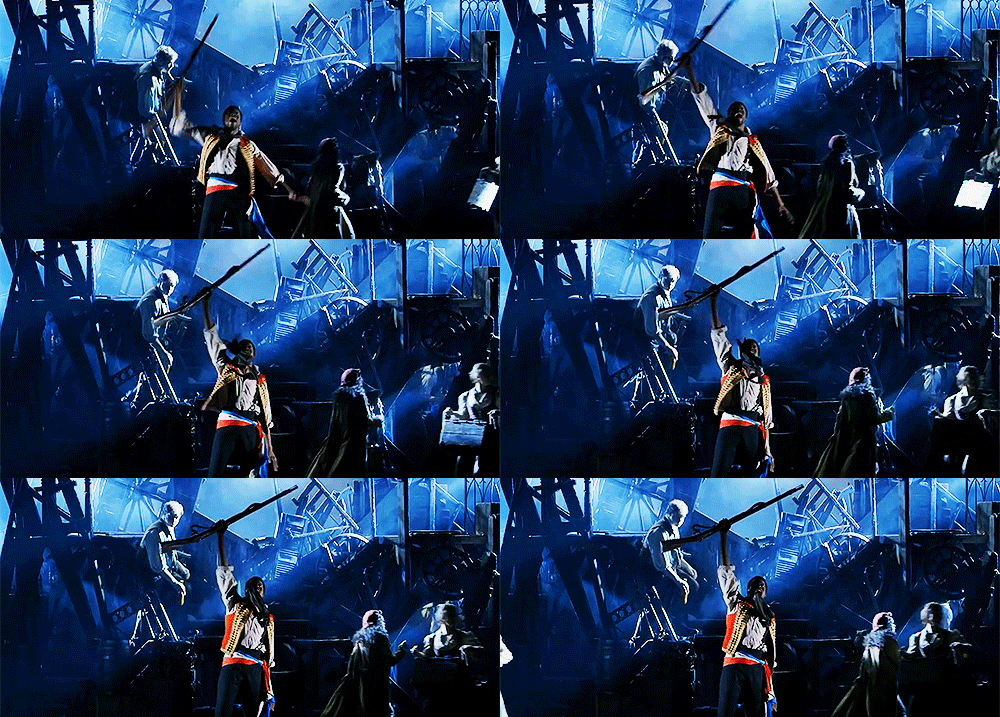
In every version, everybody dies except for Marius who is taken away by Valjean. However in the musical, they all die on the barricade, with Enjolras doing that famous fall backwards. In the book, they try to retreat into the Café Musain, only to be followed by the soldiers. The last one standing is Enjolras, until Grantaire, who is awaken from a drunken stupor, awakes and joins Enjolras, and the two die together. The 2012 film did a beautiful job of combining both versions of the demise of Enjolras and the gang. (And ripping my heart out in the process.)
tumblr_n145jqqpCO1szlqbso7_250
Marius
imdongeverythingallwrong
In the musical, we meet Marius with Enjolras as a fellow revolutionary. In the book, he is first interested a rich boy living with his aristocratic maternal family. He has cut off ties with his leftist colonel father, but hears news that is father is dying, so Marius returns to him once more. Unfortunately, he doesn’t make it to see him before his father passes away. Slowly, Marius starts learning why he never had much contact with his dad growing up. Marius’s maternal grandfather was a supporter of the royal family and aristocratic way of life, and so was his maiden aunt; while his father was a young man who fought for Napoleon as mentioned earlier. Marius’s grandfather therefore disowns his son-in-law, but agrees to take little Marius in and give him a good life and good education. All of this comes as a shock to poor Marius, who then decides to cut off ties with his rich grandfather and maiden aunt, and make it on his own.
So he gets the tiny room next to the Thénardier family, and gets by as lawyer and translator. His grandfather tries several times to offer him money and get him to come back, but he refuses each time. (We get tastes of this in the 2012 film).
He starts taking walks in the Luxembourg gardens, where he first sees Cosette (in the company of an older gentleman - her guardian of course). They eye each other, but never have an actual conversation there. At one point Valjean leaves his handkerchief with his fake initials on it, U.F. (Ultime Fauchlevant) and thinks it belongs to Cosette. Marius, being Marius, jumps to conclusions and reasons that she has “U” name so he starts referring to her as Ursule. Eventually Valjean stops taking Cosette to the gardens because he’s suspicious of Marius and his borderline stalking. At the end, he finds “Ursule” and her foster father again, and has Éponine tell him where they live.
Marius leaves Cosette a love letter, and she knows it’s from “Him”. The next day he comes again and officially has his first conversation with Cosette….and he learns her actual name. They meet every night in the garden of Cosette’s home for a couple of weeks until Cosette tells him that they are leaving for London, England. She begs Marius to come with her, but Marius has no money for a passport or for travel. So she agrees to leave him a way to reach her, which she does, except Éponine steals it. But he gets it anyway, they reunite, and they marry and all that jazz. However, they don’t get married for a few months. (February to be precise). Marius’s grandfather takes him back in, and blesses the marriage (Which he previously hadn’t before Marius went to the barricade). Marius finds out about Valjean’s past, which at first makes him distrustful of Valjean until he gets the truth from Thénardiers (before the latter move across the pond to start their new lives as southern cotton barons).
As I said earlier, Marius really isn’t a huge part of the ABC Society. As I said, he isn’t there for the formation of the barricade, and doesn’t even know about it until Éponine disguised as a boy tells him. By then he thinks Cosette has left him for London without any notification, so he goes, deciding to give up his life since he can’t be with Cosette.
I have yet to see a version that doesn’t include Marius-and rightly so. He’s the tie between the story of Valjean and the story of the June Rebellion. He’s always there as the handsome love interest that Valjean rescues, but rarely does his backstory with his grandfather (and even more rarely maiden aunt) make it in, which I suppose makes sense, cause in the grand scheme of the story, it’s not the most important part.
Cosette
So first off, Cosette isn’t her real name. Her real name is Anne-Euphrasia, Cosette is a childhood nickname given to her by Fantine that kind of sticks.
A lot of people in the fandom don’t like Cosette. I don’t hate Cosette: but I do hate the way she is portrayed in almost every version. But I love book Cosette. Most of the time she’s portrayed as just this sweet little ingénue with no real depth. Uh-uh, I ain’t about that. In the brick, Cosette actually has some substance to her. She is genuinely a kind-hearted person who was thoroughly traumatized by her time with the Thénardiers and growing up without the presence of real parents. (There’s actually a fantastic scene in the book where she runs into her biological dad, Felix Tholomeyes, but had no idea who he is and thinks he’s just terrible. That part always makes me chuckle.)
She’s the symbol of goodness and light in the book, and we get to see a lot more of her in the book that we did in the musical. After Valjean takes Cosette away from the Thénardiers, they live together for a time, in Paris, until they run into Javert and have to run. It’s there that they run into Fauchlevant-the fellow Valjean rescued from under the cart while he was the mayor of Montreuil. After ruining his leg he can no longer do his job, so Fauchlevant relocated to Paris to become a gardener for the convent. He insists on repaying his debt to Valjean, and does so, but letting Valjean and Cosette pretend to be related to him. Valjean works with Fauchlevant as a gardener, and Cosette attends the convent’s school. Years pass, Cosette grows into a young, beautiful woman, and Fauchlevant dies.  After he dies, Valjean, under the name Ultime Fauchlevant, leaves with Cosette and they start a new life in Paris. Valjean buys three different places for them to live, and they move between this there places with their maid, Toussaint, so that Javert will have a harder time tracking him down. Which works…for a while……
Other than that (and other details I’ve mentioned) Cosette in the musical is very much the same-although somewhat underdeveloped. Furthermore, since the musical portrays her falling in love with Marius within a day instead of him looking for her and then them meeting at night, their love usually feels forced to me, which is why I think so many people (including me before I read the book) are so anti-Cosette and pro-Éponine. (Yes, I love 'ponine too, but to be fair she does try to get Marius killed in a lapse of judgement.)