Mostrando entradas con la etiqueta cervantes. Mostrar todas las entradas

miércoles, 23 de abril de 2025

ANCHO CIPOTE, QUIJOTE, SANCHO


Ancho cipote, cipote ancho
Ancho es mi cipote
como el eje de un camión
Fuerte y vigoroso
como el brazo de Stallone
Y siempre está de chanza
con su inseparable amigo el cojón
Ancho cipote, cipote ancho
Ancho es mi cipote
Con regusto a salchichón
Mi cipote es un gran campeón
Y todas las chavalas se emocionan
con semejante pollón.

martes, 23 de abril de 2024

Acrósticos para el Día del Libro

Canta, oh Musa,

En un lugar de la Mancha,

Repite con fervor y

Vehemencia esas palabras,

Al caer de la tarde,

Nunca las olvidemos,

Toquemos ese plectro que

Electriza los corazones

Sin pedir nada a cambio.


...........................

Sing, oh Muse, of,

Hamlet, that brooding Danish Prince

At the crossroads of being and not being,

Knowing our thoughts and 

Emotions from those characters,

Perchance dreaming, perchance awake,

Ever caught in tragedies and comedies

As our lives unfurl

Repeatedly yet with changes,

Evolving as everyone does.


jueves, 26 de diciembre de 2019

TAPROOT TEXTS, DEFINED


If ever there was a taproot text – in John Clute’s terms, a fantasy that branches out into a thousand other fantasies – this is it (referring to the Curdie and Irene diptych by George MacDonald).
Unknown lecturer, Glasgow University (2010s).


Encyclopedia of Fantasy (John Clute, 1997)
Taproot Texts


Only in the last decades of the 18th century, when (at least in the West) a Horizon of Expectations emerged among writers and readers, did a delimitable genre now called Speculative Fiction (Fantasy, Science Fiction, etc.) appear. Before that there were writings which included the Fantastic – and such works can be described as taproot texts. To exemplify: The presence of the sylph Ariel and of Prospero's staff in William Shakespeare's The Tempest (performed circa 1611; 1623) do not make that play a fantasy or spec-fic, according to this criterion; The Tempest, however defined generically, may contain elements of the fantastic, but these elements did not govern its audience's sense of its generic nature: it was, first and foremost, a theatrical play. On the other hand, Goethe's Faust (1808) clearly reveals its author's consciousness that he is transforming a traditional story containing supernatural elements into a work mediated through – and in a telling sense defined by – those elements. For our purposes, The Tempest is best conceived as a Taproot Text and Faust as a proper fantasy.
The notion of the Taproot Text seems necessary – or at least desirable – for at least two reasons. The first is that a Water Margin of not easily definable intentions marks what we may now read as an irreversible impulse towards fantasy and proto-science-fiction. over the last decades of the 18th century, and it seems advisable to have a blanket term available to use in order to distinguish relevant texts composed or written before those we can legitimately call fantasy or science fiction. The second is that, because almost any form of tale written before the rise of the mimetic novel could be retroactively conceived as ur- or proto-fantasy (or ur-/proto-sci-fi, etc.), it seems highly convenient to apply to works from this Ocean of Story a term – i.e., "taproot" – which emphasizes the heightened significance of the text mentioned. When we refer to a text as a TT, in other words, we describe one that contains a certain mix of ingredients and stands out for various reasons – not excepting quality.
The list of Taproot Texts, therefore, may be long, but it is by no means endless; and a clear degree of qualitative judgement will be apparent in any individual cataloguing. Beyond those already mentioned, some other texts seem to fit the taxonomical needs for which the term was devised.
Relevant texts from classical literature include Homer's Iliad and Odyssey (composed by the 8th century BC); Hesiod's Theogony (composed 8th century BC), Aesop's Fables (composed before 560BC) (> Aesopian Fantasy); certain works of the Greek playwrights, like Aeschylus's Prometheus Bound (produced before 456BC) and Sophocles' Oedipus Rex (produced before 406BC); Ovid's Metamorphoses (circa AD1), Lucius Apuleius's The Golden Jackass (before AD155) and most of the surviving works of Lucian of Samosata.
Relevant early modern texts (from the turn of the Renaissance onwards) include Dante's The Divine Comedy (before 1321), Giovanni Boccaccio's Decameron (before 1353), the various Chivalric Romances and epics that mass together around the Matters of Britain (Arthurian cycle) and France (Carolingian cycle), including works like Beowulf, Sir Gawain and the Green Knight (written circa 1370) (> Gawain) and Sir Thomas Malory's Le Morte D'Arthur (1485) ed Thomas Caxton, some episodes of Geoffrey Chaucer's The Canterbury Tales (before 1400), Luigi Pulci's The Greater Morgante (1470; exp 1483), Orlando Innamorato (1487) by Matteo Maria Boiardo (1434-1494), Lodovico Ariosto's Orlando Furioso (1516), François Rabelais's Gargantua and Pantagruel (1532-1564), the Nights (1550-1553) of Gianfrancesco Straparola, Luis de Camoes's The Lusiads (1572), Torquato Tasso's Jerusalem Delivered (1581), Edmund Spenser's The Faerie Queene (1590-1596), Christopher Marlowe's Dr Faustus (written circa 1588), A Midsummer Night's Dream (performed circa 1595; 1600) and other Shakespeare plays, Miguel de Cervantes's Don Quixote (1605-1615), the Pentamerone (1634-1636) of Giambattista Basile, John Milton's Paradise Lost (1667), John Bunyan's The Pilgrim's Progress (1678) (>>> Pilgrim's Progress), Charles Perrault's Tales of Times Past or of Mother Goose (coll 1697), the various versions of The 1001 Nights (> Arabian Fantasy), Alexander Pope's The Rape of the Lock (1714) and Jonathan Swift's Gulliver's Travels (1726). The list could be considerably extended, but there is a distinction to be made: huge quantities of work can be treated as being of backdrop interest only; these titles cannot. 

miércoles, 23 de octubre de 2019

PELELE - Un juego del Siglo de Oro


20180827_120433
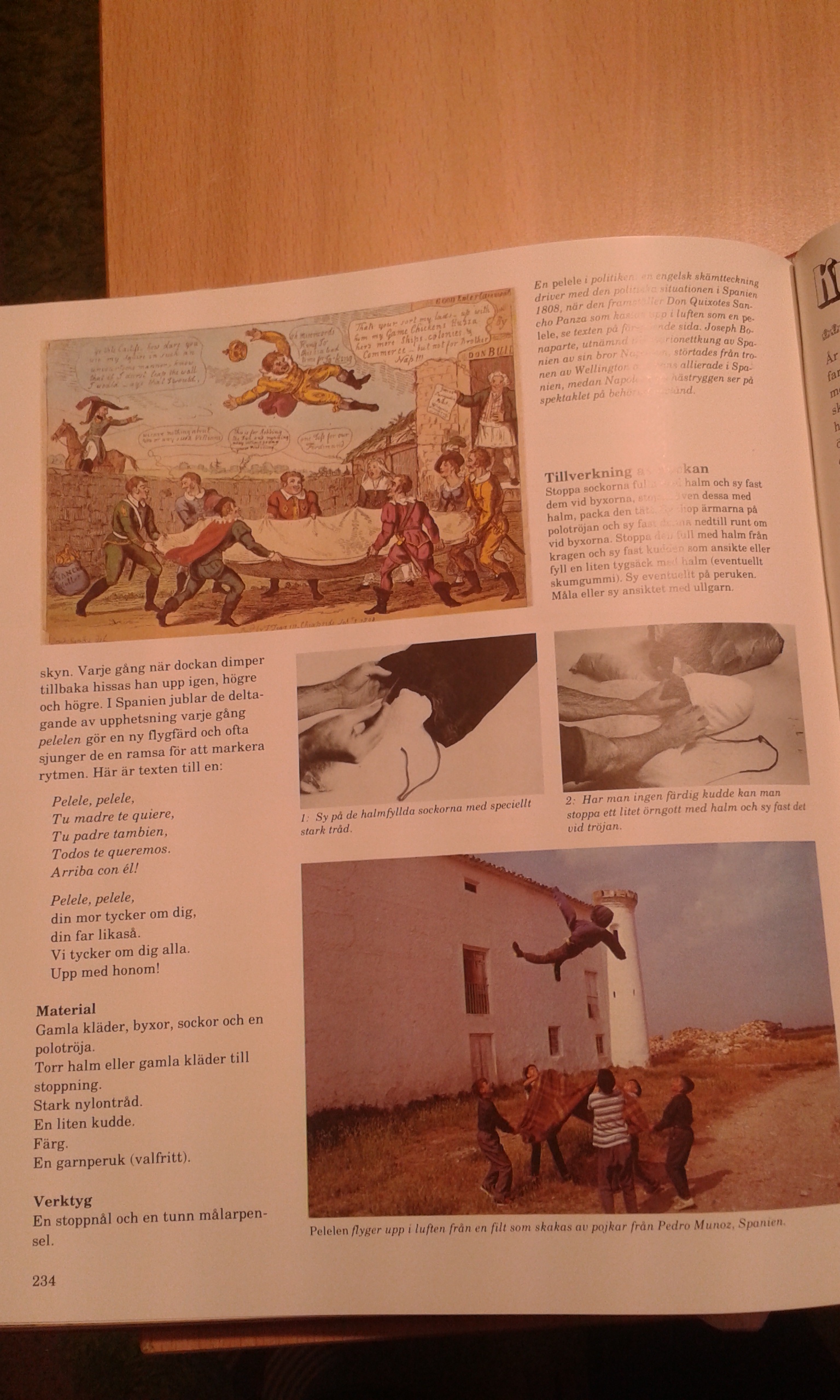
“Pelele” se llama un antiguo juego español de fiesta y de feria que consiste en lanzar a un muñeco a tamaño real arriba y abajo con una gran tela (“mantearlo”). Se supone que el pelele representa a un personaje público generalmente despreciado (p. ej. Rodrigo Rato en la actualidad), del que se escenifica la ejecución ceremonial. En general eran y son las jóvenes españolas quienes dan rienda suelta a su indignación en lo que respecta al machismo y al patriarcado de este modo.
Cuando lanzan bruscamente al muñeco, cantan alguna de las canciones satíricas tradicionales que forman parte del juego, por ejemplo ésta:
El pelele está malo,
¿qué le daremos?
Agua de caracoles,
que cría cuernos.
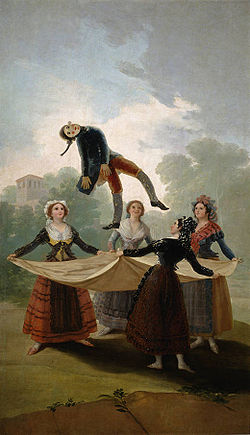
Uno de los cuadros más famosos de Goya muestra el manteo de un pelele capturado al vuelo, mientras que el compositor Enrique Granados invoca al espíritu del juego en su brillante pieza para piano titulada El Pelele.
También los varones mantean peleles. Es un juego unisex, especialmente popular en tiempos de Carnaval. En realidad, la cronología de este juego tal y como lo conocemos puede trazarse hasta una costumbre pagana primaveral: el sacrificio ritual del viejo “espíritu-árbol” al celebrar el equinoccio de primavera y el retorno del nuevo rey del bosque. En los Abruzzos, un espantapájaros se lleva en procesión aupado de pueblo en pueblo para señalar el inicio de los Carnavales. En vísperas del Miércoles de Ceniza, al final de las celebraciones, éste recibe un manteo ceremonial con una vieja sábana o frazada. Otra versión más macabra del ritual, celebrada otrora en toda Europa, implicaba mantear a un perro vivo y enrollarlo en la manta durante las mismas fechas.
También se han expuesto a personas vivas, en su día, al mismo tratamiento. En la Inglaterra de Shakespeare, el manteo era una expresión de insatisfacción pública, a caballo entre la broma y el castigo. Un autor del siglo XVI trata al manteo de “ejercicio deshonroso”. “Voy a mantear a ese canalla”, dice el personaje de Falstaff cuando un compañero se burla de él.
También el escudero de nuestro Quijote, el tolerante Sancho Panza, tiene que pasar por el aro del ridículo y ser manteado vivo cuando unos graciosos la toman con él en la venta de Maritornes.
El pueblo inuit de Alaska toma ventaja del mismo principio con fines más positivos: su nalukatok, practicado tradicionalmente con un cuero de morsa y actualmente también con una lona de barco, es una importante forma de actividad física. Este juego ha evolucionado hasta convertirse en deporte de competición: cada participante es manteado por sus compañeros de equipo y ha de tomar suficiente impulso como para saltar al menos seis o siete metros en el aire durante el manteo. Todo el rato, intenta permanecer en pie el mayor tiempo posible, y continúa rebotando, arriba y abajo, hasta perder el equilibrio. Cuando, al final, le resulta imposible distinguir entre arriba y abajo, su siguiente compañero ha de relevarle. Gana quien es capaz de mantenerse en pie durante el mayor número de manteos.
Españolitas del siglo XVIII manteando a un pelele en un cuadro de Goya, 1780. Encargo de la manufactura real de tapices.
Muñeco (arriba, dcha.): un muñeco a tamaño real cosido a mano aumenta la esperanza de vida de las prendas viejas de ropa. Si le pintas la cara con rotulador indeleble, puedes darle su propia personalidad.
REGLAMENTO DEL JUEGO
Se puede mantear al pelele bajo techo, pero es más divertido al aire libre, sobre todo en el campo o en el parque, donde el muñeco puede lanzarse literalmente por los aires. Tres, cuatro o cinco jugadores extienden la tela en el suelo y dejan al muñeco en el centro de ésta. Cada jugador coge la tela por una esquina y, a la de tres, la tela se deja caer y luego se tensa, de modo que el muñeco es lanzado y vuela por los aires. Cada vez que vuelve a caer, se lo lanza manteándolo de nuevo, cada vez más alto. Los jugadores gritan de euforia con cada vuelo del pelele, y, a menudo, marcan el compás con una cancioncilla. Si no os gusta la del agua de caracoles, aquí tenéis otra:
“Pelele, pelele,
tu madre te quiere,
tu padre también.
Todos te queremos.
¡Arriba con él!”
PD. Si disponéis de pantalones largos y de una sudadera de otoño que no os quepan, podéis enviarlos a Cáritas… o aprovechar el “paso a paso” de aquí abajo para coser un muñeco que os haga de pelele, actor en vuestro teatro de títeres, compañero de cama y/o confidente (si no sabéis coser, pedidle a un hada costurera, mamá, tía, abuela, o amiga mayor que lance un hechizo de aguja). Los pies son calcetines cosidos a las perneras; la cabeza será una almohada pequeña, a la que se cose, o se pega con Super Glue, una peluca. Podemos emplear una almohada de emoji o comprar una en blanco y dibujarle la cara con rotulador indeleble.
20180827_120525
Este pelele casero vuela por los aires desde una manta a cuadros escoceses, manteado por cinco chicos, todos varones, del pueblo de Pedro Muñoz.
Un pelele político: caricatura británica de la era napoleónica que satiriza la situación de España en el momento, ya que muestra al usurpador José Bonaparte manteado por el pueblo español y sus aliados ingleses… ¡volando cual pelele, destronado y descoronado! A la izquierda, su hermano Napoleón observa la escena a caballo desde una distancia prudencial.
POSDATA. Si os sentís de un humor anticlerical, aquí va una tercera tonada para el manteo del pelele:
Debajo de la cama del señor cura
hay un canastillo de confitura.
Los confites grandes son para el ama
los más pequeñitos pa la criada.

lunes, 7 de octubre de 2019

REVIEW - THE RESTLESS GIRLS


After their mother, the dashing, adventurous Queen Laurelia of Kalia dies in a freak accident, her 12 daughters are imprisoned in their black-draped bedroom by a bereaved King Alberto, who confiscates all of their distractions. For the twelve princesses, the Queen's demise is a disaster beyond losing a mother; she was the one to encourage all of them to follow their passions. Their father, King Alberto, cannot bear the idea of the princesses ever being in danger, and decides his daughters must be kept safe at all costs. Those costs include their lessons, their possessions and, most importantly, their freedom.
Alberto rules a kingdom in mourning, where females are not valued. After his wife’s untimely death and, now that Laurelia isn’t around to manage their education, having been raised in an all-male environment and now even more brooding with sorrow for his lost lenore, Alberto simply doesn’t know what to do with his daughters. The 12 princesses, all with distinct personalities and gifts (unlike in the original fairy tale of The Twelve Dancing Princesses, of which this story is a retelling, where they were all interchangeable paper cutouts) discover a spiral stairway in the wall, down to a strange colourful forest underworld where the princesses find the tree palace, and within, anthropomorphic animals and a magical party.
Every night, the princesses return to the underworld palace, where they dance to jazz and eat glistening pyramids of doughnuts, pavlovas, and roast chickens. Yet, every day, when they return home to far more austere halls on the surface, they have danced so much that their shoes are worn through. The King is determined to find out what the princesses are doing, but what will happen when he does?
On their side, the Restless Girls have one special possession in common that their high father can't wrest from them: THE POWER OF IMAGINATION. And so, with little but wits and ingenuity to rely on, a dozen royal sisters begin their fight to be allowed to LIVE.
Jessie Burton’s first book for children is a wonderful, magic-realist feminist fantasy of which there are translations into Italian and French (sadly, not into Spanish), perfectly balanced with the soft magic of Angela Barrett’s illustrations. It’s particularly delightful to see 12 dark-skinned princesses depicted, representing girls that are dynamic, well differentiated, and invested in the action of the story.


The first thing that called my attention to this retelling, aside from the race-lift, was the Roaring 20s or interbellum setting - now, other 12DP retellings/adaptations have chosen the same time period for a backdrop as well, but generally these are set in the real-life US (due to the whole prohibition and mafia factor); while the kingdom of Kalia, where The Restless Girls is set, is a Latina/Caribbean counterpart culture full of luscious flora, brightly-coloured façades and fashion, and interracial relationships (the titular heroines are mixed-race: Afro-descendants on their mother's side and of Spanish descent on their father's). Outside Princess and the Frog (in real-life Louisiana) and Elena of Avalor (in another Caribbean counterpart culture), I know no other fairytales with such an interbellum post-colonial setting. And the result is fresh-air-revolutionary.

The late Queen and the overprotective King, and the palace above in mourning to contrast with a vibrant underworld, are remarkable similarities with other 12DP adaptations. For instance, the doll-toyetic Mainframe version of 2006 The 12 Dancing Princesses, an animated feature with an 18th-century setting, which also had an ambitious governess micromanaging the sisters' lives in a way that makes Fräulein Rottenmeyer look like a 60s flowerchild... while tampering with the widower's drink little by little (I always yelled across the fourth wall to Randolf that he should stop taking afternoon tea)... The suitor was here the royal shoemaker (a single attractive 20sth, notch), and there was an outright badass climax with the older sisters fighting off mook guards while the youngest of them all, blond toddler Lacie, put a phial of water from the underworld lake to Randolf's lips and saved his life in extremis!! The girls had previously discovered that the lake had healing properties, exactly what they needed to set everything right (PS: the themes of this sibling batch were birthstones and flowers). Similarly, generally the Prohibition-setting historical fiction retellings of 12DP feature the same austerity and discipline above the surface and the same overprotective-parent catalysts.

Says the author herself:
"I wanted The Restless Girls to retain the unbridled joy of the original, because what had held firm for me over the gap of 30 years was the sisters' ingenuity, style and energy - and the power of a secret that nourished them all.
I wanted to build on those irresistible ingredients, to write a tale fit for a modern child. I wanted humour and resistance - vital qualities in navigating the difficult, confusing world in which we live.
My princesses are assertive, but there is more than a dollop of kindness here. Smart mouths and smart thinking are rewarded, but so are collaboration, thoughtfulness, and heart. Every princess has a name, a life, a world inside her own imagination. There's also a peacock maître d', a motor car, an aeroplane, and a lot of elderflower fizz!
I knew those girls were restless in the first place for a reason, because once upon a time, I was like them, too. It's their story: not the king's, not the suitor's. They still go dancing - every night! - except no young girl swirling in the lights will be punished for her joy.
That's some feeling, let me tell you. Put simply: it feels right."


Due to the nature of the ensemble cast and the need to flesh each character out to distinguish them from one another (what Save the Cat calls giving them "a limp and an eyepatch"), the sister teams in 12DP retellings often have a theme - zodiac, flower, and birthstone themes being extremely popular, while Vita Murrow's "Star and the 12 Dancers" had spices (and the first co-ed/equal-opportunity batch of royal siblings!), the titular character's full name being Star Anise... -- In feministically girl-power-themed The Restless Girls (even more feministic and girl-power-themed than the 2006 animated film!), the theme that unites and diversifies the ensemble cast is pastimes or passions, so this far wider diversity gives one an even more ample berth to find someone to identify themselves with.
My favourites among this dozen sisters are and were, of course, Bellina, who taught herself five languages; and Flora, always reading a book, a newspaper, or the side of a biscuit box (italics quotes straight from their character establishment in Chapter One). Of course I spent the whole novel following the character arcs of, and rooting for, the polyglot and the reader (whose character establishment reminds me of Cervantes, who even read "scraps of paper he found on the streets!") in this sibling ensemble for obvious reasons.

In the where-are-they-now epilogue at the end of the final Chapter Eight, we do see Bellina in foreign service; to quote: Bellina is chief of foreign affairs, and since her appointment Kalia’s wars with neighbouring kingdoms have ended. (Just like Ling in the Waterfire Saga; foreign service happens to be every polyglot's career dream, but not all of us are that lucky as our fictional counterparts with that quirk, so we have to dream on); and Flora... (jot down what Flora does at the end -- librarian, minister of culture, something literary non-writer? The youngest sister Agnes was the one with writing as a hobby, and she is credited with becoming a novelist, her first work being of course her own rendition of this story). Let's say I nailed it when guessing "librarian;" - Flora is the palace librarian, and people flock from miles around to come and find a cosy nook, where they while away the hours with her excellent choice of books.


The happier life when Mum was alive (above) and the boating across an underworld lake, something like the Styx (below).

The austere, Dickensian bedchamber in mourning has an orphanage atmosphere; the only note of colour in this barren sepia-tone hall is the portrait of the late Queen, who seems to be encouraging her daughters from the afterlife.

Firstborn, future Queen, and de facto leader Frida (centre stage in the previous illustration, the one in the bedchamber) rebels by tearing away a mourning curtain to let the light in.


The descent down the spiral stairs into the underworld

A long line of suitors, all single males of different age and rank, queue before the palace gate; not an unfamiliar scene in any engagement challenge tale. Yet this dozen damsels need no hero to save their days!


Frida finally calls the old man out and has him abdicate the throne; time for a new, younger ruler to take over -- and like mother like daughter (notice also her masculine, casual adventurer's outfit)!!


Last of all, the icing on this cake are definitely the lavish illustrations by Angela Barrett; I have already been wowed by the pastels and the textures of her lavish B&tB and Snow Queen, both of them set in Victorian European kingdoms - so here are a few samples of her takes on those two tales to see what I mean:
Cover art for Beauty and the Beast: what a beastly bush is lurking behind our shero!


The Master of the castle captures Mr. Fortune, a businessman home from town, who had stopped to pick a red rose from the garden for his daughter. You know how this will go down...


Belle Fortune has a heart-to-heart with her catlike beast in the royal gardens.


The palace grounds have it all that Belle could wish: libraries, aviaries, music rooms, English gardens, French gardens, a lake...

She returns to help him out in his hour of need...

Kissing the disenchanted prince under the roses.


https://kinita.livejournal.com/14940.html

And as we have said before her Snow Queen is as evocative as her B&tB:

Cover image of the Snow Queen kissing Kai.


Gerda and Kai in spring in their aerial bower.

The Snow Queen peers into Kai's room.

Gerda and Kai sledding in winter.


Kai spots the Snow Queen's troika

 The Queen whisks Kai away.

 The orchard witch finds Gerda.

 Gerda among the flowers in the springtime garden.


 Gerda and Mr. Crow

 Entering the palace gardens, then moving up the stairs.


 The robbers' ruin

 Gerda wins the trust of the robber maiden. Note the lesbian overtones!


 Riding across the tundra

 Gerda and the wise woman


 Gerda summons warriors with her breathing, to combat the Queen's guards


 Kai and the Snow Queen in her throne room

The Queen leaves her ice fortress

 Gerda warms Kai's heart

 Reunion with the robber maiden in the woods

Back home - physically adults, yet children at heart

lunes, 23 de abril de 2018

ASÍ HABLÓ GONZALO

For this Shakespeare Day, the turn has finally come to Gonzalo to give a little speech; I have endeavoured this by translating the good chancellor's afterthoughts (after leaving the isle of the wreck) into his mother tongue, that also happens to be my own.
I have see and abso-fricking-lutely adore a female Gonzalo, with the telling name Dolores:, a seductive, Gurdjieff-quoting flower child of a Californian intellectual, a true apostle of the New Age (played by Lucianne Buchanan), from a 1982 postmodern AU/retelling. Slightly improbably, Gonzalo is transformed into a dizzy blonde called Dolores (Lucianne Buchanan) who, with obvious Gonzalo correspondences, chatters senselessly and daydreams about everything turning out well for the good of humanity.
Be this character a he or a she; queer, straight, or ace; Californian, Australian, or from the Crown of Aragon (as Shakespeare's original was)... Sweet summer child for whom it takes decades to grow... surely reimagined sipping at a bar in the middle of a hot wasteland with the counterparts of Alonso Quijano and Mikel Tellagorri (ie; Dolores the Californian flower child sharing drinks with a fiftyish single LARPer and an eccentric, libertine former etarra). Where Quixote would be Enjolras and Tellagorri would combine Grantaire and Courfeyrac, Gonzalo/Dolores is definitely Combeferre. I claim the part of Marius, as the admiring newcomer, for myself. The drinks are on the house.

(Insert pinwheel here)

And where does this pinwheel come in? Is it a stylised reference to the Ingenious Hidalgo's feats of derring-do, a simple anemometre, or something far more metaphysical?
The pinwheel is a banner, an ideal, a sign; these mentors' counterpart to the tricolore at the backroom of the Café Musain.
You can take the girl out of the province, but you will never take the province out of the girl. The pinwheel is an ensign from Castellonian mythology, which stands for ideals such as modesty, kindness, and doing one's best. The tale, as narrated by our own regional Bard, Josep Pasqual i Tirado, tells of a humble, stunted-growing reed cane; it was at first used to make a kite, but the kite crash landed and was left by the children who flew it; yet the single mother of an ailing child found the broken kite and plumed its cane skeleton with its papers of bright colours to make a pinwheel, the only toy the little family could afford in their squalour. For the few years the child had left to live, the pinwheel brightened up and enlivened that short life. Not only that, but, after the mother was left alone, she kept the pinwheel as a keepsake, as a treasure to remember her lost beloved one.

»-Quan la meua ama morirà, seré canyeta; hui per hui sóc un record estimat i volgudíssim, sóc lo voladoret del fill de la mareta. . .»
"When my lady dies, I will be a little reed cane; nowadays, I am a beloved and most adored keepsake, I am the pinwheel of Mum's little one..."

This parable is also the reason why I would like pinwheels on my grave (if I chance to be buried in the cold, dark soil), or where my ashes shall be scattered, instead of flowers that only last for a short while, aside from being a tad too cliché.

Anyway, without further ado, let us return to the point, for the original Gonzalo, the good privado from the Crown of Aragón, has been waiting in the wings long enough; and, though I do not consider myself as worthy of rendering tribute to such a noble soul, let me nevertheless try by translating the good chancellor's afterthoughts (after leaving the isle of the wreck) into his mother tongue, that also happens to be my own:


ASÍ HABLÓ GONZALO
Sandra Dermark, 30 enero MMXVIII

La tarde solemne, inmensa y clara,
se cierne sobre nuestra nave,
cuya estela persiste, sin distorsionarse,
sobre el mar y el silencio. Miro
hacia atrás por última vez
mientras el Sol se pone tras la isla
donde se alteraron todos nuestros afectos: sí,
mi predicción se cumplió,
mas no estoy justificado,
sin soberbia estoy llorando.
No es mío el crédito por
las palabras que dije años ha,
cuya alegría traicioné:
las verdades de hoy no deben
nada a aquel consejero
cuya rimbombante elocuencia
trocó la honradez en falsedad.
¿No soy yo Gonzalo, el cual
con reflexión en torno a su ser
hizo del consuelo una ofensa?

No hay nada por explicar:
si en el Absurdo confiara
y, nota a nota, exactamente,
lo que había oído cantara...
aquella instantánea euforia
habría tomado, allí mismo,
al universo por sorpresa.
Todos bailarían la jota
de la autorredención ignota.
Fui yo quien lo había previsto,
celoso de mi antiguo oído,
mío el arte que hacía que el canto
sonara ridículo, de espanto.
Yo, cuya interferencia rompía
el galope en prosa más lenta,
y, especulando, las quimeras
cristalizaba en ideas vacías;
en bromas, las ironías;
hasta ser condenado reo
de duda y de falta de afecto.

Adiós, querida isla de naufragar:
todos hemos recuperado la salud,
todos hemos visto el Bien Común,
y no hay nada que perdonar.
Ya que la decisión de la tempestad
la pasión sujetiva devolvió
a uno inclinado a meditar,
hasta el recuerdo podrá
refugiar de un hostil ambiente,
cual torre en ruinas junto al mar
donde asustados adolescentes
aprendan la fórmula necesaria
para afrontar su mortalidad.
Hasta la carne marchita será
una campana, un cascabel
sobre el que pueda poner el Ya Está
las manos si, en cualquier ocasión,
se sienta inspirado a comunicar:
a quien solo está... "Aquí estoy",
a quien tenso está... "Todo va bien".

-----------------------------------------------------------------------------------------------


“Gonzalo”
—  from W. H. Auden’s “The Sea and the Mirror”
Evening, grave, immense, and clear,
Overlooks our ship whose wake
Lingers undistorted on
Sea and silence; I look back
For the last time as the sun
Sets behind that island where
All our loves were altered: yes,
My prediction came to pass,
Yet I am not justified,
And I weep but not with pride.
Not in me the credit for
Words I uttered long ago
Whose glad meaning I betrayed;
Truths to-day admitted, owe
Nothing to the councilor
In whose booming eloquence
Honesty became untrue.
Am I not Gonzalo who
By his self-reflection made
Consolation an offence?

There was nothing to explain:
Had I trusted the Absurd
And straightforward note by note
Sung exactly what I heard,
Such immediate delight
Would have taken there and then
Our common welkin by surprise,
All would have begun to dance
Jigs of self-deliverance.
It was I prevented this,
Jealous of my native ear,
Mine the art which made the song
Sound ridiculous and wrong,
I whose interference broke
The gallop into jog-trot prose
And by speculation froze
Vision into an idea,
Irony into a joke,
Till I stood convicted of
Doubt and insufficient love.

Farewell, dear island of our wreck:
All have been restored to health,
All have seen the Commonwealth,
There is nothing to forgive.
Since a storm’s decision gave
His subjective passion back
To a meditative man,
Even reminiscence can
Comfort ambient troubles like
Some ruined tower by the sea
Whence boyhoods growing and afraid
Learn a formula they need
In solving their mortality,
Even rusting flesh can be
A simple locus now, a bell
The Already There can lay
Hands on if at any time
It should feel inclined to say
To the lonely – “Here I am,”
To the anxious – “All is well.”