Mostrando entradas con la etiqueta stereotypes. Mostrar todas las entradas

miércoles, 19 de febrero de 2025

THE QUEEN'S LOVER (1001 NIGHTS)

 I remember now the depiction of the Queen's lover at the start of 1001 Nights and find it a racist caricature and stereotype. I do not mean to be racist towards Sub-Saharans, but I give the description nonetheless:

And as he continued in this case lo! a postern of the palace, which was carefully kept private, swung open and out of it came twenty slave girls surrounding his bother's wife who was wondrous fair, a model of beauty and comeliness and symmetry and perfect loveliness and who paced with the grace of a gazelle which panteth for the cooling stream. Thereupon Shah Zaman drew back from the window, but he kept the bevy in sight espying them from a place whence he could not be espied. They walked under the very lattice and advanced a little way into the garden till they came to a jetting fountain amiddlemost a great basin of water; then they stripped off their clothes and behold, ten of them were women, concubines of the King, and the other ten were white men in drag. Then they all paired off, each with each: but the Queen, who was left alone, presently cried out in a loud voice, "Here to me, O my lord Saeed!" and then sprang with a drop leap from one of the trees a blackamoor with rolling eyes which showed the whites, a truly hideous sight. He walked boldly up to her and threw his arms round her neck while she embraced him as warmly; then he bussed her and winding his legs round hers, as a button loop clasps a button, he threw her and enjoyed her. On like wise did the other slaves with the girls till all had satisfied their passions, and they ceased not from kissing and clipping, coupling and carousing till day began to wane; when the Mamelukes rose from the damsels' bosoms and the blackamoor slave dismounted from the Queen's breast; the men resumed their disguises and all, except the negro who swarmed up the tree, entered the palace and closed the postern door as before.

Había en el palacio unas ventanas que daban al jardín, y habiéndose asomado á una de ellas el rey Schahzaman, vió cómo se abría una puerta para dar salida á veinte esclavas y veinte esclavos, entre los cuales avanzaba la mujer del rey Schahriar en todo el esplendor de su belleza. Llegados á un estanque, se desnudaron y se mezclaron todos. Y súbitamente la mujer del rey gritó: «¡Oh Massaud!» Y en seguida acudió hacia ella un robusto esclavo negro, que la abrazó. Ella se abrazó también á él, y entonces el negro la echó al suelo, boca arriba, y la gozó. A tal señal, todos los demás esclavos hicieron lo mismo con las mujeres. Y así siguieron largo tiempo, sin acabar con sus besos, abrazos, copulaciones y cosas semejantes hasta cerca del amanecer.

Now there were in King Shahzeman’s apartments lattice-windows overlooking his brother’s garden, and as the former was sitting looking on the garden, behold a gate of the palace opened, and out came twenty damsels and twenty black slaves, and among them his brother’s wife, who was wonderfully fair and beautiful. They all came up to a fountain, where the girls and slaves took off their clothes and sat down together. Then the queen called out, “O Mesoud!” And there came to her a black slave, who embraced her and she him. Then he lay with her, and on likewise did the other slaves with the girls. And they ceased not from kissing and clipping and clicketing and carousing until the day began to wane. 

Not only are there crossdressers in the Burton translation but also the Queen's lover, called Saeed in that version, is caricaturized and made to look scary: "a blackamoor with rolling eyes which showed the whites, a truly hideous sight." He is monstrous. He climbs up and down the tree like a large black gorilla. And in his treatment of the Queen he embodies the stereotype of the mandingo, or hypersexual black man (compare Iago's depictions of Othello as "black ram" and "black Barbary horse"), the picture of an 'untameable' Black man with voracious, violent sexual urges and with a large penis. 

Done right, portrayals of interracial relationships can be wonderful, like in the case of Othello and Desdemona (it is, after all, the villain Iago and his henchman Roderigo in whose mouths we can find all the racist ranting), but you have to tread a fine line in this balancing act. Or you might screw up like the creators of this Vogue cover, where a howling NBA superstar LeBron James, the first black man ever to grace the cover of Vogue, cradles blonde German Brazilian model Gisele Bündchen in a way so reminiscent of King Kong with Fay Wray that the magazine went viral. There you have the blonde bombshell held aloft by the brutish "ape," and even though Gisele is portrayed as having fun instead of terrified, the iconography of Hollywood about both the "stud muffin" stereotype and King Kong sends a crystal clear subject matter:


Eighteenth-century Westerners believed that large male apes, whether orangutans on Borneo or gorillas in Sub-Saharan Africa, carried off native human maidens from their villages into the jungles and raped them, reproducing and giving rise to the next generation of apes; these apes, for generations, had human blood in their veins, in other words. This was long before Darwin, and people like Thomas Jefferson, infamous for having affairs and illegitimate half-blood children with female slaves of African descent that he owned, subscribed to this notorious ape-rape theory.

In the twentieth century, post-Darwin, we had chimp testicle implants into impotent human males' scrota (there were also goat testicle implants, that became a boom or bubble in the US), and even the theoretical possibility (still held by some) of the humanzee, a human-chimp hybrid.

Still today, this mag cover is a hot potato. Hope we have learned our lesson and shy away from such iconography in mass media nowadays and in the future.


miércoles, 14 de junio de 2023

EL DULCE SABOR DEL RACISMO

Hubo una época no muy lejana (los años noventa, para más señas), cuando no había Conguitos blancos en absoluto, y todos los oscuros Conguitos que existían eran más tribales y guerreros, ataviados con faldas de flecos, armados con lanzas de sílex y provistos de marcados labios rojos:


Gracias a algo llamado "corrección política", esos Conguitos de antaño son historia. Desde que surgieron los Conguitos blancos en la primera década del nuevo milenio, se ha dado un giro copernicano a la marca: ahora todos los Conguitos vienen en son de paz (sin lanzas), carecen de labios rojos y van al parecer desnudos, sin las faldas de flecos:


La publicidad de chocolate y de cacao, tanto por su color como por tratarse de un producto históricamente colonial, se ha prestado en el siglo pasado a anuncios que en la actualidad tildaríamos de racistas, ya ligeramente, ya totalmente desarrollando estereotipos racistas. Preguntadles a vuestros padres o madres por la canción del negrito del Cola-Cao que salía en la tele en su niñez (y, si son demasiado jóvenes, a vuestros abuelos):


A pesar de que el negrito desapareció de la tele, siguió apareciendo en el tarro de Cola-Cao durante décadas, más estilizado...


... hasta la primera década del nuevo milenio, cuando, en aras de la corrección política, fue reemplazado por los alienígenas Kao-Kao, que personificaban los nutrientes del producto (Ferki, el hierro; Fosfik, el fósforo; Akinha, la vitamina A... ).


El discurso racista puede limitarse también a un único ingrediente del producto. Entre "nata Made in Vaca" y "fresas del bosque de Caperucita" muy inocentes que atraen a toda la familia, la agencia publicitaria que introdujo el helado de palo italiano Doctor Strabik en España para Frigo (de su marca hermana en Italia Algida, bajo el sello Eldorado) a principios de los noventa (como el Frigurón, sólo duró un par de veranos) describió su cobertura de chocolate de una forma que hoy en día sería totalmente inaceptable; "De crrrrrrrujiente chocolate negro Bwana". Negro BWANA. "Bwana" es un vocativo en suajili que literalmente quiere decir "amo" o "señor". La palabreja de marras ganó tracción en Occidente con las películas de aventuras en la selva, tipo Mogambo o las de Tarzán, donde los sirvientes africanos suelen tratar de "bwana" a sus amos blancos constantemente.


Pero no está confinada a nuestro país de Sagitario esta costumbre de la publicidad de chocolate histórica racista. En alemán "Mohr" es literalmente tanto "moro" como "negro" (se dice, por ejemplo, del Otelo de Shakespeare). La marca alemana de chocolate Sarotti tuvo clásicamente a un pequeño moro negro, con turbante, babuchas y los labios muy rojos ("der Sarotti-Mohr"), como mascota y para atraer a los niños, en anuncios animados, como muñeco, etcétera...


El personaje existe hoy en día aún, salvo que es un pequeño mago oriental de tez dorada, con el mismo traje islámico ("der Sarotti-Magier"), que está presente en todas las estrategias publicitarias ya existentes además de en Internet y en los medios sociales. Simplemente le han cambiado el color de la piel y el grosor de los labios:


En la vecina Austria existe un postre conocido como "Mohr im Hemd" ("moro encamisado"), un pudin de chocolate y almendras cocinado al baño María (como un pudin navideño británico). En el 2009, la empresa heladera austríaca Eskimo, que forma parte de Heartbrand junto con Frigo (y Algida en Italia [también en Hungría, Croacia, Serbia, Grecia, Chipre y otros países], Langnese en Alemania, GB Glace en Suecia, Olá en Portugal, Frisko en Dinamarca, Wall's en Reino Unido [también en Corea, Japón y otros países], Streets en Australia y Nueva Zelanda, y otras heladeras) lanzó un helado en pinta Cremissimo con sabor Mohr im Hemd con el eslógan "I will Mohr" (juego de palabras con el inglés "I will/want more," "quiero más", dado que "more" ["más"] se pronuncia igual que "Mohr"). Los medios austríacos tacharon enseguida el eslógan de racista. Por cierto, el nombre del pudin se está convirtiendo en un arcaísmo, puesto que cada vez menos restaurantes lo ponen como "Mohr im Hemd" en el menú y, en cambio, describen el postre, por ejemplo, como "Schoko-Nuss-Kuchen mit Schlag" (literalmente: pastel de chocolate y frutos secos con nata montada).

Pudin "Schoko-Nuss-Kuchen mit Schlag", antes "Mohr im Hemd"


"I will Mohr!" Helado Cremissimo de Eskimo sabor Mohr im Hemd

Un dulce que no muchos españoles aprecian pero que muchos adoran en Alemania y en los países nórdicos es el regaliz. No hace falta salir de Europa para conseguirlo, pero su color ya da una buena pista de que también su publicidad ha conllevado polémicas racistas. GB Glace, la empresa heladera sueca de Heartbrand (hermana de Frigo y de otras muchas heladeras internacionales que ya se han mencionado aquí arriba), lanzó en exclusiva para Suecia en 2005 un helado de palo con cobertura y relleno de regaliz salado (una delicia en Suecia), y encima mediante una campaña publicitaria con una estética "callejera", con rap en los anuncios y tipografía similar al grafiti. La gota que colmó el vaso era el nombre del helado en cuestión: Nogger Black. NOGGER BLACK, a una letra de Nigger Black. El helado sólo duró dos veranos y se retiró del mercado en 2007, tras protestas del Centro Sueco contra el Racismo.


Pero los suecos tampoco estaban en contra del chocolate racista antes de la corrección política. Estas delicias esféricas del tamaño de pelotas de ping-pong se llamaron en su día "negerbollar" (bolas de negro"); en la actualidad, son conocidas como "chokladbollar" (bolas de chocolate) o "kokosbollar" (bolas de coco). Ay, la corrección política...


Para finalizar este recorrido por la historia racista de los dulces y de los helados, volvamos a la España de los años noventa. Allí, la marca Camy lanzó un helado mucho, mucho más blanco... De hecho, color blanco HUESO y con una forma acorde. Este sorbete de limón con aspecto de fémur estaba atravesado por el palo en sentido longitudinal y se comía agarrándolo con una mano por cada extremo. Igual que lo haría un bárbaro, un vikingo o un caníbal royendo un hueso de verdad. El problema yace en que la refrescante delicia se llamaba KANÍBAL, escrito con K para parecer más salvaje, y encima en una tipografía de fémures, y en el envoltorio se veía a un africano con gruesos labios rojos, un húmero en la coleta y desnudo excepto por una falda de flecos (vamos, semidesnudo).
Hoy en día, esta helada delicia no podría, a diferencia del Frigurón, resucitar en un verano del futuro. Aunque cabe admitir que la canción del anuncio era pegadiza:


"KANÍBAL es de Camy...


...y se come así..."

"Jarl!" (Sí, Chiquito de la Calzada decía "jarl", o eso parecía, al final de los anuncios de Camy)


martes, 1 de enero de 2019

19 THINGS TO KNOW ABOUT ME, THE GAY MALE SIDEKICK

19 THINGS TO KNOW ABOUT ME, THE GAY MALE SIDEKICK IN A ROMANTIC COMEDY

  1. My part was first offered to Stanley Tucci. He said FUCK NO. I said FUCK YES.
  2. I am 24. (Actually, 33)
  3.  I got my MFA in Acting at Yale, bitch.
  4.  I only took this role for the SAG health insurance.
  5.  I can only talk while walking and escorting you to an important meeting/lunch/drop-in.
  6. All the exposition I need to share with you is conveniently packed into that short walk to meeting/lunch.
  7. I look like a gazelle fucked a marble kitchen countertop.
  8. My character’s name is usually Chad, Derek, Marc, Mark, Joey, Danny, etc.
  9. Usually remind you where you work: “YOU WORK AT VOGUE!
  10. Other fave lines:
    1. “Well the boss is PRE-TTY pissed. You know how he gets on Thursdays…”
    2. “WOOOOWWW”
    3. “She’s really doing it!”
    4. “YOU ARE TOTALLY IN LOVE WITH HIMWORD IS HE WORKS IN MARKETING…”
  • 11. I don’t have a last name so don’t bother asking.
  1. 12. My outfit is some sort of purple/orange monstrosity that is… ridiculous?
  2. 13. I will give you a really good idea, but of course, let you think you came up with it yourself. Just happy to be a part of your narrative!
  3. 14. I live at the office. I am never seen outside the office, and if I am it’s in some sort of ridiculous disguise getting your character some intel.
  4. 15. I make more facial gestures in one scene than anyone else in the entire film. I am especially great with eye-rolls.
  5. 16. At one point, the female lead will undoubtedly say, “Ugh, why can’t I just date you?” to which I will reply any of the following: “Tried it in college,” or “Do I look 19 anymore?”
  6. 17. I secretly wish you were Cate Blanchett or Kate Winslet.
  7. 18. I’ll be invited on the press junket but I am in a thespian play (Othello, bitch), so I won’t go.
  8. 19. I firmly believe this dreck should have stayed a book.

domingo, 18 de junio de 2017

ON STEREOTYPES

They're peanuts covered in chocolate. At first, there were only dark ones, and their mascots wore hula skirts and were armed with flint spears --not to mention the thick lips--. Their name? Conguitos. Which obviously comes from the place name Congo.


But the white Conguitos that appeared in the early 2000s gave a Copernican turn to the history of the brand, breaking the racial stereotype; first both white and dark Conguitos had thick red lips, now neither kind of Conguitos has this feature. Anyway, no matter the size of their lips, they're all completely unarmed, coming in peace, ever since the white ones appeared.


In a similar vein, the "Negritos del África tropical" that had been the mascots of Cola Cao ever since the drinking chocolate brand's inception became, in the same decade, a crew of space aliens (Los Kao Kao) that represented the various nutrients (iron, calcium, phosphorus, vitamin A...) present in the product. No aliens from other star systems have been harmed psychologically by characters like Ferki, iron personified:


In the Germanosphere, similarly, a third chocolate mascot, the Sub-Saharan Muslim Sarotti Moor, has become the golden-skinned, but still Middle-Eastern, Sarotti Mage. No one has complained about the phototype lift, in spite of the turban and pointy slippers being retained.


Sarotti Mage (on the left) and Moor (on the right).

Ditto Pears' Soap adverts, which in the Victorian era featured the whitewashing of negroes:


And in the present decade star this mother and daughter, both equally European-looking:


There is a film from postbellum Spain, script written by the Generalísimo himself, which bears the title of Raza (Race).
Nowadays, this is a four-letter word for a concept dismissed as total balderdash.
The climax of Raza, of which previous scenes had been set in Barcelona and Bilbao, takes place during the Battle of the Ebro, right before the downfall of the Valencia Region in general and the Castellón Province in particular (shudders). All the lead characters are rightist, while the leftists are portrayed as the bad guys unless they make a right turn (a dentist with «un pasado malo de izquierdismo» lo cual le dio «influencia en aquella sociedad corrompida» [sic]). The leftists defeated at the Ebro are "HOLLOW men" («hombres huecos»). Vae victis! Demonizing the wicked enemy to revel in the victory over them is nothing new under the sun; it's existed for as long as there's warfare.
But we hadn't been conscious of the labels attached to ideologies, religions, ethnic groups... and their negative innuendo before the countercultural revolution of the late 60s.
Victorian fairytales may be the perfect example. To put the most well-known example, the Pickaninny tribe of Neverland has recently been whitewashed over and over again (being portrayed as Caucasians in the latest Pan film): as early as in the 50s Disney film, the Pickaninnies were still so-called redskins, ie racist caricatures of the Sioux and other prairie First Nations tribes (lyrics of their crowd song even suggesting that the first Pickaninny prince turned red, a trait which has been passed to his descendants, due to an awkward crush blush while kissing his bride; and that the term "ugh" came to be when that first leader of the tribe saw his mother-in-law!)... More redskins appear in the Pecos Bill Texan legends as told by Disney; this time their warpaint runs off as the cowboy chases them, colouring the Painted Desert.
Oscar Wilde's fairytales also offer caricatures of, for instance:

"the old Jews bargaining with each other, and weighing out money in copper scales."

As if the only thing that Jews feel at all is greed, and similarly, that Negroes (Sub-Saharans) are prone to quarrel over glass beads:

"The negroes chattered to each other, and began to quarrel over a string of bright beads."

Oscar Wilde also portrays, in the same fairytale, Afghans (and Tatars) as tribal, warlike mountain savages who engage in animal sacrifice before battle (a far more pagan than Islamic custom) and who fight with iron helmets, shields, and spears (no firearms!):

"There is war in the mountains of Tartary, and the kings of each side are calling to thee (to Death). The Afghans have slain the black ox, and are marching to battle. They have beaten upon their shields with their spears, and have put on their helmets of iron."

NOTE: black ox sacrifices are due to the gods of the dead and the Underworld in the Far East of Asia. The black steer represents either the earth/mother/fertility goddess or the gods of the Underworld. Close to Afghanistan (Mongolia, Imperial China) but no cigar. The Asian Hades (Yamaraja in Sanskrit, King Enma in Chinese and Japanese) rides a black buffalo.

Hollow leftists, Jews bargaining with each other and weighing out money, negroes quarrelling over a string of bright beads, Afghans with spears and shields and helmets of iron. Add foppish gay men and butch lesbians. Nowadays, we frown at the sole thought of such stereotypical caricatures. The concept of human races is outdated. But in fiction from before the countercultural revolution, such stereotypes appear like mushrooms. 


A Croatian lieutenant who took to writing and illustrating storybooks after the Great War (trading the sword for the pen like many others), considered one of the Great Ones of Austrian children's literature, Franz Karl Ginzkey is most renowned for Hatschi Bratschis Luftballon (Hadji Bradji's Hot-Air Balloon), about the all-Austrian boy Fritz whisked away by a malignant and turbaned Turk skilled in sorcery (similar to the Jafar and the evil jinni of 1001 Nights), the titular villain, by means of the titular montgolfière. Turks, that even besieged Vienna more than once, had always been demonised by Austrians. More than Croats, Hungarians, or any other outgroup within the Habsburg Empire. The story ends with Fritz, who had wound up in Turkey after a series of adventures, freeing all of Hadji Bradji's European child prisoners from his dungeons, slaying the sorcerer, and returning in triumph home to Austria, followed by all the children he's freed.

As time has gone by since the Roaring Twenties, the titular villain has been regularly less and less Orientalised, his home country changed from Turkey to some Morningland (Morgenland) in the Middle East, and nowadays the turban and the Hadji title (given to male Muslims who have undertaken their Pilgrimage) are the only things that remain intact in the storybooks. The initially Jafar-esque malignant and turbaned Turk has become a jolly, hefty figure like a Dickensian gentleman (Mr. Fezziwig, Mr. Micawber, Wemmick the Elder...), but still with a sinister side as a child abductor.
Also, the monkey episode. Originally, when Fritz had anchored the balloon on a small tropical island to harvest dates or bananas and have a well-deserved rest, it were Negro cannibals (Menschenfresser, ie Human-Eaters, or Person-Eaters), who stormed forth to eat his flesh. Just like when it comes to the gipsy brigands who want to eat Gerda and introduce themselves by butchering her entourage in the Fifth Story of The Snow Queen, dark-skinned Others attempt cannibalism on the innocent, blond European child hero/ine, who finds a lucky, providential escape (Gerda is saved by the leader's daughter, who later frees her from the clutches of the outlaws; Fritz manages to set sail on the balloon just in time). Nowadays, in the present-day updated version, Fritz is attacked by monkeys, who are less interested in his flesh and more in defending the fruit he is wresting from them.


(Original Menschenfresser version on the left, vs. present-day Affen version on the right)

And these illustrations explain the parallel episode in The Snow Queen (Story the Fifth) which may have inspired Ginzkey:


The brigands in ambush, before lunging at Gerda's carriage. Edmund Dulac.


Right when the leader is about to slit Gerda's throat, her hoyden daughter makes a sudden entrance. Pavel Tatarnikov.


The Robber Maiden pleads for Gerda's life. Nika Goltz.


Returning to the lair, an old keep in ruins. The Robber Maiden drives Gerda into the courtyard. Christian Birmingham.


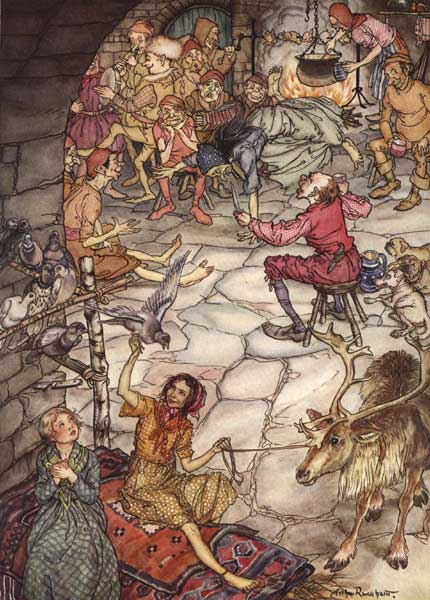
Gerda spending the night at the Robber Maiden's woodland zoo, while all the adults drink hard and celebrate their latest capture. Arthur Rackham.


The Robber Maiden supplies Gerda with winter clothes. Clara Creed.


Gerda and the Robber Maiden flee the keep together. Anastasia Arkhipova.

The Robber Maiden frees Gerda and the reindeer, wishing them success. Christian Birmingham.


Nazi storybooks like Der Giftpilz (The Poison Mushroom, a series of anecdotes about sinister and/or greedy Jews waylaying innocent Germans), or Der Pudelmopsdackelpinscher (The Poodle-Pug-Dachs-Pinscher, about the counterparts of the Jew in the various provinces of the animal kingdom, one of them being the titular mutt), as well as Francoist kidlit, go the extra mile. The same can also be said about left-wing, let's say Stalinist, propagandistic children's fiction --the far left being as interested in this strategy as the far right--. But still the most vivid examples are from the Third Reich.
In Der Giftpilz, a mother and child, both obviously German (blond, good-looking; all the Jews in this book are dark-haired caricatures with potato noses and thick lips, and sinister looks in their eyes: what a stark contrast to the mother and child in the introduction!), serve as a way to break the ice while picking mushrooms in the woods. 


Jewish lawyers, Der Giftpilz. Contrast the two men on the right with the two girls on the left, and also with the mother and child in the prologue illustration below.


"Just like there are good and bad mushrooms," Mami says, "there are good and bad people. The toxic mushrooms of humankind are the Jews. Often, just like when we take a really poisonous mushroom for an edible one, it's hard to see the Jew as the scoundrel he or she is."
The titles of the stories are as ominous as: 
HOW TO RECOGNISE A JEW, 
HOW A GERMAN FARMER WAS DRIVEN FROM HOUSE AND HOME,
THE EXPERIENCE OF HANS AND ELSA WITH A STRANGER,
INGA'S VISIT TO A JEWISH DOCTOR,
HOW JEWS TREAT THEIR DOMESTIC SERVANTS,
HOW TWO WOMEN WERE TRICKED BY JEWISH LAWYERS,
and
MONEY IS THE GOD OF THE JEWS...

The cover, which has mushrooms with caricature Jewish features not unlike those of the stories' villains, already gives an idea:


It makes even Wilde's "old Jews bargaining with each other, and weighing out money in copper scales" look innocent in comparison.

The same goes for the animals used as counterparts for Jews in Der Pudelmopsdackelpinscher, aside from the titular mutt, which is described as the scourge of the street where the author lives. Most of them are toxic or parasitic species, or pests: hyenas (scavengers), cuckoo chicks (nest parasites), bedbugs (vampiric pests), locusts (crop pests), venomous snakes, and the crowner may be the last two stories about endoparasites: tapeworms and pathogens, respectively.
The first story, the one with the tapeworms, opens with little Hans's Mami, Frau Müller, taking him to an obviously German doctor: "My lad is so weak, so pale, he never smiles... but he eats like a horse, more than both his parents! It happened overnight..." After examining Hans's abdomen, the Herr Doktor breaks the news to a shocked mother and child: "He's got a... tapeworm!" He then explains that it can be several meters long.
FRAU MÜLLER: And does that huge... thing live inside my boy?
HERR DOKTOR: In the gut of a human, it grows to reach that length of several meters.
The Herr Doktor explains that tapeworms wind up in the human gut if the host has ingested rare pork or beef meat, or rare freshwater fish: the pig, the cow, the pike already had the bug in the flesh, and only cooking it well can remove the parasite before it gets in... but this tapeworm is currently feeding off the nutrients Hans has consumed, so he has to take a purgative medicine to flush both the head and all the proglottids of the dead tapeworm out of his system. If the dead head's out, the infestation will be no more, he reiterates, warning Frau Müller to cook her meat and freshwater fish well to kill the cysts and prevent further tapeworm incidents.
This short tale might as well be completely positive tapeworm prophylaxis... if not followed by an allegory of how the Jewish fifth column is undermining, and sapping, the health of the Reich's system from within, and this parasitism will never stop until the land is completely purged of Jews. 
In the next story, in which Jews are compared to pathogens and we see young Hans Müller and the Herr Doktor once more, things get equally ominous. The comparison of a healthy system to a well-ruled state isn't that new either, dating back to the Greeks and/or Egyptians...

ANGEL CAKES (falsetto, mincing on their toetips) One and two and three, four; one and two and three, four... You should marry one of us because we are so good!

Moving away from Nazis and back to Disney before the 1990s Renaissance, and to when-Walt-was-still-alive simple stereotyping (as opposed to propaganda)... from the various stereotypes in the Cookie Carnival short ("queeny" gay angel cakes, alcoholic babas au rhum, a negro Miss Licorice and an Eskimo Miss Coconut), to the jive-talking crows that encourage Dumbo, the yellow-peril Siamese cats who threaten Lady and the Tramp (similarly, space overlord Ming the Merciless of Mongo was distinctly Asian before his skin was changed to chartreuse [tennis ball green-yellow])... Long story short, the redskin Pickaninnies in the 1950s Peter Pan are only the tip of the ominous iceberg.
There was a time before political correctness, and, whether we like it or not, we should take such stereotypes in fiction with a grain of salt. If present-day B movies like Foodfight or Sausage Party want to perpetrate such noxious stereotypes, it's a free world but I'm nevertheless at least slightly offended.


The "leftish" drinking chocolate on the left, the "rightish" brand on the right.
There's nothing that says all tub-bathers are rightists and all showerers are leftists. The same goes for brands of drinking chocolate (Cola Cao vs. Nesquik in Spain, Ögon [owned by Fazer] vs. O'Boy in Sweden) and newspapers. Being called a Commie (Sp. "rojo") is as much of a slur as being called a Tory (Sp. "facha"). The lyrics of the Gaber song Destra-Sinistra do nothing more than satirising stereotypes, this time related to ideology. Leftists and rightists are portrayed as not so different at heart: no matter if you have a swim in a private pool or a lake, wash yourself in a tub or a shower, prefer one brand or another... it says that stereotypes are merely labels not to generalise with...

Tutti noi ce la prendiamo con la storia 
ma io dico che la colpa è nostra 
è evidente che la gente è poco seria 
quando parla di sinistra o destra. 

L'ideologia, l'ideologia 
malgrado tutto credo ancora che ci sia 
è il continuare ad affermare 
un pensiero e il suo perché 
con la scusa di un contrasto che non c'è 
se c'è chissà dov'è, se c'é chissà dov'é. 

PS. MORE GREEDY JEWS IN VICTORIAN FICTION:

1) THE THIEF IN "THE DISCONTENTED TREE:"
A well-known moral tale about a conifer tree wishing for other kinds of leaves, I first heard it in kindergarten. His first wish is for golden leaves, but that night a thief (only specified to be a thief in my childhood versions) creeps by and strips the golden tree entirely of leaves. It wasn't until my late teens that I found the original British Victorian versions, in which the thief is a stereotypical old Jew (Replacing "Jew" with "thief," in both the verse and prose versions, was all that the politically correct version needed to set the tale right):

Now, by came a Jew, with a bag on his back,
       who cried, "I'll be rich today!"
He stripped the boughs, and, filling his sack
       with the yellow leaves, walked away!


But as evening drew nigh, an old Jew, with a long beard, came walking through the wood, carrying a heavy sack on his shoulders. When he saw the tree, with its brilliant, glittering foliage, he quickly plucked the golden leaves, one by one, thrust them into his sack, and hastened away, leaving the tree empty and shorn. 


But, as a child, I heard it the other way:


Now, by came a thief, with a bag on his back,
       who cried, "I'll be rich today!"
He stripped the boughs, and, filling his sack
       with the yellow leaves, walked away!


But as evening drew nigh, an old thief, with a long beard, came walking through the wood, carrying a heavy sack on his shoulders. When he saw the tree, with its brilliant, glittering foliage, he quickly plucked the golden leaves, one by one, thrust them into his sack, and hastened away, leaving the tree empty and shorn. 


The story is apparently Germanic, "Es ist ein Bäumchen gestanden," written by Friedrich Rückert in 1813, and the original verse/lyrics has "ein Jude" as well. Both schoolroom and home versions of the poem have changed it to "ging ein Räuber durch den Wald" (as it appears as early as in the 1830s version!) in the present day (Considering the impact of the Third Reich, it would come as no surprise)...

ORIGINAL NAPOLEONIC-ERA VERSION:

4. Aber wie es Abend ward,
ging ein Jude durch den Wald
mit großem Sack und langem Bart,
der sieht die goldnen Blätter bald;
Er steckt sie ein, geht eilends fort
und läßt das leere Bäumlein dort.


1830s VERSION, SUNG AT SCHOOL AND HOME IN PRESENT-DAY GERMANY:

4. Aber wie es Abend ward,
ging ein Räuber durch den Wald
mit großem Sack und langem Bart,
der sieht die goldnen Blätter bald;
Er steckt sie ein, geht eilends fort
und läßt das leere Bäumlein dort.


The reception of the Bäumchen song has appeared to fluctuate throughout German history, and one may trace a history of anti-Semitism and political correctness within the Germanosphere by simply regarding the timeline: the first Räuber version was published already as early as in the 1830s, but a Jude version from the 1840s was also quite popular... the Jude and Räuber version must have coexisted in the Kaiserzeit and the interbellum period... but the nail in the coffin, the last iteration, of the Jude lyrics was Heinz Tischmeyer's 1940 propagandistic animated short film adaptation of the song, Vom Bäumlein, dass andere Blättern hat gevollt (Of the Little Tree that Wished for Other Leaves); like an animated music video or a Disney Silly Symphony, but made by Nazis, with the Jude character as a caricature not dissimilar to the ones in Der Giftpilz:


Ging ein Jude durch die Wald, mit großem Sack und langem Bart: Vom Bäumlein..., Tischmeyer, 1940


Er (der Jude) steckt sie ein, geht eilends fort: Vom Bäumlein..., Tischmeyer, 1940

Consider that this short was made in the Third Reich, and that, ever since its fall, the canonical, official Bäumchen song has been and is the Räuber version!


The Grimms also have a story with the antagonist title "The Jew in the Thorns," ("Der Jude im Dorn") but nowadays mostly known as "The Dance in the Thorns" ("Der Tanz im Dorn", Germanophone title) or "The Miser in the Thorns" (Anglophone title), the villain torn down to a generic loanshark scrooge (or "Geizhals", in German) who might as well profess any creed.


2) THE CHEATING JEWELLER IN THE ORIGINAL "ALADDIN" TALE:
When he goes to sell the valuables he found in the cave of wonders, Aladdin, or rather Ala-ed-Din --in the written 1001 Nights-- goes to a pair of jewellers, the first of whom cheats him of his rarities. He then goes to the second, more honest jeweller, and gets the price right. In the uncensored version of the tale, the first jeweller was a Jew, "viler than all the devils" (and the other jeweller, a decent, honest-to-Allah Muslim sheik, "who was a just man and feared Allah"):


So perceiving that nothing remained to them to eat, he arose, and took one of the plates which the slave (the genie/jinni) had brought on the tray, which were of pure gold, though he knew it not; and he went with it to the market. And there met him a Jew, viler than the devils, and to him he offered the plate. And when the Jew saw it, he took ‘Ala-ed-Din aside so that none should see, and examined the plate carefully and assured himself that it was of fine gold; and not knowing whether ‘Ala-ed-Din was acquainted with its worth or was inexperienced in such things, he said to him: “How much, O my master, is this dish?” And ‘Ala-ed-Din answered, “Thou knowest its value.” And the Jew considered how much he should bid for it, since ‘Ala-ed-Din had answered him a business-like answer; so he thought to offer him a small price, and yet he feared that ‘Ala-ed-Din might know the value of it and expect to receive a high price. So he said within himself: “Perchance he is ignorant of it and knoweth not the value.” Then he took from his pocket a dinar of gold and gave it him. And when ‘Ala-ed-Din had looked at the piece of gold in his hand, he took it and quickly went away. So the Jew knew that the youth did not understand the value of the plate, so he repented with abject repentance that he had given him a dinar instead of a carat of a sixtieth. ‘Ala-ed-Din meanwhile did not tarry, but went to the baker’s and bought of him bread and changed the dinar and took and went to his mother and gave her the bread and the change of the gold, and said to her: “O my mother, go and buy for us what we need.” And she arose and went to the market and bought all they required, and they ate and were merry. And every time the price of a plate was exhausted, ‘Ala-ed-Din took another and went with it to the Jew, and the accursed Hebrew bought it of him for a pitiful price; and he would have reduced the price further, but he was afraid, as he had given him a dinar the first time, that if he reduced it the youth would go away and sell to some one else, and he would thus lose his usurious gains. And ‘Ala-ed-Din ceased not to sell plate after plate till all were sold, and there remained only the tray on which the plates were set; and as this was large and heavy, he went and brought the Jew to his house, and shewed him the tray, and when he saw its size he gave him ten dinars, which ‘Ala-ed-Din took, and the Jew departed. And ‘Ala-ed-Din and his mother subsisted on the ten dinars till they were done.  
  Then ‘Ala-ed-Din arose and fetched the Lamp, and rubbed it, and there appeared before him the Slave who had appeared to him before. And the Jinni said to him: “Command what thou wilt, O my master, for I am thy slave and the slave of him who possesseth the Lamp.” And ‘Ala-ed-Din answered: “My desire is that thou bring me a tray of food like unto that which thou didst bring me before, for I am starving.” Then, in the twinkling of an eye, the Slave brought him a tray, like the one he came with before; and on it were twelve plates of the richest, and on them the proper viands; and on the tray were also bottles of clear wine and white bread. Now ‘Ala-ed-Din’s mother had gone forth when she knew that her son intended to rub the Lamp, that she might not look a second time upon the Jinni; and presently she came home and perceived this tray, covered with dishes of silver, and the odour of rich viands permeating her house; and she wondered and rejoiced. And ‘Ala-ed-Din said to her: “See, O my mother, thou didst tell me to cast away the Lamp; behold now its advantages!” And she answered: “O my son, may Allah multiply his weal! but I would not look upon him.” Then ‘Ala-ed-Din and his mother sat down to the tray, and ate and drank till they were satisfied; and they put aside what was left for the morrow. And when the food they had was finished, ‘Ala-ed-Din arose and took a plate of the plates of the tray under his garment and sallied forth in quest of the Jew to sell it to him; but by the decrees of destiny he passed by the shop of an honest jeweller, a sheykh, who was a just man and feared Allah. And when the sheykh saw ‘Ala-ed-Din he questioned him, saying: “O my son, what dost thou want? for I have seen thee often passing by, and thou wast dealing with a Jewish man, and I have seen thee making over to him various things, and I am thinking that thou hast something with thee now, and thou seekest him to buy it. But thou dost not know, O my son, that the property of the Muslims, who profess the Unity of Allah Most High, is fair spoil to the Jews, who always defraud them, and worst of all this damned Jew with whom thou hast dealt and into whose hands thou hast fallen. So if thou hast with thee, O my son, anything thou wishest to sell, shew it me, and fear not at all, for I will give thee its value by the truth of the Most High God, Allah.” So ‘Ala-ed-Din produced the plate before the sheykh, who when he had looked upon it, took it and weighed it in his balance, and questioned ‘Ala-ed-Din and said: “Didst thou sell the like of this to the Jew?” And he answered, “Yes, its like and its brother.” And the other said: “How much did he give thee for its price?” And he answered, “He gave me a dinar.” And when the sheykh heard from ‘Ala-ed-Din that the Jew had given him only a single dinar for the price of the plate, he exclaimed: “Woe to this accursed who cheats the servants of the Most High Allah!” And looking at ‘Ala-ed-Din he said: “O my son, verily this rascally Jew hath cheated thee and mocked at thee; for thy plate is of fine virgin silver; and I have weighed it and found its value to be seventy dinars. So if thou wilt take its price, take it.” And the jeweller sheykh counted out to him seventy dinars, and ‘Ala-ed-Din took them, and thanked him for his kindness in shewing him the Jew’s fraud. And whenever the price of a plate was gone, he went and brought another, so that he and his mother became well to do, though they ceased not to live as of old, as middle-class people, without excess or waste.

------------------------------------------------------------------------

3) POST SCRIPTUM IN JULY 2018:
Oscar Wilde's old Jews weighing out money in Hebrew translation - Or, When Jews become, simply, merchants of indeterminate creed (who may be standing in prayer and blessing the Moon!)
(analysis bDalia Cohen-Gross):

Despite the large number of translations of The Happy Prince into Hebrew, to date, these translations have not been compared. This article will discuss Wilde’s attitudes toward social minorities. Such attitudes are expressed twice in the story: [···] second, in the description of the Jews in the Ghetto. The focus on the attitude toward minorities will serve our attempt to anchor the linguistic and cultural points of departure of the various translators' relation to the source text, and examine the degree to which the translators' language reflects the period and linguistic community to which they belonged and within which they operated. (See the Appendix for basic biographical information on the translators.) Furthermore, the examination may help us to shed light on the various registers in the new, written Hebrew against the background of the changes in norms of translation in Israel following the change from a purist approach to a more adapted language, more faithful to the source (Toury 1977, 1998, 2000; Zoran 1979; Ben-Ari 1992; Weissbrod 1992; Ben-Shahar 1994, 1998; Even-Zohar 2006).

Description of the Jews

The Third Lateran Council (1179) decreed that Jews should be confined to their own living areas and their occupational possibilities limited. However, the Council did not act upon the idea of relocation (Melson 1992: 83-84). In 1516, the Serenissima designated a walled area, surrounded by canals, as the Jewish living space. The area was in the vicinity of the new foundry – il ghetto nuovo  , and the shortened name of the foundry became the name of the Jewish area, eventually turning into the name for all Jewish quarters or Jewries in Europe (Gutman 1990: 'Ghetto'). In the eighteenth century, Jews began receiving equal rights in Western and Central Europe. This process culminated in the Emancipation of the nineteenth century, part of which was the gradual opening of the ghettos or Jewries. The Rome ghetto was the last to be opened, in 1870, and its walls came down in 1885 (Lerner 2002). However, prejudices did not disappear with the walls, and the European attitude toward Jews, especially their perception as conniving and dishonest merchants prevailed. A clear indication of this attitude is the twelfth-century expression 'to jew down' – to bargain sharply and beat down in price (Costello 1992: 'jew').
Wilde's writings, too, contain stereotypical references to Jews (for a comprehensive survey of the Jew's image in the Victorian period and in Victorian literature see: Fox 1991; Valman 2001, 2003; Cheyette & Valman 2004: 1-26.) Thus, some view Wilde's depiction of Salome (in the play of the same title) as wanton and corrupt to be an expression of racism. In The Picture of Dorian Gray Wilde points out the fact that the doctor, who injects the blood of three lads to one of his patients, is Jewish. Dorian Gray (1992) contains other specific negative references to Jews: "A hideous Jew (55); The horrid old Jew (59); Then we must get her out of the Jew's hands (62); The fat Jew manager… was beaming from ear to ear with an oily, tremulous smile (91); The Jew manager, who was standing at the back of the dresscircle, stamped and swore with rage" (95). However, the research literature does not tend to accuse Wilde of declared anti-Semitism, rather seeing him as a faithful product of his times (Nassaar 2003). Furthermore, while he was in college, Wilde befriended the Jewish Leonard Montefiore, who was the son of Nathaniel Montefiore and the nephew of the well-known Sir Moses (Moshe) Montefiore. At a later date Wilde heeded his mother's advice to improve his financial position by marriage (Ellmann 1987: 220), and proposed to Charlotte, Leonard's sister. When she rejected his proposal he wrote her, "'Charlotte, I am so sorry about your decision.With your money and my brain we could have gone so far" (Ellmann 1987: 221). In The Happy Prince the Jewish issue reappears. This short story (about 3500 words) takes place in an unidentified northern European country. Despite the paucity of descriptions of the town, Wilde does not skip mentioning the Jewish ghetto and its inhabitants as seen flying overhead: "[···] and saw the old Jews bargaining with each other, and weighing out money in copper scales." This sentence received various treatments in translation (see Table 2).

Table 2 Descriptions of the Jews 

  • Wilde, 1888 (SOURCE TEXT): … saw the old Jews bargaining with each other, and weighing out money in copper scales.
  • Ben-Avram, 1921: --- (Omission)
  • Halpern, 1923:  ... saw the merchants negotiating amongst themselves and weighing the gold with copper scales.
  • Ben-Eliezer, 1924: ... heard two old Jews discussing matters with each other.
  • Maximon, 1924: ...saw old Jews buying and selling, and earning a living off each other.
  • Orland, 1947: ... saw the old Jews trading with each other and weighing money on scales.  
  • Skulsky, 1949: ... saw the old Jews standing in prayer and blessing the moon.
  • Uriel, 1954, 1979: --- (Omission)
  • Tarsi, 1954, 1974: And there ... saw Jews, well stricken in age, bargaining with each other and weighing for each other silver coins on copper scales.
  • Yoram, 1959: --- (Omission)
  • Elgad, 1971: ... saw the old Jews trading with each other and weighing gold bullions on scales made of copper. 
  • Bason, 1984: ... saw the old Jews bargaining with each other and weighing coins on copper scales.
  • Bar, 1988: ... saw the old Jews bargaining with one another and weighing money on copper scales.
  • Ofek, 1989: ... saw the old Jews trading with each other and weighing gold coins on copper scales.
  • Ben-Moshe, 1999:  ... saw old Jews who were negotiating with each other, and weighing money on copper scales.
  • Adler, 2008: ... saw elderly Jews bargaining with each other and weighing merchandise on copper scales.

Table 2 Descriptions of the Jews
(Underlined passages are Dermark's, to notice the starkest differences in translation, which will be detailed)

The findings reveal that this sentence clearly discomfited translators into Hebrew who were not native Israelis (Dermark notes: And also who translated before and during the Second World War). However, quite possibly the reason is not related entirely to the geography of the translation, but also to Zionist negativism toward the Diaspora and the Jews of the Diaspora, and to a certain degree of tolerance of anti-Semitism in world literature (Weissbrod, 2007). In addition, until recently children’s literature was especially dominated by a protective approach, and to this day stories with an anti-Semitic tone are not published in Israel (Weissbrod 2005). Indeed, some of the translators (Ben-Avram, 1921; Uriel, 1954, 1979; Yoram, 1959) preferred to omit this sentence altogether and those who kept it found ways to cushion it (Table 3, Translations strategies: Description of the Jews):

Strategy: 

  • Wilde, 1888: Bargaining with each other and weighing out money in copper scales.

Avoidance:

  • Ben-Avram, 1921.
  • Uriel, 1954, 1979.
  • Yoram, 1959.

Evasion:
  • Halpern, 1923:  ... (the merchants) negotiating amongst themselves and weighing the gold with copper scales.
  • Ben-Eliezer, 1924: discussing matters with each other.
  • Maximon, 1924: buying and selling, and earning a living off each other.
  • Skulsky, 1949: standing in prayer and blessing the moon.
  • Adler, 2008: bargaining with each other and weighing merchandise on copper scales. 
Faithfulness to source:
  • Orland, 1947: trading with each other and weighing money on scales.  
  • Tarsi, 1954, 1974: (Jews, well stricken in age), bargaining with each other and weighing for each other silver coins on copper scales.
  • Elgad, 1971: trading with each other and weighing gold bullions on scales made of copper. 
  • Bason, 1984: bargaining with each other and weighing coins on copper scales.
  • Bar, 1988: bargaining with one another and weighing money on copper scales.
  • Ofek, 1989: trading with each other and weighing gold coins on copper scales.
  • Ben-Moshe, 1999: (who were) negotiating with each other, and weighing money on copper scales.
Table 3 Translations strategies: Description of the Jews

(More on coping of Hebrew translations with racist or anti-Semitic references see: Ben-Ari 1992, 2000; Bassok 1995; Gordon 2002; Regev 2003; Muchnik 2005.)

Thus, we find three distinct ways in which translators dealt with this sentence (Table 3): (1) Avoidance – total omission; (2) Evasion – faithfulness to the original in the beginning of the sentence and changing the end, and vice versa; (3) Faithfulness to source. The methods of tacking this issue were:

  1. * Avoiding any reference of the ethnic origin of the ghetto's residents, rather than treating them as a nation or a people: "merchants" (Halpern, 1923); 
  2. * Minimizing the description by referring to two individuals only: "two old Jews" (Ben-Eliezer, 1924); 
  3. * Describing the Jews as just talking, or using words that soften the racist connotation of Wilde's text: "discussing with each other" (Ben-Eliezer, 1924), "buying and selling and earning a living off of each other" (Maximon, 1924); "weighing merchandise on copper scales" (Adler, 2008); 
  4. * "Converting" the text while introducing a Jewish ritual element that did not appear in the original: "The old Jews standing in prayer and blessing the moon" (Skulsky, 1949). 
Furthermore, the translators who were careful to preserve the ghetto's original identity as the Jews' residence always used the word zkenim to translate the word 'old' when referring to 'old Jews'. Only two translators did not follow suit – Tarsi (in both translations) chooses the Biblical locution ba bayamim translated in Table 2 as 'well stricken in age'. Adler preferred the Aramaic kshishim, the Hebrew plural of kashish – a word used regularly in Modern Hebrew as an unbiased word for 'old' – as oppsed to its original meaning 'older than'. Almagor-Ramon says (2007) that in Modern Hebrew "kashish, too, is a person of age. However, for some reason the old person, the zaken, has lost his glory in our everyday Hebrew, and instead of zkenim we began saying kshishim." (For an expanded discussion on zaken as a taboo word in Israeli Hebrew: See Kantor, 1997)

Conclusion 
In this article we focused on the various ways translators dealt with Wilde’s attitude toward social minorities (Jews),  examining the translators’ work against their historical period, personal background, and the linguistic communities they inhabited and in which they worked. It was also found that in the description of the Jews in the ghetto, just about half of the translations (8 out of 17, 47%) remained faithful to the source, despite the racist slur. This finding can be indicative both of changes that have taken place in translation norms as well as of rejection of the Diaspora and the exclusion of Diaspora Jews from a Zionist affiliation and the image of "the new Jew."