Mostrando entradas con la etiqueta anti-racist. Mostrar todas las entradas

miércoles, 14 de junio de 2023

EL DULCE SABOR DEL RACISMO

Hubo una época no muy lejana (los años noventa, para más señas), cuando no había Conguitos blancos en absoluto, y todos los oscuros Conguitos que existían eran más tribales y guerreros, ataviados con faldas de flecos, armados con lanzas de sílex y provistos de marcados labios rojos:


Gracias a algo llamado "corrección política", esos Conguitos de antaño son historia. Desde que surgieron los Conguitos blancos en la primera década del nuevo milenio, se ha dado un giro copernicano a la marca: ahora todos los Conguitos vienen en son de paz (sin lanzas), carecen de labios rojos y van al parecer desnudos, sin las faldas de flecos:


La publicidad de chocolate y de cacao, tanto por su color como por tratarse de un producto históricamente colonial, se ha prestado en el siglo pasado a anuncios que en la actualidad tildaríamos de racistas, ya ligeramente, ya totalmente desarrollando estereotipos racistas. Preguntadles a vuestros padres o madres por la canción del negrito del Cola-Cao que salía en la tele en su niñez (y, si son demasiado jóvenes, a vuestros abuelos):


A pesar de que el negrito desapareció de la tele, siguió apareciendo en el tarro de Cola-Cao durante décadas, más estilizado...


... hasta la primera década del nuevo milenio, cuando, en aras de la corrección política, fue reemplazado por los alienígenas Kao-Kao, que personificaban los nutrientes del producto (Ferki, el hierro; Fosfik, el fósforo; Akinha, la vitamina A... ).


El discurso racista puede limitarse también a un único ingrediente del producto. Entre "nata Made in Vaca" y "fresas del bosque de Caperucita" muy inocentes que atraen a toda la familia, la agencia publicitaria que introdujo el helado de palo italiano Doctor Strabik en España para Frigo (de su marca hermana en Italia Algida, bajo el sello Eldorado) a principios de los noventa (como el Frigurón, sólo duró un par de veranos) describió su cobertura de chocolate de una forma que hoy en día sería totalmente inaceptable; "De crrrrrrrujiente chocolate negro Bwana". Negro BWANA. "Bwana" es un vocativo en suajili que literalmente quiere decir "amo" o "señor". La palabreja de marras ganó tracción en Occidente con las películas de aventuras en la selva, tipo Mogambo o las de Tarzán, donde los sirvientes africanos suelen tratar de "bwana" a sus amos blancos constantemente.


Pero no está confinada a nuestro país de Sagitario esta costumbre de la publicidad de chocolate histórica racista. En alemán "Mohr" es literalmente tanto "moro" como "negro" (se dice, por ejemplo, del Otelo de Shakespeare). La marca alemana de chocolate Sarotti tuvo clásicamente a un pequeño moro negro, con turbante, babuchas y los labios muy rojos ("der Sarotti-Mohr"), como mascota y para atraer a los niños, en anuncios animados, como muñeco, etcétera...


El personaje existe hoy en día aún, salvo que es un pequeño mago oriental de tez dorada, con el mismo traje islámico ("der Sarotti-Magier"), que está presente en todas las estrategias publicitarias ya existentes además de en Internet y en los medios sociales. Simplemente le han cambiado el color de la piel y el grosor de los labios:


En la vecina Austria existe un postre conocido como "Mohr im Hemd" ("moro encamisado"), un pudin de chocolate y almendras cocinado al baño María (como un pudin navideño británico). En el 2009, la empresa heladera austríaca Eskimo, que forma parte de Heartbrand junto con Frigo (y Algida en Italia [también en Hungría, Croacia, Serbia, Grecia, Chipre y otros países], Langnese en Alemania, GB Glace en Suecia, Olá en Portugal, Frisko en Dinamarca, Wall's en Reino Unido [también en Corea, Japón y otros países], Streets en Australia y Nueva Zelanda, y otras heladeras) lanzó un helado en pinta Cremissimo con sabor Mohr im Hemd con el eslógan "I will Mohr" (juego de palabras con el inglés "I will/want more," "quiero más", dado que "more" ["más"] se pronuncia igual que "Mohr"). Los medios austríacos tacharon enseguida el eslógan de racista. Por cierto, el nombre del pudin se está convirtiendo en un arcaísmo, puesto que cada vez menos restaurantes lo ponen como "Mohr im Hemd" en el menú y, en cambio, describen el postre, por ejemplo, como "Schoko-Nuss-Kuchen mit Schlag" (literalmente: pastel de chocolate y frutos secos con nata montada).

Pudin "Schoko-Nuss-Kuchen mit Schlag", antes "Mohr im Hemd"


"I will Mohr!" Helado Cremissimo de Eskimo sabor Mohr im Hemd

Un dulce que no muchos españoles aprecian pero que muchos adoran en Alemania y en los países nórdicos es el regaliz. No hace falta salir de Europa para conseguirlo, pero su color ya da una buena pista de que también su publicidad ha conllevado polémicas racistas. GB Glace, la empresa heladera sueca de Heartbrand (hermana de Frigo y de otras muchas heladeras internacionales que ya se han mencionado aquí arriba), lanzó en exclusiva para Suecia en 2005 un helado de palo con cobertura y relleno de regaliz salado (una delicia en Suecia), y encima mediante una campaña publicitaria con una estética "callejera", con rap en los anuncios y tipografía similar al grafiti. La gota que colmó el vaso era el nombre del helado en cuestión: Nogger Black. NOGGER BLACK, a una letra de Nigger Black. El helado sólo duró dos veranos y se retiró del mercado en 2007, tras protestas del Centro Sueco contra el Racismo.


Pero los suecos tampoco estaban en contra del chocolate racista antes de la corrección política. Estas delicias esféricas del tamaño de pelotas de ping-pong se llamaron en su día "negerbollar" (bolas de negro"); en la actualidad, son conocidas como "chokladbollar" (bolas de chocolate) o "kokosbollar" (bolas de coco). Ay, la corrección política...


Para finalizar este recorrido por la historia racista de los dulces y de los helados, volvamos a la España de los años noventa. Allí, la marca Camy lanzó un helado mucho, mucho más blanco... De hecho, color blanco HUESO y con una forma acorde. Este sorbete de limón con aspecto de fémur estaba atravesado por el palo en sentido longitudinal y se comía agarrándolo con una mano por cada extremo. Igual que lo haría un bárbaro, un vikingo o un caníbal royendo un hueso de verdad. El problema yace en que la refrescante delicia se llamaba KANÍBAL, escrito con K para parecer más salvaje, y encima en una tipografía de fémures, y en el envoltorio se veía a un africano con gruesos labios rojos, un húmero en la coleta y desnudo excepto por una falda de flecos (vamos, semidesnudo).
Hoy en día, esta helada delicia no podría, a diferencia del Frigurón, resucitar en un verano del futuro. Aunque cabe admitir que la canción del anuncio era pegadiza:


"KANÍBAL es de Camy...


...y se come así..."

"Jarl!" (Sí, Chiquito de la Calzada decía "jarl", o eso parecía, al final de los anuncios de Camy)


lunes, 2 de diciembre de 2019

ADVIENTO - RELATO DE LAS DOS VAINILLAS

RELATO DE LAS DOS VAINILLAS

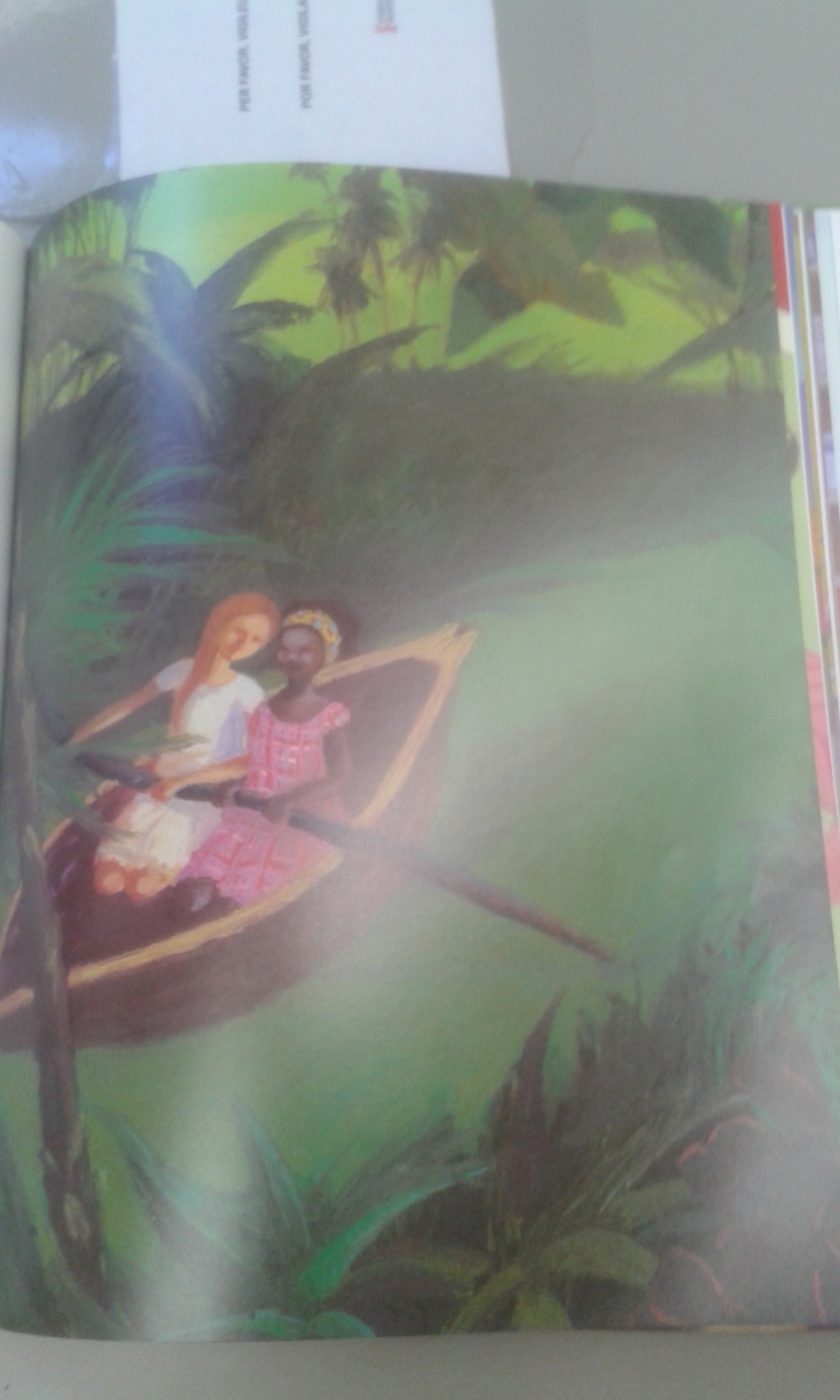
Los muy bobos la llamaban “Cacao”, porque había nacido en una mazorca de cacao, muy lejos de allí. Su piel era tan blanca como una nube generosa y los demás niños se burlaban de ella: “¡Cacao, Cacao!”. Esos mismos abusones bautizaron a su mejor y única amiga con el nombre de “Nieves” porque había nacido lejos, en el vientre frío de una muñeca de nieve; ella, que tenía la piel oscura como una sombra en pleno verano. Un día vino a la escuela un anciano para contar la guerra de colores en que le habían obligado a participar en los bárbaros años de su juventud. Algunos niños lloraron. Las dos niñitas sonrieron: el color de su piel era la menor de sus preocupaciones. Incluso se habían inventado un nombre secreto: Vainilla. ¿Quién sabe de verdad cuál es el color de la vainilla? ¿El del helado o el de la vaina que la contiene?


20190313_174723

viernes, 8 de enero de 2016

NOSE OF TURK AND TATAR'S LIPS...

Disclaimer:

No Jews, Tatars, Turks, stillborn infants, other humans, or any other animals (quadrupedal or otherwise) or plants (non-ligneous or otherwise) were harmed in the making of this post.
Thank you for your comprehension.
PS. The quotes from Macbeth were adapted into modern language orthographically (ex. Tartar -> Tatar) and semantically (ex. drab -> whore) by the author of this blog for better understanding the play. Thank you for your comprehension.

Macbeth, Act Four, Scene I (the infamous witches' stew)

Third Witch (to the tune of the Thénardiers' song):
Nose of Muslim Turk, liver of a Jew,
filling up the cauldron with this and that, too...
Tatar's lips are more than welcome,
flavour is intensified,
reasonable charges, plus some little extras on the side...
Oh, Macbeth!

Well, the real play does not have the Thénardiers' song, though its mention of a liver in a modified "liver of a/n X" phrase made the filk come up pretty smoothly... (Someday I will do the whole song, with all three witches as M. Thénardier and Macbeth as Mme. Thénardier!)
What really drew my attention was the fact that the human ingredients in the stew included significant parts of non-Europeans (for being non-Europeans, non-Christians --though the Tatar is Orthodox!--, etcetera):

Third Witch: [···]
Liver of blaspheming Jew, [···]
Nose of Turk, and Tatar's lips, [···]

See what the freak I mean? They don't take these organs from Europeans, but from non-European foreigners. Racist and chauvinist brew, isn't it?

The third witch initially adds parts of animals which are a little weirder than the second witch's (scale of dragon!) but then adds in human body parts all of which have an anti-Christian theme: the Jew, the Turk, and the Tatar are all non-Christians. Or maybe NOT. The Tatar is Orthodox.

Three of these parts come from explicitly non-Christians and an Orthodox (the Jew and presumably two Muslims or a Muslim Turk and an Orthodox Tatar), which perhaps carry more magic than the presumably “saved” Catholic Christian recently dead.

The liver of blaspheming Jew endorses the common anti-Semitic beliefs of that era, alongside the racial prejudices held against the Turk and Tartar (sic).
(A country audience, however, may have interpreted Macbeth’s cauldron quite differently from the royal courtiers. Many of these exotic ingredients are actually poetic variants on the common names for herbs.
Liver of Jew = Jew’s myrtle or box holly; Nose of Turk = Turk’s cap; Tartar’s (sic) lips = ginseng or tartar root [···]
Why did Shakespeare choose these fierce-sounding ingredients?  Joyce Froome (Wicked Enchantments) argues that, for the wise women of Pendle, these herbs would be part of their everyday folk magic.  Catt Foy (Witches & Pagans) suggests that maybe “Shakespeare knew a little more about herbcraft than he was letting on,” and Nigel Beale (Literary Tourists Blog) believes he chose names “designed to gross out the masses, to stop them from practicing magic.”)

Beyond that, parts of human bodies were mixed in the compound as well, some of them regarding religious prejudices against Jews, Muslims, and barbarians. 

Liver of blaspheming Jew, 
Religious prejudices against Jews came from the Church widespread belief that they were responsible for the murder of Christ. Furthermore, they were considered blasphemous for they denied that Jesus was the Messiah.
Nose of Turk, and Tartar’s (sic) lips, 
Muslims and barbarians were, like Jews, subject to religious prejudices. The Tatar is Orthodox, Christian yet exotic.

Plus there are two more human ingredients, which are more international (though still two against the three "racist" ones) in this ominous recipe: one is mummy, as in preserved corpse (there can be found some in the fens and marshes of the British Isles among other European wetlands, and in the New World, but the Egyptian ones are the most renowned), and another one is as macabre as it is international (it references a practice common to all continents except Antarctica, where the only resident mammals are seals and would by no means dedicate themselves to that):

Finger of birth-strangled baby,
ditch-delivered by a whore.
Makes the gruel thick, for sure.

So, this refers any of the ten (or maybe eleven or twelve, in case of mutation) hand appendages (the Hungarian translation specifies a pinky!) of a stillborn infant, strangled with the umbilical cord as it was born in a roadside ditch unto a prostitute mother. A literal son or daughter of a bitch. I could have also written these verses as:

Finger of child of a bitch,
strangled at birth in a ditch:
thickens the brew of the witch.

(Pardon me, Shakespeare) But I prefer my first version because it has the more extreme "whore", not those obvious and painful rhymes, and is more faithful to the Bard's original (lexically modernized, then adapting the rhyme).
"The plot thickens... is that a soup metaphor?" Like Gustave and Zero, we could say that. A stillborn lovechild is extremely unfortunate, being unbaptized and illegitimate. So yes, this baby coud be born in any continent except Antarctica (seals have flippers and do not practice the world's oldest profession). But still grouped in with the Jew, Turk, and Tatar in the same cauldron of outcasts.

[···] thus making the baby damned like the unbaptized Turk, Tatar, and Jew. 


In the cauldron scene of Macbeth, the three weird sisters throw the “liver” of a “blaspheming Jew” into their potion (4.1.26). As one of a series of disembodied parts the Jew’s liver may not at first seem all that remarkable, but given these beliefs about the odour of otherness, the witches’ ingredients take on new significance.
Yet the Third Witch’s additions to the brew focus on human parts that invoke the specific foulness of miscegenation, menstruation, and aborted reproduction.
The cultural and racial others “Jew,” “Turk,” and “Tatar” balance uncomfortably on the border of human and animal. Smell again marries them together in a monstrous hybrid. Where all these men are unchristened, like the “birth-strangled babe,” the Jew is likely mentioned “because of the Jews’ reputation, in anti-Semitic tradition, for obscene rites” with the blood of “Christian children” (Biggins 271). The organs of prominence, both “nose” and “liver,” revisit not only male menstruation but sexual passion.


A recipe for the brew by Shakespeare enthusiasts puts it this way:

  • 1 liver of a blaspheming Jew – minced
  • Thanks Janet, you realize this makes us look antisemitic, right? 
  • 1 nose of a Turkish man or woman
  • 1 pair of lips of a Tatar
    • Fun fact: there are around 6 million Tatars living in and around the Volga Region!
  • 1 finger from a baby strangled at or just after birth and left in a ditch by a whore
    • Yeah, this one’s dark. Let’s blame Janet again for the last three ingredients. 


Oh, that is so dark, right? Like Gilbert and Sullivan's patter songs (Modern Major General, Heavy Dragoon, I've Got a Little List...) have been updated through the ages with new references and more political correctness, surely there is a bowdlerized PC version of this stew somewhere. One without any offensive ingredients in its recipe.

Besides... if the liver of a Jew is drained of blood... is it kosher? :o


miércoles, 14 de enero de 2015

MISS DERMARK'S STYLE GUIDE

THE FOLLOWING IS NOT INTENDED TO BE MEANT AS A CRITIQUE OR SATIRE OF POLITICAL CORRECTNESS.

RATHER, IT IS INTENDED AS AN HONEST, NON-OFFENSIVE STYLE GUIDE I USE FOR MY OWN WRITINGS AND ENCOURAGE YOU READERS TO OBSERVE AS WELL.

THIS GUIDE CONCERNS THE PRONUNCIATION OF CERTAIN WORDS AS WELL AS THE STRATEGIES THAT SHOULD BE USED TO AVOID THE DISCRIMINATORY USES OF STANDARD ENGLISH MOST COMMON IN AN EVERYDAY CONTEXT.

ONLY TWO SIMPLE RULES ARE OBSERVED IN THIS GUIDE:
  • TO CALL A SPADE A SPADE.
    This is a spade.

  • NEVER TO BE OFFENSIVE IN ANY WAY.


PRONUNCIATION
Certain words with double pronunciation should be pronounced in the least offensive way possible, for instance:

  • "Lieutenant" should always be pronounced /lefténant/.
  • "Uranus" should always be pronounced /ooráhnus/.


AGAINST RACISM

  • Avoid at every cost the use of the ethnic terms "black", "nigger", "white", "red", "Injun" (and variations thereof), "yellow", and "chink" (and variations thereof), et cetera. And the word "race" itself in terms of human descent.
  • The appropriate term should be "ethnic descent" or "ethnic group". To name ethnic groups in particular, use "Sub-Saharan", "Caucasian", "East Asian", "Native American" or "First Nations", "Middle Eastern"... "Sun person" in general, for dark-skinned ethnic groups, is also acceptable.


AGAINST SEXISM

  • Say "humankind" to count in both or all of the genders/sexes.
  • Avoid at every cost the use of profession names ending with the suffix "-man" (or "-woman" if it also exists). Say "firefighter", "police officer", "lollipop person/officer", "military person/officer", "noble", "Chairperson" or plain "Chair"...
  • Do not perpetuate or promote traditional gender roles.
  • Make use of the newfangled generic pronoun "s/he" (pronounced "sh-he"), of the genderless number-pronoun "one", and of the plural "them/they": "All good things come to those who wait".


AGAINST SPECIESISM

  • Avoid at every cost the use of the word "animals" to refer solely to mammals and/or reptiles, lowing out aquatic and aeroterrestrial fauna. This use is both ambiguous and discriminatory.
  • Avoid at every cost the use of the word "plants" to refer solely to herbaceous flora, lowing out shrubs, trees, ferns, and mosses. This use is both ambiguous and discriminatory.


AGAINST HETEROSEXISM

  • Do not perpetuate or promote prejudice against free love and/or alternate lifestyles.
  • Avoid at every cost the discrimination of LGBTQ people and offensive insults like "fag", "dyke", or "wanker". Queer people have the right not to be offended.

AGAINST ABLEISM

  • Avoid at every cost the use of old-fashioned terms for impairments. Use the terms containing the word "challenged" more common nowadays: "cerebrally/emotionally/socially/physically/visually/aurally/speech challenged".
  • "Differently abled" is also a term that should be used in these cases.
  • For certain kinds of physique, there are also equivalent "challenged" and "gifted" terms: "vertically challenged/gifted", and "horizontally challenged/gifted". 
  • The addiction to certain chemicals shall be always referred to as "substance abuse" or "chemically challenged".


OTHER
  • Our opposable thumbs are also fingers.
  • The Sun is actually a star.
  • The Earth's Moon is actually a natural satellite, or moon with a lower-case "m".
IF YOU WISH TO EXPRESS YOURSELF IN A WAY THAT CONTRADICTS THE EXAMPLES ABOVE, SHUT. UP.

lunes, 31 de marzo de 2014

ON MY WESTEROS FIC: STRUWWELPETER

The footprints of Struwwelpeter

Half a year after discovering Westeros, l found an attention-grabbing little booklet in a foreign-language bookshop in Bergen, Norway. The Germanophone storybook had the striking title (translated) Struwwelpeter, or Funny Stories and Droll Pictures. It had been first penned by one Dr. Heinrich Hoffmann (physician, author, and illustrator) in the nineteenth century.
The cover is striking. There’s STRUWWELPETER written in bold red letters, and below, a picture of a boy in red, with a tangle of blond locks that looks like a hybrid of afro and lion’s mane, and ostensibly Wolverine claws on his fingers (In short, like Joffrey Baratheon-Lannister wearing scissor hands, after having dried his hair in a tumble dryer). Pretty shocking.
Struwwelpeter, the lion-boy, is standing on a pedestal with the following verses (my translation from the German, as those of all the other Struwwelpeter verses featured):
See, here stands this creature.
Eww! It’s Struwwelpeter.
On both of his hands,
his nails, as he stands,
haven’t been cut for a year.
Neither has he combed his hair.
Eww! What a creature!
Awful Struwwelpeter!


So this boy hasn’t had his nails cut or his hair dressed for a year. A warning against the neglect of personal hygiene. Fittingly enough for a book of Victorian cautionary tales. Wicked Frederick, the animal bully, is infected with rabies. Pauline, who plays with a lighter “like Mum has done so often before”, though her mother has forbidden it, catches fire and is reduced to ashes. The Wild Huntsman is attacked by a bunny, who has stolen his gun (another animal rights story, but this one with an adult). The bullet does not hit his body, but it causes him to fall into a well and drown, as the bullet shatters the Huntswife’s cup of afternoon coffee (she’s been widowed, but she seems to care more about her java!).
“The Story of the Black Lads” is a parable against racism:


There came a-walking through a park
a Moor whose skin was raven dark.
The sun shone hot on our Othello,
so up went his nice green umbrella.


Ludwig came, with the speed of light,
waving Prussia’s flag at the sight.
Kaspar came to the spot as well,
carrying a pretzel, you can tell.
And Willi did they not outsing:
he brought with him his stick and ring.
And all three laughed at line of sight,
“because his skin is black as night!”


Then came the Mighty Nicholas
with his great inkstand. Lord! Alas!
“You children won’t listen to me!
Why not calm down and leave him be?
Such racist jokes are all unfair!
It’s not his fault his skin’s not fair!”
But they laughed louder than before
at the poor raven pitch black Moor.


Then Great Nick turned wicked with rage,
just see the picture on this page!
He caught the fair-haired children three,
their coats, their arms, they were not free.
Kaspar fought back, cried “Open fire!”,
but Nick dismissed him as a liar.
Into his inkstand (Lord! Alas!)
dunked them the Mighty Nicholas.


Look at them now! What a sore sight!
All three are really “black as night”.
Had they shown tolerance and care,
I bet their skin would have stayed fair.


“The Story of Konrad the Thumbsucker” is one of the most striking. The young hero doesn’t die, neither is he left unpunished. Though the retaliation is rather disproportionate considering the offense behind it:


Mrs. Mum said: “Konrad, son,
right now shopping I’ll be gone.
You’re a big boy. Thus, no quips,
and keep your thumbs from your lips!
Or the Schneider will arrive
before you can count to five,
cut your thumbs off with scissors hard,
as if they were made of card”.


As soon as Mum was out of sight,
he tucked in his right thumb aright.


Thud! Someone opens the door,
and then, without warning before,
the Schneider springs (this looks so bad!)
towards Konrad, the sucker lad.
Scissors flash at lightning speed,
blood flows on the floor indeed,
With sharp scissors! Cold, hard steel!
And such a pain Konrad does feel!


When Mum has come home again,
her child bleeds like a fountain pen.
Without thumbs, frozen, there he stands:
both have been severed from his hands.


In “The Story of Soupy Kaspar” (the first Struwwelpeter story I ever read in my life, translated into Swedish, in an anthology storybook), the titular character refuses to eat for five days, with devastating consequences:


On the fourth day (poor little thing!)
Kaspar was slender as a string.
He weighed like one sole crumb of bread…
and, on the fifth day, he was dead.


The success of Struwwelpeter generated more than a clone in Germany and abroad. In the UK, Hilaire Belloc wrote more than one cautionary tale in verse, considering especially the following ones:
In the Victorian Era, the cautionary tale emerged as a genre to teach children the difference between right and wrong, usually in a gruesome way: such stories featured naughty children whose faux pas were punished with either death, disability, or ostracism.


The most renowned Anglophone author of such cautionary tales about middle-class and upper-class children hoist by their own petards is the nowadays hardly known Hilaire Belloc.
His most horrible stories for misbehaving children include:


  1. The story of Jim, who ran away from his nanny at the zoo and was eaten alive by a lion.
Self-explanatory. This one teaches that well-behaved children never leave their governesses in a crowd: even worse things than Jim's fate may happen to those who run away from their nannies.
  1. The story of Matilda, the girl who cried fire. This one is a modern update of an age-old fable. The risk of fire makes up for the lack of wild wolves in Victorian London, where our orphaned anti-heroine lives with her aunt. Matilda can't find any better pastime than calling the Fire Brigade every night her aunt goes to the theatre. Of course, she perishes in a real fire.
  2. The story of Rebecca Offendort, who slammed doors for fun and perished miserably.  Poor Becky died an untimely death when one of her door slams knocked a marble bust from a nearby shelf. The sculpture fell, in less than a second, on the little girl's head.


As you can see, the stories deal with either physical or social death as punishment for rebel protagonists. In The Naughty Sack (Der Mummelsack), Envious Klärchen (“Neid-Klärchen”) wants a green gown like Lieschen’s birthday present. She develops a sickly obsession with the dress of her dreams, gradually turning literally green with envy!
Traditionally, all of these cautionary tales start with the title “The Story of... (character’s name and/or flaw)”, ever since Struwwelpeter itself (“Die Geschichte von…”). The stories typically follow a specific formula:
  1. The titular character and his/her flaws are introduced.
  2. The character is punished by either an accident due to his/her flaw (most examples given here), or an adult authority figure (sometimes a magical being, like the Schneider or the Mighty Nicholas).
  3. The titular character dies, or is branded an outcast.


In fact, the stories in “Alice of Human Sacrifice” can be read as cautionary tales. This interpretation is the one played with, for irony, in “Alice of Westeros Sacrifice”. The leading characters are treated as victims of their own flaws, with their opponents and/or allies (Loras in I, Stannis in II, Cersei in III, Drogo in IV) taking on the role of punishing authority figures. To show that the cautionary tales’ morals are ironic, the stories are told in prose. Otherwise we might get something in this fashion:


The Story of Renly Baratheon, who Made the Wrong Kind of Love


A young lad soft as a ripe peach
came from the Stormlands to the Reach.
If not for darker hair to tell,
you’d swear Renly was a Tyrell.


Years later, he’s stubbled, well fed,
to Margaery Tyrell just wed,
but the one who does his heart flaw
is one of his brothers-in-law!


With Loras he’d rather caress.
To the Tyrells, that’s no distress.
They’ve come to love him as their own,
and even offered him a throne.


Yet he’d seek Loras and entwine
their limbs in an arbor of vine.
Now, riding comes a lady fair,
and asks “Is young King Renly there?”


The tidings leave no one unharmed,
there’s a reason to be alarmed.
For Stannis has left Dragonstone,
and seized the Stormlands as his own.


“The flames of war are fanned awake,
the Seven Gods burned at the stake,
the godswood too… Come, Renly, lead,
for those strange zealots to recede!”


They leave the Reach, those gallant ranks,
with rainbow cloaks, each breastplate clanks.
Soon, they encamp before Storm’s End:
“I was born here, Loras, good friend!”


“You were born here, and so is the foe.
He’s older than you, as you know.”
“Sure jealous, as older brothers are.
Not a chance he stands, he won’t go far.”


The campfire’s lit, the flagon’s passed,
Renly and Loras lie, caressed.
Within Storm’s End, by faint moonlight,
Stannis Baratheon views this sight.


“There you are, loving a gentleman!
Now you’re as sinful as you can!
This ain’t forgiven, little bro!
Your sweet, short life will end in woe!”


Renly Baratheon, young Tyrell,
stand kissing before the farewell:
cold steel is thrust in Renly’s back,
and everything for him turns black.


The blade’s tip rises from his chest,
he falls, now everyone’s impressed.
To Storm’s End the slayer returns:
no one in camp his features learns.


The next day, on the battlefield,
Loras’s ranks to Stannis yield.
Soon young Tyrell is on his own:
his sweetheart’s lost life, love, and throne.


And to the Reach Loras has fled,
with lifeless form of Renly dead.
Golden rose trees watch now with grace
his last eternal resting place.


Every twilight, and every morn,
the Tyrells gather there to mourn.
Had Renly loved his darling wife,
he would have lived a longer life.


But the story is an ironic subversion, a critique of homophobia on religious grounds, as well as a eulogy for the late Renly Baratheon. Thus, it isn’t written in verse, and it employs a different style.