#OthElokuu
DESDEMONA'S STORY - by ninjapoptart
(maybe this will be part of some #Rethello saga in which there are only retellings of this tragedy!)
******************************************
About
My name is Sam and I am a senior at Empire High School. This will be for my Senior Composition class, for which I will be posting about Othello and A Streetcar Named Desire.
In the play Othello, I will be assuming the role of Desdemona, Othello’s wife. Based on background information about the play and its characters, I expect that Othello will be dealing with a lot of inner turmoil with his jealousy and mistrust of Desdemona, fueled by Iago. In turn, his relationship with Desdemona and others will probably begin to deteriorate and being a tragedy, this will, of course, lead to an unhappy ending. As for Desdemona specifically, after reading a bit of background about her character, I am very interested in seeing how her character progresses. For this time period, she is very eccentric in that she wishes to follow her husband wherever he may go when fighting battles and because she chose a Moor for her husband at all. Her character first interested me because of how Shakespeare uses her to create a new image of women in society.
FIRST THINGS FIRST
Posted on 1st of April, 2011 by ninjapoptart
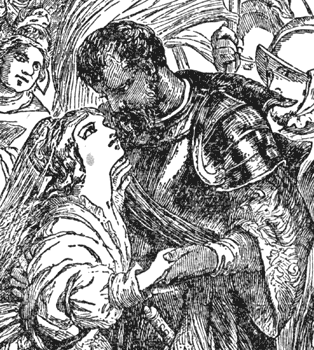
For the play Othello, I have decided to analyze the character Desdemona, Othello’s wife. The quote in the header is from Desdemona in Act I, Scene I and I will update it with a new quote from every scene that she is in. My expectations can be found in the About section, I mostly wanted to post something so that annoying “Not Found” post would go away.
HE TOOK ME AWAY FROM HERE
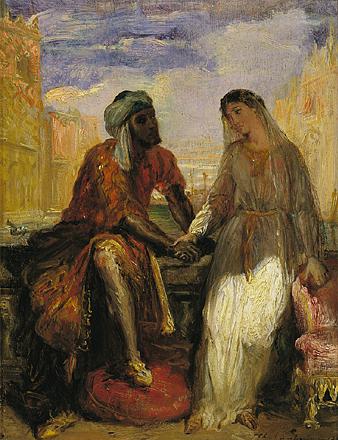
He captured my heart, my dark soldier, Othello, as surely as he has been captured whilst away at war. I knew, from the moment my lord father invited him across the threshold of our home, that this man was like no other. He had about him an aura of authority, of respect, and of otherworldliness. He spoke about traveling to foreign lands and countries as casually as I would speak of taking a walk down the street. I found him mesmerizing.
I “question’d [him] the story of [his] life, from year to year, the battles, sieges, fortunes, that [he has] passed.” His sieges and fortunes were endless, his conquests of lands far and near, endless. I was shocked to hear of how he tempted death so easily, and yet always remained unscathed. Of his past slavery, I hardly took notice. To me, his skin was a thing of curiosity, not abhorrence. It was, instead, testament to how very much this man has lived through, to experiences few others can ever boast of.
I was especially fond his tales of the distant creatures; among my favorites, the headless cannibals that prey upon fellow men as surely as I would dine upon roast lamb for supper. He was cautious with his tales with my presence in the room; yet my father bade him to continue hence, assuring him that should my sensibilities ever be offended, I would quietly remove myself and leave them to peace. To my dear father’s dismay, I was affected quite contrary to his predictions. I was fascinated by Othello’s tales, of the adventure he brought into my life by simple word of mouth. With a greedy ear did I devour his stories with gusto, immersing myself in the life of the Moor, whom I began to hold dear as though I had known him all my life.
His life exploits were so grand as to be nearly fictitious with wonder. If only “Heaven had made [me] such a man,” that I, too, would lead such adventures as his. The dangers of war would make every breath, every sip of brandy and wine and water that much sweeter with there ever-constant perils that threatened them. Would that I had such significance in my life.
Before him, I knew only my life here in Venice. I knew only my household, the circle of high-born peers my parents thought fit to associate me with, and the duties that would befall me as a daughter. Marriage and bringing up children were all that my future held for me, by my lord father’s decree, of course. Though I know he means only the best for me, his desires for the future are not my own. I knew, also, that he would be terribly disappointed were he to ever learn of the small ember of affection that I harbored for Othello, that I found to grow with every visit to our home, with every story that nurtured forbidden thoughts and a yearning for a life outside of Venice and marriage. I shudder to think of how he would react were he ever to discover that I found myself to be falling quite in love with the soldier Othello.
And what is this? A summons from my dear father? At this hour, ’twill be for nothing good, of that I am sure. Honest Iago, he hath sent for me, on a matter concerning my Othello. For my lord father questions the verity of our love, believes me bespelled by the Moor through witchcraft or deceit. So swift was his awareness of our union that I do ask the question: how hast my father come to this knowledge tonight?
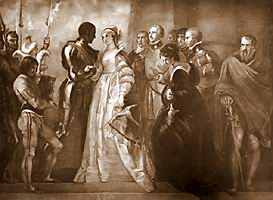
Nevermind; there are matters more important at the moment. O, what is this? An audience my lord father has made of us before the senators and Duke of Venice himself! What foul play of fate would have me choose between my duty to my lord father and my loyalty to my lawfully wedded husband?
And with a simple admission of my true feelings, I have forever damned myself in my dear father’s eyes with my confession:
“I am hitherto your daughter: but here’s my husband,
And so much duty as my mother show’d
To you, preferring you before her father,
So much I challenge that I may profess
Due to the Moor my lord.”
And so much duty as my mother show’d
To you, preferring you before her father,
So much I challenge that I may profess
Due to the Moor my lord.”
Such pain that flooded my dear father’s eyes! He did not believe I would be at odds with him for the Moor. But my heart is set and so we made plans to embark to Cyprus together, Othello and I. For I would follow him to war than to be left alone in peace. And in his ensign’s care did I leave this hall tonight, cut deeply by the words my dear father did impart, of my so-called treachery.
But my heart was warm’d by the assured reply of trust that to Othello’s lips did swiftly fly. Upon his life, did he invest my faith. And for that, I love’d him evermore.
WHERE HE TREADS, I SHALL FOLLOW
Posted on 13th of April, 2011 by ninjapoptart

Ah, what happiness that hath taken root in my heart! Despite my anxiety at being upon such a tempest as that which batters our ship, I can think only of when I may see my Othello again. And here! There lies the great Cyprus, my lord’s new charge. In Iago’s care, have I long awaited our arrival that I may set foot upon land and lips upon my lord’s.
O, how the good Cassio jests! He of such light-hearted spirit knows always how to lift mine own, which is downtrodden with worry for Othello. Might I even say, how bold he is with Emilia, and in front of her own husband? Bah, surely ’tis nothing more than his amicable charm, which extends to all who he meets.
The same could be said for the good Iago, who hath such a clever tongue, one might think him a politician! How good it is to know that men of such integrity serve my lord, that he may be all the better for it.
Hark! Could that trumpet belong to none other than my Othello? I think I should die of happiness to be once more with my love.
❦❦❦
What is this clamor that awakens us thus so? I was astonished to hear of the attendant’s breathless summons for my lord, Othello, to come quick; that the good Cassio had struck down Montano was nearly fantastical in its improbability. I know Cassio as I do a brother and the thought of him in the midst of such a brawl was enough for both my husband and I to quickly spring forth from the honeymoon of our bed to settle the matter at once.
Never hath I seen such a wrath as Othello’s as he bellowed a demands for the telling of what transpired during the watch. There lay Montano, struck so that he soon lost consciousness, as well as Cassio, around whom hovered the unmistakeable air of one deep in his cups. It hurt to hear the truth of the matter spill forth from honest Iago’s lips upon mine ears. I could see the pain of such a realization in my lord’s eyes, heard the fury with which he dismissed his lieutenant and friend.
What an unexpected course of events this night hath bring us. Very soon, my Othello and I returned to bed, but I could not forget the anguish in Michael Cassio’s eyes.
❦❦❦
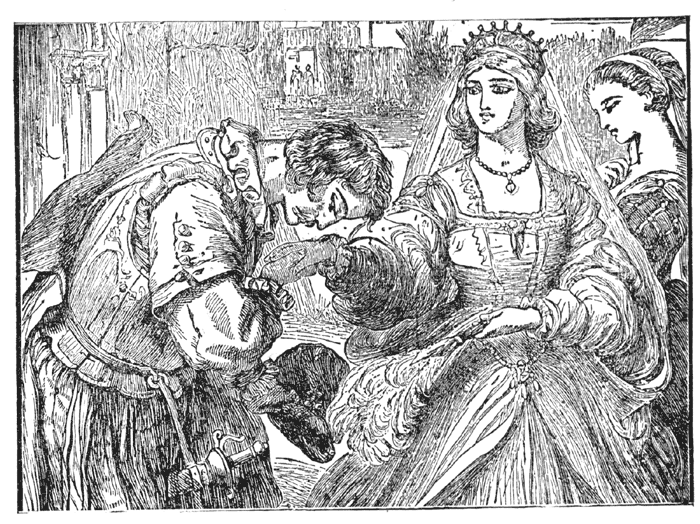
O, the grief with which good Cassio beseeched me to speak on his behalf to my lord, Othello. In the presence of my maid, Emilia, as is only proper, he confessed his grief and love for Othello. He was much distraught, no longer having the love of the valiant general, that I could not turn him away without assuaging his misery. To my assurances, he most gratefully replied:
“Bounteous madam, Whatever shall become of Michael Cassio,
He’s never any thing but your true servant.”
He’s never any thing but your true servant.”
The gratitude that he bestowed unto me was true testament to how dear he held my lord to him. I want nothing more on this earth than to make things right between the two again, and as I promised dear Cassio, I will not cease my efforts until they are cordial in all matters.
But I fear Cassio is still much abashed for his behavior, for as my lord approached, he fled most quickly for shame. I implored him to stay, to hear my case, but he thought it best if he removed his presence so as not to test Othello’s patience further. This, I understood, and bade him farewell as my lord and Iago came upon us.
With as much persuasion as I could muster, I entreated my lord only to call Cassio back, to make amends with one who so trusts and admires him. Though Othello tried cleverly to push the matter aside, I persisted, knowing that he would be much happier with his lieutenant back in his rightful place. ‘Twould be best, I knew, if it were sooner rather than later and so I asked and asked again for as soon as his time allowed him to see Cassio. O, how I hope that amends will be made soon!
A POISONED HEART
Posted on 18th of April, 2011 by ninjapoptart
Note: this is a continuation of the previous post, I just didn’t want it all clumped together.

I was much pleased with Othello’s acquiescence to speak with Cassio but my joy was soon usurped by concern, for my lord, upon my return before dinner, looked much ill. His pain is mine own and I took my handkerchief, the very one he bestowed upon me with love, to wipe upon his brow. My lord looked very unwell but even my administrations could not ease him.
But, oh! What hath become of that handkerchief? I held it dearer than any other thing that I possess and am very sore to have it misplaced. Though I hold my Moor true in heart and mind, his suspicions on my lack of the handkerchief put mine own heart ill at ease. To think I could love any other than my Moor!
But every man’s heart is capable of falling victim to envy, and the thought that my love is under scrutiny is near more than I could bear.
And here, my lord enters! Even with these rough waters between us, does my heart soar at his sight. But what a manner he has this evening! I sense a tension beneath his words, a steel blade clothed in silk.
Instead, I focused upon my newfound crusade and again implored him to see Michael Cassio. Instead, a most curious thing, did he make a crusade of locating my handkerchief! After he had chastise’d me, I near believed it spun of gold and made by the holiest of saints! My guilt near overcame me!
And all the time I tried to redirect his attention to dear Cassio, he would only shout for that curse’d handkerchief! O, what hast overtaken my Moor? Didst I not foresee this jealous rage that overtake’d my husband for the misplacement of that handkerchief? O, misery!
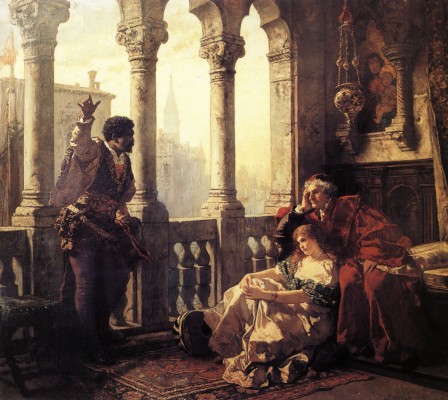
My heart has been torn asunder at this rage of some unknown cause. For him to strike me! He hath made his displeasure known to all and yet none but he knows from whence it came!
He hath said terrible things to me, things no husband should ever accuse their ever-honest wife of! A strumpet? Nay, upon my life and soul in Heaven! Such an outlandish accusation that hast flown from his mouth! What poison has found its way into the heart of my beloved husband? Would that I had never loved at all!
He hath bade me to bed, and upon it I have laid sheets of white purity. In my distress, the good woman Emilia hath tried to comfort me, imparting upon me this wisdom:
O, as much as my heart doth swell with love for Othello, it does sink with despair, for I believe these words are much truthful.
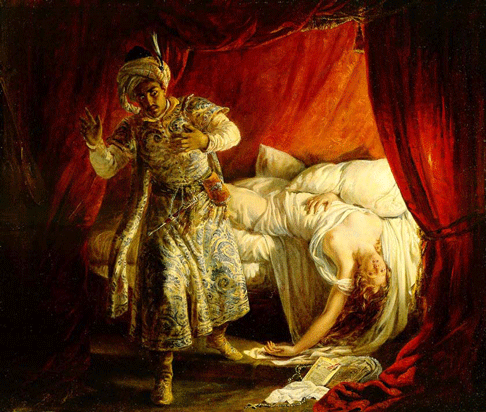
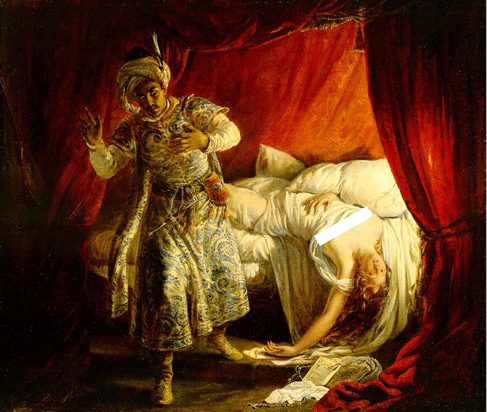
And here! My husband’s breath in mine ear, whispering me to wake. There is such a gleam in his eye that I believe he means to murder me. Yes, did those words he imparted upon me strike such fear. If I were to have but one more wish upon this earth, it would be the answer to this: What hath invoked such rage from my beloved Othello?
REVENGE IS SWEET, AKA MOST OF THESE CHARACTERS ARE TOOLS
Posted on April 25, 2011 by ninjapoptart
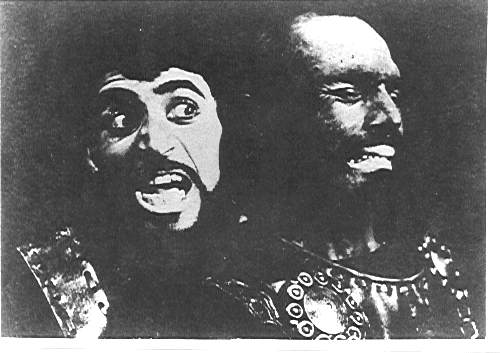
How well this clever ploy of mine is turning out to be! Roderigo has proven to be a most invaluable instrument in the Moor’s demise. Such a malleable fool, blinded by his affection for the fair Desdemona. Ah, but how men are undone by the glance of a beautiful woman. Roderigo shall kill Cassio and Othello will praise me for the deed even as he destroys himself; ’tis perfection!
And here my scheme shall be set in motion yet again; here comes that fool, Roderigo! I directed his rapier towards that swine, Cassio and here I step into the shadows, to watch my plot unfold in bloody clarity. O, how I loathe the way Roderigo’s hand shakes! The fool will surely just as soon stab himself than Cassio.
And here he enters! I hath riled Roderigo into a righteous fury; surely he will dispose of Cassio quickly? Damnation, but my hopes are dashed. Roderigo, the incompetent halfwit, missed his mark and Cassio so easily down’d him! It seems I am needed thus more; here, I have wounded him!
While Cassio cries for assistance, I shall put some distance between us so that I may be free from any suspicion. Who is’t this, that comes to answer Cassio’s cries? Lords Lodovico and Gratiano! How easily this plot shall fall into place.
I presented myself in a matter that beseech’d utmost innocence, of course. I brought myslf to Cassio’s aid and upon therewhich, spied the foolhardy Roderigo but paces away, still drawing breath with which could give me away. To bring conviction to my act, and with a cry of, “O murderous slave! O villain!”, I gave a thrust of my sword and brought an end to the ultimate tool that was Roderigo.
When light was finally brought to illuminate this scene that I have so skillfully orchestrated, I gave a much grieved cry for the reveal’d villainy of Roderigo. O, how easy it is to play the innocent victim of circumstance when they are so blinded to my true intentions. For “this is the night that either makes me or fordoes me quite.”
❦❦❦
And now I enter a scene most gratifying to my soul. Hark, the Moor hast slain his love, Desdemona! Triumph is so swift, so sweet.
But here, this wife of mine, Emilia, prattles on so! She brings to light details of this plot that I would rather leave to oblivion. How she can persist! Would that she held her sharp tongue, as her role as wife ought dictate. I was made to confess, I had let my suspicions fall upon Othello’s wanting ears, but nothing more! For truly, the evil stemmed purely from his own heart. Play me the villain, Emilia, dear, but if Othello had been true in his love for Desdemona, none of these tragic events need have happened.
I tried, as much as I am able, to bid her leave but once the woman hast set her mind unto a thing, pray tell she will not let go! In embarassment, I offer, in a humourous inflection, to silence her with steel. This did not bode well for the others’ opinion of me but it was of little concern of mine. All at once, Emilia let loose from her lips the bit of truth that unraveled my plan in entirety as it would a loose trapesty. O, fie upon this treacherous woman that I didst take for a wife!
Now all know that this was my doing, undone, am I, from that damned handkerchief she revealed I had planted upon Cassio. I saw the fury in the Moor’s grief-dulled eyes as he lunged for me. I dodged his blow, landing one, instead, upon the woman I had once call’d my wife, she who proved the undoing of my stealth.
She fell, though her fate, I knew not. I made haste in my retreat, springing from the chamberas a hare would when the hunting hounds are released unto it. But those devils Lodovico and Montano are swift! They bound me to a chair and once more, I am in that ill-fated chamber. Fie upon their wretched souls!
And here, the Moor describes me a devil! O, bah! ‘Tis he that let the envious poison cloud this eyes. He drew his blade across me, not to kill, but to wound. A devil he wishes to prove me, for he cannot kill me. How poetic this man hath the nerve to paint me! But satisfaction belong’d to me, for the betrayal Othello hath laid on Cassio, whom he did entice me to kill.
He turn’d his accusing eyes to me, upon which time I declared my silence. What have I to explain to this Moor, who hath reaped only what he hath sown?
And upon Othello’s final thrust of blade with which he took his own life, my tale of everlasting revenge is complete.