Mostrando entradas con la etiqueta summary. Mostrar todas las entradas

lunes, 18 de septiembre de 2023

TSQ-IV: CTHTHONIA PODCAST SUMMARY

 This is a disappointing retelling/summary from the Chthonia podcast by Brigid Burke.

BRIGID BURKE: So, I'm gonna read the synopsis and I'm gonna read all the... sections. Then I'm gonna go back right through the fairy tale and I wanna give you kind of an explication of what's going on, what are we seeing, what is the symbolism here... what's it telling us.

As it was pointed here, it's a tale told within seven stories. There's sort of seven self-contained stories within the main story. And the seven sections are: ... The Prince and the Princess, the Little Robber Girl, ... and What Happened ... Afterwards. So those are the sections of this particular tale.

... is at the princess's Palace. ... to the palace and meets the princess and her Prince, who .... they provide ... with warm clothes and a beautiful coach.

While travelling in the coach ... is captured by robbers and brought to their Castle, ...

(No mention of the Prince and Princess on honeymoon in foreign countries!)

martes, 21 de marzo de 2023

ABITFRANK: THE SNOW QUEEN FOURTH STORY

 This is an excerpt from a YouTube video titled "How Frozen Could Have Been Drastically Different" in which fairytale YouTuber Abitfrank sums up the Hans Christian Andersen story of the Snow Queen. In this post, as usual, we focus on my favourite subplot, the Fourth Story featuring the Prince and the Princess, for intelligent conversation is a relationship goal for me!


The princess in a realm close by has married someone like Gerda described, right down to his new squeaky boots!


This princess would only marry someone who was handsome and could have an intelligent conversation with her, and hundreds were turned away, except for this one boy who won her heart!


The crow has an "in" to the palace - his tame sweetheart, who is also a crow and who gets a key for Gerda to enter the decadent royal bedchambers by way of a back door of the castle.


Once there, Gerda sees that the Prince is not her Kai, but tells her whole story to the Prince and Princess, who want to help her. They provide her with fancy warm clothing, AND a golden carriage outfitted with a full contingent of staff, as well as candy, fruit, and cookies.


The crows, whom the royal couple scolded and then thanked, are now married and are allowed to eat the kitchen's leftovers.
One has a food hangover, but the original friendly crow accompanies Gerda for the first three miles of her journey in the golden carriage.


But because a fancy shiny golden carriage is a pretty conspicuous means of travel through a forest, she is soon waylaid by bandits, who kill all of her men and steal the horses.
They are about to kill her too, when a little spoiled bandit girl stops them.


...


Gerda asks after the prince and princess, who have apparently gone off to other countries.


martes, 10 de diciembre de 2019

Salmacis and Hermaphroditus (From the podcast Literature and History)

To many generations of readers, authors, and artists, the Metamorphoses served and still serve as a card catalog for classical literature, encompassing a thousand years of Ancient Mediterranean stories in a single volume, stories which moved loosely from the moment of creation up to Ovid’s contemporary world of the Pax Augusta.

The twelve thousand lines, and over 250 stories of Ovid’s Metamorphoses focus on a single theme. This theme is not only in the epic’s Latin title – Metamorphoseon libri, or Books of Transformations, but also in its very first line. “Changes of shape,” writes Ovid, “new forms, are the theme which my spirit impels me / now to recite” (I.1-2). Whether they transform to birds, trees, flowers, rocks, water, or dozens of other things, the humans, nymphs, satyrs, and gods of the Metamorphoses live in a world of perpetual flux, in which one’s identity and physical form are endlessly mutable.

The challenge of reading the Metamorphoses is formidable – one not only has hundreds of tales occurring in rapid succession - these tales also often contain or interpenetrate one another like Russian nesting dolls. At the end of Book 10, for instance, Ovid describes Orpheus telling the story of Adonis, in which (in turn) Aphrodite tells the story of the beautiful huntress Atalanta and her lover Hippomenes. Stories are told within stories being told within stories, and tales break off at unlikely moments. As one critic remarks, “Even when we turn to the individual tales, beginning as they do in mid-sentence and mid-hexameter, straddling book divisions, and framing each other, they resist separation and reordering. While tales are often sundered and woven together according to the formal whims of the poet, they are also filled with a galaxy of proper nouns – places, deities, both well-known and obscure, mythological creatures, mythical and semi-legendary historical figures, and a dizzying meshwork of legends and lineages that makes even the most experienced reader turn to the footnotes from time to time.

One of the advantages to doing a serial podcast on literary history is that we have covered much of the salient material that Ovid uses in the Metamorphoses. Ovid read and incorporated stories from Hesiod and Homer, Sophocles and Euripides, Apollonius of Rhodes, and Callimachus, and nearer to his own time, Catullus and Virgil. Scholar Peter Levi writes that “Few generations of genius have devoted such prolonged and deep study to what poetry is and can be as Virgil’s did,” and in our many shows on Roman writers thus far we have learned that Latin literature’s golden age was characterized by an overall interest in erudition and synthesis. Catullus wrote widely in a range of meters; Horace’s poems span many genres and tones; Virgil’s three works self-consciously display his encyclopedic learning; and Propertius, though he died relatively young, was even by his fourth book of poems enthusiastically moving beyond the constraints of love elegy. And Ovid, perhaps more than any of his predecessors, marked the apex of Augustan-age literature’s desire to consume and repurpose the entire literary history that had preceded it.


Because of the scope, the density, and the intermingled nature of the Metamorphoses, offering you a summary of Ovid’s 250 interlinked stories presents me with a challenge. On one hand, we could group the tales by theme, talking about the stories involving rape (ie pride before a fall), or tales involving hubris, or narratives concerned with specific mythological events. On the other, it’s quite important to remember that the Metamorphoses is a continuous narrative poem that begins with the faceless chaos that preceded creation, and ends with the ascendancy of Augustus, and that almost without exception Ovid moves us from story to story with notoriously brilliant little narrative inserts. In other words, while the stories that fill the Metamorphoses are deservedly their centerpiece, the structure of the Metamorphoses also ended up being quite influential, inspiring the linked short story collections of Chaucer and Boccaccio in the fourteenth century, not to mention many others. And because the form, as well as the content, of the Metamorphoses was widely prominent in later literary (and scenic, and musical, and visual artistic) history, I’ve decided to summarize the epic in chronological order.

[···]

Salmacis and Hermaphroditus

Now remember, in Book 4 of the Metamorphoses we’re still in a frame narrative, and the blasphemous sisters who deny the sacred rites of Bacchus are still telling the stories. With the tale of the sun’s ill-fated romance wrapped up, another sister began the next story – the story of a certain magical fountain. The fountain in question is the fountain of Salmacis, whose waters could make even the brawniest and most manly man soft and effeminate, and the story is about how this fountain came to be.

NAVEZ Francois Joseph The Nymph Salmacis And Hermaphroditus
François Joseph's The Nymph Salmacis and Hermaphroditus (1829) shows the moment when Salmacis, watching the bathing youth, can stand it no longer, and rushes to embrace him. 

Once, there was a boy, the son of Hermes and Aphrodite. At just 15, the young man began a long trek through the rugged terrain of modern day Turkey. After many adventures, he found a still pool unclogged by aquatic plants, full of clear water and surrounded by a carefully manicured lawn. A nymph lived there called Salmacis – a nymph who had rejected the virgin cult of the huntress Artemis, and spent her days preening her hair and gazing into the still pool. This nymph, again Salmacis, saw the adventurous fifteen-year-old boy tramping around her pond.

The nymph Salmacis carefully arranged her hair and then gave lavish compliments to the boy, whose resulting blushes were becoming on him. Unable to resist, she leaned in for a kiss, but the boy wouldn’t let her, and so Salmacis retreated to a hiding place, leaving him alone to bathe. And bathe the boy did. Salmacis watched him, drinking in the details of his naked body as he paddled around her pool. Finally, she could resist no longer. The nymph Salmacis tore off her clothes and flung herself into the pool, seizing the boy and twining her limbs together with his. He resisted her kisses and other efforts, but she told him that even if he would not yield, he’d never escape. The nymph Salmacis prayed that she would never, under any circumstances be parted from her beloved youth, and the gods granted her wish – Salmacis and the boy were fused as one, and the new being was rightfully called Hermaphroditus (which incidentally was the name of the lad before this animesque fusion!). Hermaphroditus prayed to their divine parents that, for the sake of what they’d endured, anyone who touched the fountain of Salmacis would be softened and made effeminate, as they had been, and the gods granted their wish. [short music]


viernes, 25 de octubre de 2019

TSQ-IV: LAUREN LE VINE

Frozen

Source material: The Snow Queen by Hans Christian Andersen (1844)

Original story:

[···]

... tells ... about a well-read Princess in the kingdom where ... . The Princess decided to get married, so she called for all the eligible suitors in the land to visit her. ... apparently arrived with a knapsack on his back, which ... . wasn’t there to win the princess’ heart, but to hear her knowledge, but she fell for him anyway. ... 
take ... to the Prince and Princess.

The Prince looks ..., but younger and more handsome. But it’s apparently ...? Hans Christian Andersen made this story seven parts, so clearly ... cannot ... in part four. Anyway, the Prince and Princess send ... on ... way to find ... .

We’re now at part five, or rather, the fifth story, which is called “The Little Robber Girl.” ... carriage is jumped by a band of robbers in the forest.

(No mention of the honeymoon in foreign lands in this summary)

viernes, 2 de agosto de 2019

TSQ-IV: LITERAWIKI (LITERATURE WIKIA)

The princess has recently married a handsome and clever young man. She was determined only to marry someone who could answer every question sensibly. (Similarly, in Hans Christian Andersen's 1855 short story "Clod Hans", a princess declares that she will only marry the man who can speak best for himself. In both "The Snow Queen" and "Clod Hans", most of the princess' suitors find themselves incapable of speech when she calls upon them.) ... that the new prince ... because ... is a very clever boy. The ... sweetheart ... who lives at the palace. ...  that evening, ... is able to sneak into the palace and into the bedroom of the prince and princess. When ... the prince, ... that he is .... The prince and princess take pity on .... is told that ... can stay with them at the palace but ... prefers to continue looking for .... is given new clothes and a golden carriage with a coachman, a footman and other attendants.

Unfortunately, when the golden carriage enters a forest, it is attacked by robbers. The coachman, footman, and other attendants are all killed.

... (No mention of the honeymoon in foreign lands in this Literawiki summary).

sábado, 19 de enero de 2019

OTELO - en pocas palabras

Otelo está casado con la bella Desdémona, pero sufre un ataque de celos avivado por la trama de Yago, un oficial que se siente agraviado por las decisiones del protagonista. Otelo caerá en su trampa y recelará de Cassio, su compañero de armas, que tiene una buena amistad con su esposa. Loco de celos estrangula a su esposa, entonces, aparece Cassio malherido tras un ataque de los secuaces de Yago y descubre el engaño. Otelo advierte su terrible equivocación y se suicida.

domingo, 9 de diciembre de 2018

Die Schneekönigin

Karte vom Reich der Schneekönigin - Claudia Bordin


Die Schneekönigin

Ein Märchen in sieben Geschichten

Kunstmärchen von Hans Christian Andersen. Die Geschichte von der Schneekönigin ist eines der längsten und zugleich poetischsten Märchen des Dänen und ist durch die Strukturierung in sieben Teile wie ein kleiner Roman aufgebaut. Die Märchenheldin ist nicht die titelgebende Schneekönigin, sondern ein kleines Mädchen namens Gerda, dessen Freund Kai von der Schneekönigin in ihr kaltes Reich entführt wurde. Der größte Teil des Märchens handelt von Gerdas Suche nach Kai (»Suchwanderung«). Andersen erzählt in diesem Märchen außerordentlich fantasiereich, manches wirkt gar wie die Schilderung eines Traums. Bizarre Begegnungen (beispielsweise mit sprechenden Blumen) und grotesk-komische Episoden (beispielsweise Gerdas Begegnung mit einem kleinen Räubermädchen) wechseln mit romantischen Motiven, etwa im Palast einer Prinzessin, die ihren Traumprinzen gefunden hat.

Inhaltsübersicht

Der böseste aller Trolle hat einen Spiegel erschaffen, der alles Gute und Schöne ganz klein macht, bis es fast nicht mehr zu sehen ist …
… aber das, was nichts taugte und sich schlecht ausnahm, das trat recht hervor und wurde noch ärger.
Die Trolle in Trollschule haben Spaß an den Verwirrungen, die der Zauberspiegel bei den Menschen auslöst, und fliegen deshalb eines Tages mit dem Spiegel hoch zum Himmel, um sich selbst über Engel lustig zu machen. Dabei entgleitet ihnen der Spiegel und geht auf der Erde zu Bruch. Millionen kleiner Glassplitter fliegen durch die Luft, und wessen Auge von einem Splitter getroffen wird, der sieht das Schöne in den einfachen Dingen nicht mehr, dafür tritt jeder kleine Makel übergroß hervor.
Einige Menschen bekamen sogar eine Spiegelscherbe ins Herz, und dann war es ganz entsetzlich, das Herz wurde wie ein Klumpen Eis.
Diese erste Geschichte bildet den Prolog zur eigentlichen Handlung, in der zwei Nachbarskinder, Gerda und Kai, sich verlieren und nach langer Trennung wiederfinden. Am Ende sind sie nicht einfach nur wieder zusammen, sondern auch — auf ganz unterschiedliche Weise — erwachsen geworden. Dabei ist das Mädchen die aktiv Suchende, Herausforderungen Annehmende, während der von der Schneekönigin ent- bzw. verführte Junge seines eigentlichen Wesens beraubt ist und erst durch Gerda wieder erlöst wird.
Die Schneekönigin. Gerda und Kai. Märchenbilder von Arthur Rackham
Die Schneekönigin. Illustration Arthur Rackham
Gerda und Kai wohnen in zwei benachbarten Dachkammern in den kleinen Häusern ihren Eltern. Im Frühling und Sommer erfreuen sie sich am Rosenstock, der in einem Blumenkasten vor ihren Fenstern wächst, im Winter hauchen sie kleine Gucklöcher auf die mit Eisblumen beschlagenen Fenster. In jenem Spätsommer, als die Geschichte ihren Anfang nimmt, wird Kai am Auge und im Herzen von den Splittern des Zauberspiegels getroffen. Nun ist nichts mehr, wie es war; Kai findet die Rosen und die Bilderbücher hässlich, ebenso Gerda, wenn sie über sein verändertes Wesen weint. Er äfft die einfachen Leute in seiner Straße nach und benimmt sich sogar gegen Gerdas Großmutter rüpelhaft, die ihnen immer Geschichten erzählt hat. Im nächsten Winter nimmt er seinen Schlitten und geht (ohne Gerda) zum großen Platz rodeln. Die kecksten Jungen hängen dort ihre Schlitten an Fuhrwerke an und lassen sich ziehen. So macht es diesmal auch Kai — er bindet seinen Schlitten an den Schlitten der Schneekönigin, die gekommen ist, um ihn zu entführen. Er hat sie im vorigen Winter schon einmal gesehen, ganz klein, als sie in einer großen Scheeflocke vor dem Fenster tanzte. Doch als er die Schneekönigin erkennt, ist es zu spät; er schafft es nicht seinen Schlitten loszubinden.
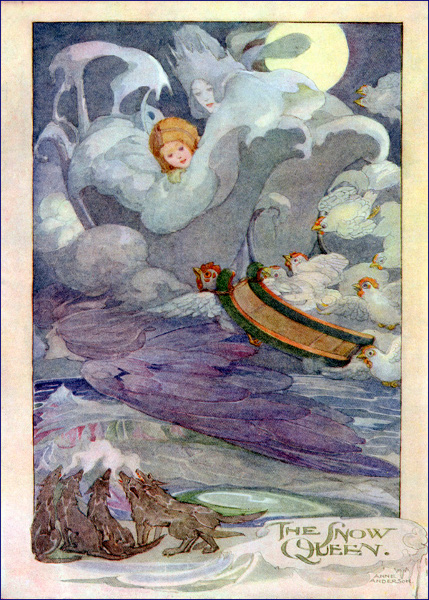
Die Schneekönigin, Märchen von Hans Christian Andersen. Märchenbilder von Anne Anderson
Die Schneekönigin. Illustration von Anne Anderson
Gerda macht sich auf eine lange, abenteuerliche Suche und gelangt schließlich auf einem Rentier ganz hoch in den Norden, auf die Insel Svalbard, wo das Schloss der Schneekönigin steht. Kai steht ganz unter ihrem Bann. Er ist ganz blau vor Kälte und versucht die Aufgabe zu lösen, die ihm die Schneekönigin gestellt hat: kleine, flache Eisstücke zu dem Wort Ewigkeit anzuordnen. Dann könne er sein eigener Herr sein und würde obendrein ein Paar neue Schlittschuhe bekommen. Doch es will ihm nicht gelingen. Als Gerda ihm gegenübersteht, glücklich, weil sie ihn endlich gefunden hat, ist er zunächst ganz steif und kalt. Erst ihre Tränen und ihr Lied, das sie ihm als kleines Mädchen schon vorgesungen hat, holen ihn zurück in seine frühere Welt. Endlich daheim sitzen sie wie früher bei der Großmutter …
…und [sie] las aus der Bibel vor: »Werdet ihr nicht wie die Kinder, so werdet ihr nicht in das Himmelreich kommen!«

miércoles, 21 de diciembre de 2016

OTHELLO IN NUCE

La tragedia de Otelo

La obra que inspiró a Verdi y a Boito para crear una de las óperas más catárticas de la Historia fue escrita por William Shakespeare a principios del siglo XVII, y fue estrenada el día de Todos los Santos de 1604 en la corte real inglesa, en el palacio de Whitehall. La tragedia de Otelo gira en torno a temas tan relevantes aún hoy en día como la identidad (racial, sexual, de género, social), la traición, los celos y la fina línea entre el amor y el odio, por lo cual sigue siendo, hoy en día, una de las obras más populares del Bardo. La obra presenta una trama bastante sencilla, sin dejar de ser emocionante y llena de suspense, con elementos que recuerdan al actual género thriller (ambiente claustrofóbico, intrigas, emociones intensas…).
Otelo transcurre en una plaza fuerte en la isla de Chipre, en la frontera entre la república veneciana y el imperio otomano, durante un período de paz armada a finales del siglo XV. El personaje titular, el gobernador de la isla, es un veterano general morisco que ha alcanzado su elevada posición mediante sus hazañas en el campo de batalla, y que ha desposado a una dulce e inocente heredera, la joven noble Desdémona, rubia y de tez clara, a quien ama con una pasión arrebatadora y es correspondido. Sin embargo, la idílica relación entre los esposos no tardará en resquebrajarse.
Y el causante de ello será Yago, suboficial veterano y que ve cómo el joven e inexperto teniente Cassio, amigo de la infancia de Desdémona, se hace con el puesto de ayudante de Otelo que Yago, confidente y camarada del general, ve como suyo por derecho.
Resentido, Yago se hace con la ayuda de Rodrigo, un pretendiente despechado de la esposa del general, dándole vanas esperanzas de recuperar a su amada, convirtiéndole en esbirro suyo.
Esa misma tarde, estando Cassio de guardia, Yago y Rodrigo embriagan al joven teniente y le involucran en una reyerta, por lo cual su superior, Otelo mismo, despoja a Cassio de su puesto de oficial. Desesperado, el joven recibe el consejo de Yago de pedirle a Desdémona que interceda por él, lo cual le da al intrigante razones para intentar persuadir al gobernador que su esposa y el teniente son mucho más que amigos. Sin embargo, Otelo está convencido de la pureza y fidelidad de su Desdémona, y duda tanto de ella como de Yago, por lo cual le pide a este último pruebas del adulterio de su mujer. Será un pañuelo, primer regalo del general a la rubia dama, que ella ha perdido, que Yago consigue de manos de su esposa, y que él dejará en manos de Cassio, lo que desencadene la tragedia: el otrora confiado y altivo general se vuelve un monstruo furioso, que insulta y maltrata a su consorte, a quien ha dejado de amar y ahora desprecia con toda su alma, a la par que nombra a Yago su brazo derecho y le da un plazo de tres días para matar a Cassio. Los dos hacen un juramento de vengar tan infame afrenta.
Al final, en un acceso de furia y de celos, Otelo estrangula o asfixia a su esposa en la cama, mientras Yago le tiende una emboscada a Cassio, de la cual el joven teniente se salva, perdiendo una pierna, pero es dado por muerto. Desdémona muere a manos de su esposo, a quien aún ama y en quien aún confía, defendiendo su inocencia y su fidelidad. Será Emilia, la mujer del intrigante, quien revele toda la verdad sobre las traiciones de Yago, muriendo asesinada por su marido, pero no sin antes revelar al general y al teniente toda la verdad. Desesperado, al ver que ha dado muerte a su amada en vano, y que ella nunca le traicionó, habiendo sido él mismo quien confiaba en la persona equivocada, Otelo hace arrestar a Yago, perdona a Cassio (ahora su sucesor como gobernador) y, deshecho en lágrimas, se hiere con su propia espada, y expira besando los fríos labios de su amada esposa.

Sandra Elena Dermark Bufí (aka una servidora)