Mostrando entradas con la etiqueta frozen. Mostrar todas las entradas

sábado, 11 de noviembre de 2023

CUALQUIER NOCHE PUEDE HABER SOL

 CUALQUIER NOCHE PUEDE HABER SOL

Original de Jaume Sisa

Traducción y versión de Sandra Dermark


Es noche clara y tranquila,

con luna llena que da luz,

les invitades ya llegan y

van llenando toda la sala

de perfume y de color...


Blancanieves, siete enanitos,

Lobo Feroz, los tres cerditos,

Bella y la Bestia, Aladín, Yasmín,

Simbad, Alí Babá, Gulliver,

Zipi y Zape y Sapientín.


Welcome, willkommen, bienvenides,

las penas vamos a desterrar,

que casa mía es casa nuestra

si hay casas de alguien al final.


Hola Jaimito, y doña Urraca,

Éric y sirenita Ariel,

Elsa Reina de las Nieves,

su hermana Anna, Peter Pan

y Campanilla y Wendy y 

Papá Noel y pato Donald

y criatura de Frankenstein.


Welcome, willkommen, bienvenides,

las penas vamos a desterrar,

que casa mía es casa nuestra

si hay casas de alguien al final.


Buenas noches, Astérix,

señor Obélix y Panorámix,

Tintín y Haddock, y Castafiore,

y señor profesor Tornasol,

Pinocho y Pepito Grillo,

y también Nils Holgersson.


Welcome, willkommen, bienvenides,

las penas vamos a desterrar,

que casa mía es casa nuestra

si hay casas de alguien al final.


Y a las doce llega ya

Cenicienta con Alicia,

Conejo Blanco, con Harry Potter,

acompañado de Ron y Hermione,

también Frodo, con Samsagaz y Gandalf,

además de Arwen y de su Aragorn.


Oh, bienvenides, pasad, pasad,

ahora ya no falta nadie, no,

o tal vez sí, ya me di cuenta

de que tan sólo faltas TÚ.

También puedes venir tú si quieres,

aquí hay lugar para muches más,

no cuenta el tiempo ni el espacio,

CUALQUIER NOCHE PUEDE HABER SOL.

jueves, 27 de julio de 2023

SPANISH IN THE EUROPEAN SPANISH DUB OF BARBIE (2023)

Today I went to see the Barbie film, in pink and with new pink make-up on. Now you must know I am Spanish, so I went to see the European Spanish or Castilian dub. 

The real-world portions of the film are set in L.A., and the character of Gloria's husband, Sasha's dad, who looks pretty Anglo or Nordic (he is played by Ryan Piers Williams), is frequently seen learning Spanish with DuoLingo and speaking with a Nordic accent. Due to my Translation studies, I wondered what language he was learning in the original film, and I looked it up on TV Tropes:

Gloria's husband (who's trying to learn Spanish) says "Sí, se puede" to Barbie.

  • There's a Cutaway Gag to Gloria's husband practicing Spanish with Duolingo.

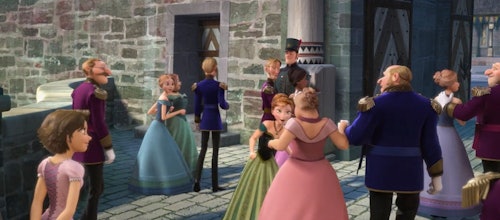
Holy moley... That happens very rarely when Spanish occurs in the European Spanish dubs of Hollywood films (I can only think of "la Muerte Roja" in Osmosis Jones and Puss in Boots, or el Gato con Botas, from the Shrek franchise and his own films, dubbed in the original and both Spanish dubs by Antonio Banderas (the first European Spanish character in the DreamWorks canon!), aside from Barbie now! There's also Buzz Lightyear's Spanish Mode, done as Modo Romántico, European Spanish with an Andalusian accent, by legendary cantaor, flamenco singer, Diego el Cigala!). Normally, what was Spanish in the source material gets usually dubbed as another Romance language (French in Frozen --the Spanish Dignitary, Disney's first canonical European Spanish character, who became French in the Castilian dub, Brazilian Portuguese in Pulp Fiction, or Italian in The Goonies to name a few good examples).


lunes, 17 de julio de 2023

HE APRENDIDO TANTO DE ELLAS...

El Renacimiento Disney me dio las heroínas Disney con las que crecí. Las agallas de Ariel (perdón por el juego de palabras), el cerebro de Bella, la fortaleza de Nala (en el musical), el amor por la naturaleza de Pocahontas, el sarcasmo de Megara, la fe de Esmeralda, el arrojo de Fa Mulán y la voluntad de sacrificio de Jane Porter me han forjado tanto como la experiencia de la vida. Y luego en la actualidad llegaron Mérida la rebelde, Rapunzel la creativa, Anna la ingenua pero de buen corazón, Elsa la que se acepta a sí misma, Vaiana la que descubre y explora su legado, Tamara Calhoun la dura con su corazoncito y las Madrigal: Isabela la perfeccionista que descubre otros aspectos de sí misma, Luisa que aprende a sacar fuerzas de flaqueza y Mirabel que descubre que aunque no tengas poderes especiales también podrás tener alguna clase de talento. Y su prima Dolores, que lo oye todo y cuyos dolores en amores, si no se rinde, se truecan en felicidades.

lunes, 23 de marzo de 2020

HIGH JUMPS AND LOW CONFIDENCE

Healin' Good Pretty Cure - Episode
My Own Review
HIGH JUMPS AND LOW CONFIDENCE


https://rorymuses.wordpress.com/2020/03/22/healin-good-%e2%99%a1-precure-episode-8-sea-and-sky/
https://angryanimebitches.com/2020/03/healin-good-precure-episode-8/


MY OWN HUMBLE OPINION:
This being our first real day in the limelight/focus episode for our academic athlete (intro episodes don't count),
Chiyu's hairstyle, her personal struggle, and the ice pathogerm that, as a purified elemental, gave her ice powers all looked like a Frozen reference (Frozen AU anyone, with Chiyu as Elsa, orphaned and adopted by the Hiramitsus, and Hinata as Anna - :3 meow -?)
Chiyu and the ocean... let's not say we may get another Minami Kaido, though as a swimmer instead of a biologist!

sábado, 2 de noviembre de 2019

COUNTDOWN TO LÜTZEN II: CONCEAL, DON'T FEEL...

...is, speaking of Scandinavian counterpart cultures, and favourite fairytales as well, already translated and going to be released in Spain this winterval in time for the release of Frozen 2! (quaffs three shots of brännvin in quick succession).


In this installment of the Twisted Tales/Un giro inesperado novel series, Anna and Elsa have been raised apart since ostensibly forever. And not only that; it's our favourite icebender who takes on the role of Gerda in questing for an estranged sister - flipping the premise of the animated musical on its head! We will also get to know more about this nineteenth-century Nordic world from both the film and the novel...


Como futura reina de Arendelle, la vida de la princesa Elsa está llena de expectativas y responsabilidades, pero sobre todo de preguntas. ¿Qué tipo de gobernante será? ¿Cuándo tendrá que elegir un pretendiente? ¿Y por qué siempre ha tenido la sensación de que le falta una parte vital de sí misma?
Tras la inesperada muerte de sus padres, Elsa se ve obligada a responder estas preguntas antes de lo esperado y se convierte en la reina de su pueblo, estando cada vez más sola. Cuando unos misteriosos poderes de hielo aparecen, Elsa comienza a recordar pequeñas partes de su infancia hasta entonces enterradas en la memoria; momentos que incluyen a una chica de aspecto muy familiar. Decidida a llenar el vacío que siempre ha sentido, Elsa debe afrontar un desgarrador viaje a través de su gélido reino para deshacer una terrible maldición... y encontrar a la princesa faltante. Su hermana menor, Anna... ¿pero cómo reaccionará ésta a la hora del reencuentro?


CONCEAL, DON'T FEEL


What if Anna and Elsa never knew each other? 
As the future Queen of Arendelle, Princess Elsa's life is full of expectations and responsibility ---not to mention questions. What type of ruler will she be? When will she have to pick a suitor? And why has she always harboured the feeling that some critical piece of herself is missing? Following the unexpected death of her parents in that tempest-tossed shipwreck, Elsa is forced to answer those questions sooner than she'd hoped, becoming the sole ruler of her kingdom and growing lonelier than ever.
But when mysterious powers begin to reveal themselves, Elsa starts to remember fragments of her childhood that seem to have been erased --- pieces that include a very familiar-looking girl, Titian-haired and spangled with freckles. Determined to fill the void she has always felt, Elsa must take a harrowing journey across her icy kingdom to undo a terrible curse... and find the missing Princess -- but how will her sister react?

jueves, 26 de septiembre de 2019

UPCOMING TWISTED TALES INSTALLMENTS

So far, there is one hot off the presses and one for release next year in English --let's keep our fingers crossed for foreign rights!--


CONCEAL, DON'T FEEL (THE MOST RECENT RELEASE!)


What if Anna and Elsa never knew each other? 
As the future Queen of Arendelle, Princess Elsa's life is full of expectations and responsibility ---not to mention questions. What type of ruler will she be? When will she have to pick a suitor? And why has she always harboured the feeling that some critical piece of herself is missing? Following the unexpected death of her parents in that tempest-tossed shipwreck, Elsa is forced to answer those questions sooner than she'd hoped, becoming the sole ruler of her kingdom and growing lonelier than ever.
But when mysterious powers begin to reveal themselves, Elsa starts to remember fragments of her childhood that seem to have been erased --- pieces that include a very familiar-looking girl, Titian-haired and spangled with freckles. Determined to fill the void she has always felt, Elsa must take a harrowing journey across her icy kingdom to undo a terrible curse... and find the missing Princess of Arendelle.

STRAIGHT ON TILL MORNING (Anglophone release for February 2020)
What if Wendy first traveled to Neverlandwith Captain Hook?
Sixteen-year-old Wendy Darling's life in London society is not what she imagined it would be. The doldrums of an empty house after her brothers have gone to boarding school, the dull parties where everyone thinks she talks too much, and the fact that her parents have decided to send her away to Ireland as a governess... it all makes her wish things could be different.
Wendy's only real escape is in writing down tales of Neverland. After nearly meeting her hero, Peter Pan, four years earlier, she still holds on to the childhood hope that his magical homeworld truly exists. She also holds on to his shadow.
So when an opportunity to travel to Neverland via flying pirate ship presents itself, Wendy makes a Mephistophelian deal. But Neverland isn't quite the place she imagined it would be. Unexpected dangers and strange foes pop up at every turn, and a little pixie named Tinker Bell seems less than willing to help.
But when Captain Hook reveals some rather permanent and evil plans for Neverland, it's up to the two of them to save Peter Pan-and his world.


viernes, 20 de septiembre de 2019

TSQ-IV ECHOES IN FROZEN


A Prince and Princess — Part I


In the fourth “The Snow Queen” story, “The Prince and the Princess,” there is told a story about a clever princess who wanted to get married as soon as possible: “And she made up her mind to marry as soon as she could find the sort of husband who could give a good answer when anyone spoke to him, instead of one of those fellows who merely stand around looking impressive, for that is so tiresome.”
The explanation of the princess and her willingness to be married is kind of reminiscent of Anna and Hans’s relationship. Anna was so quick to agree to marry someone who understood her quirkiness. But it is a bit of a stretch since there are no real romantic relationships in the original fairytale. It may be for the best since the whole Hans thing didn’t really work out for Anna anyway. However, that also means no Kristoff in the original fairytale. Say it ain’t so!


A Prince and Princess — Part II

... the princess mentioned in the previous slide has found her prince .... Turns out it’s not him, but the princess and prince are very kind to ... and take care of .... Wouldn’t it be cool if this kind princess and prince were the inspiration for the Rapunzel and Eugene "Flynn Ryder" cameo in Frozen, eh? Eh?


Images: Walt Disney Pictures


REMARK BY DIAMOND GRANT
In an interesting parallel between movie and tale, in the fourth section of The Snow Queen, ... is told a story of marriage ..., about a princess who was fixated on getting hitched.


CRITIQUE BY Glory of Frozen vs. TSQ-IV

The different adventures (in TSQ) ... all represent a progression of love, of possession. ... the Princess who thought love was choosing a man who was handsome and talked well, ...

Anna (in Frozen) meets many people on her adventure and on the journey to locate her sibling, all of them representing love in its different forms: Hans, like the Princess of the tale, is almost shallow in his view of love, "true love" found so quickly and from nothing more than a day's meeting and a quick-witted word. 


FROZEN VS TS IN DISNEYFIED OR DISNEYTRIED, ON THE OTHER HAND, SEES KRISTOFF AS THE PRINCE (INSERT REMARK HERE):


lunes, 29 de julio de 2019

A N-ICE REFRESHING SPOT FOR THE AQUARIUS PEN

Star*Twinkle Pretty Cure - Episode 24

My Own Review

A N-ICE REFRESHING SPOT FOR THE AQUARIUS PEN

Madoka and company escape the summer heat as they touch down on a planet covered entirely with permafrost in episode twenty-four of Star ☆ Twinkle.


Madoka is concerned about her grand piano practice

In this episode, our PreCures travel to the Icesnow Planet where they discover that the Aquarius Princess Star Colour Pen is in the possession of a sentient snowman named Olaf... I mean Yukio. He will only hand it over if they can make a girl named Irma laugh. As that happens, Madoka, ever since on Earth before the quest, worries about her grand piano practice.

Madoka may have won first prize, but she doesn’t feel satisfied with her victory
There are two plots running through this episode, with the first one being Madoka and her piano practice. She’s quite good at what she does, though she is not satisfied with her performance. Madoka doesn’t quite know what it is she’s missing, but the events of this episode help her to realise.
Yukio
The main story of Star ☆ Twinkle is also advanced with this episode, with the Aquarius Princess Star Colour Pen being the next one that PreCures set their sights on. It is, ut supra, in the possession of a snowman called Yukio.
Irma
Besides Yukio, our PreCures also meet his unrequited love interest Irma. She is the stoic type; so much so that Yukio has never seen her smile. That gives PreCures their objective for this episode: make Iruma smile.
Madoka and Elena snowboarding
There is a lot of fun that can be had with ice floes and snow, as PreCures show Yukio. Well, most of our PreCures, anyway. Yuni is less enthusiastic about it; she even considers the possibility of not being able to make Irma smile. Things do generally work out for PreCures in the end, but I can appreciate Yuni considering the possibilities.
Yuni sings
Whilst this may be an episode that is more focused on Madoka, Yuni does get some attention as well. In particular, we discover just what it is that inspires her to sing. We get a nice impromptu concert scene, with Madoka and Yuni performing together a duet on a stage of ice. Said concert is also the event that allows Madoka to realise just what she was missing when playing the piano.
Irma transformed
Can’t have an episode without an antagonist showing up, and this time it is Tenjou. She has Irma transform into the monster of the week, which of course means that PreCures have to step up and do their thing.


Aquarius Selene Arrow
The battle unfolds in pretty typical PrettyCure style, with Cure Selene adding a new power to her arsenal. After the battle and a visit to the Star Palace, the episode wraps things up.
Only two more Princess Star Colour Pens (Pisces and Cancer) to go.


This episode was pretty good. We got some nice stuff from Madoka, and Yuni too. That is about all I really have to say, though.
Next episode looks like it could be quite a good one, as the focus is on Yuni.

Episode 24: Basically Madoka was troubled with how despite winning piano competitions, the audience as a whole seems bored compared to her competitor’s performances. Basically Madoka forgot to have fun with it, and they all needed to help a snowman make the girl he likes laugh and smile. That’s it that’s the episode.


https://angryanimebitches.com/2019/07/star-twinkle-precure-episode-24-25/

MY OWN HUMBLE OPINION!!
A n ice planet for the pen of my sign right now in Thermidor... WOOOOOW!! Not to mention AT LAAAAAST!! Pretty refreshing at this whistle-wetting time of year, right?

Yukio and Irma - the Czarevna Nesmeyana of Planet Icesnow: So, in fairytales there is the convention of the crown princess who never laughed or even smiled (generally an only child with at least one deceased parent, plus all the pressure). The one who will make her lips curl, if male and single, will be her husband (it's always either a male single peasant with a quirky trick up his sleeve, or an eccentric old crone/deviant woman --though the latter is more common in mythology, think Baubo/Iambe or Uzume!--). Since Slavic folklorists like Propp were the ones who first identified the motif across cultures, we got to know this archetype as Czarevna Nesmeyana (Cyrillic Царевна Несмеяна - ie Czarsdaughter Neversmiles).


A Czarevna Nesmeyana character in a Grimm story, illustrated by Victorian Brits.
Notice the joke book behind her back.

 
The boyish Czarevna Nesmeyana in The Princess who had Never Laughed, from the Faerie Tale Theatre live action series.


This storybook illustration from Russia shows a Czarevna Nesmeyana wearied by many obnoxious suitors.

The Aquarius Pen (aaaaaaah...):
Fuwa - Cupbearerwa:


Power-Up: Let it go, let it go... Cryokinetic arrow attack by firing ice arrows.


Princess:


Ralf Hart's monologue -- one lonely prodigy singing to others:

"And what about me? I have my creativity, I have my paintings, which are sought after by galleries all over the world, I have realised my dream, my village thinks of me as a beloved son, my ex-wives never ask me for alimony or anything like that, I have good health, reasonable looks, everything a man could want ... Do you know what loneliness is?
But you don't know what loneliness is like when you have the chance to be with other people all the time, when you get invitations every night to parties, cocktail parties, opening nights at the theatre ... When women are always ringing you up, women who love your work, who say how much they would like to have supper with you - they're beautiful, intelligent, educated women. But something pushes you away and says: 'Don't go. You won't enjoy yourself. You'll spend the whole night trying to impress them and squander your energies proving to yourself how you can charm the whole world. So I stay at home, go into my studio and try to find the light, and I can only see that light when I'm working."

Ralf Hart, world-renowned artist in his twenties, from a wealthy background in hinterland Francophone Switzerland (and my favourite Paulo Coelho character).

It's not hard to think of why Ralf Hart is my favourite Coelho character. Young, healthy, wealthy, renowned, artistic, intelligent... and still feeling empty, yearning for something more somewhere over the rainbow. Just like me. We are kindred spirits. Ralf is 29 going on 30, I am 23 going on 24. Both of us are only children from sheltered bourgeois backgrounds, with toys and books for friends (Ralf had his trains, I had my dolls and plushies), who have finally made it to have a social life thanks to their creative talent. Yes, Ralf Hart (like to put more examples: Cassio, Portia, the princess in Story the Fourth of The Snow Queen, Brienne of Tarth, Ada Goth, Luna Lovegood, Chamsous-Sabah, Oscar de Jarjayes, Jacinto [in Doña Perfecta]...) is a favourite of mine because I see myself reflected in that character. The words Ralf Hart says about his emotions and his past always bring me to tears. This passage in particular, if translated into French and put into verse, would make a great chanson.


The duet - Each season we have covered has its own master and commander.

jueves, 6 de junio de 2019

REVIEW of Skånland (counterpart culture!)

Since today is also the national day of Sweden, when Gustavus Vasa declared independence from the Danes, I have decided to review the live action princess film remakes' newest counterpart culture, which is this time definitely counterpart Sweden - and fangirl a tad about it.
To sum up the real-life equivalences of other adjacent counterpart cultures in the Period Pieces of the Animated Canon (ps. IRL means In Real Life):
  • Arendelle - (mid-nineteenth-century) Norway (IRL unified with Sweden)
  • Southern Isles - (mid-nineteenth-century) Denmark
  • Tirulia (Eric's kingdom) - (mid-nineteenth-century) unified Italy (having a Nordic prince and a multicultural royal castle staff -British butler and head maid, French chef- may have been the result of an adoption of a foreigner by a childless couple, Bernadotte style)
  • Corona (Rapunzel's kingdom) - (eighteenth-century) Prussia and Northern Poland (IRL claimed by Prussia during the tripartition - "Frederick" is the standard name for Prussian male royals, the court dresses are Rococo-style...)
  • Berk - (Viking-era/Medieval) Iceland (IRL Viking-era free republic, then claimed by Denmark from the late Middle Ages until the twentieth century)
  • Skånland - Though Aladdin is set centuries before the Andersen-era (or Biedermeier-era) of the Andersen adaptations, we could try making a crossover timeline that also encompasses Eric's, Rapunzel's, and the Frozen sisters' origins as well as some more events. Adding Skånland to the table definitely leads to a lot of possibilities... <3 
Upon watching the film and reading its novelisation, I have realised that this counterpart culture has far more of counterpart Sweden than Ondalina and Galagard put together. To be more precise, Skånland is Golden-Age Sweden by another name... For starters, there's the name of this nation-state: Skåne (ie Scania) + land. Now Scania belonged to Denmark until the Treaty of Roskilde and some wars at the height of the Golden Age (halfway between Lützen and Poltava).


The friendly and handsome, though eccentric and arrogant Prince Anders of Skånland; though "Anders" was a peasant name in that era (stormaktstid-Golden Age), and his attire looks pretty Slavic (suggesting more a counterpart culture like Kievan Rus), the novelisation in particular gives me all the stormaktstid vibes...
So all we know from this counterpart culture in the film is gleaned from books as well as this prince and his boat and cannon in a foreign context. Oui, you heard it right, cannon. Skånland has firepower, for starters. And what would the Swedish Baltic Empire be without any cannons?
The first things we get to know about Skånland is that the word for yes is "ja" and of their shipbuilding technology: according to Anders himself, who sails himself in his own luxurious flagship made in that way ("luxurious?" like with an overly ornate transom astern?), their boats have such a good design that one nearly does not notice the waves. "It's like walking on a cloud or something like that..." Now I have been to the Vasa Museum (which I warmly recommend - Gustavus Adolphus' flagship perfectly preserved as the largest museum object at least in Europe - I don't recall if on Earth as a whole - and all the historical context you need!) and seen how large royal and military shipyards were (basically, complexes or compounds on the shores of Lake Mälaren that enclosed, within the palisade, villages of shipwrights and artists as well as all the vital space needed for making their crafts), as well as the fact that oakwood was reserved for shipbuilding and protected by the Crown for that use (no peasant woodsman was allowed to fell an oak and get away with murdering the navy - the punishment being 40 crowns for first time, 80 for the second, and execution for the third time one had at least hurt an oak!; the same interdiction also encompassed the Church and bourgeoisie - but in time the restrictions loosened only to allow felling oaks only for the Crown and for the nobility, for furniture I presume!). So shipbuilding was obviously key to cross the Baltic and North Seas and thus being able to both wage war and carry out trade abroad. Ditto for Skånland, in fact! (Actually, the three-master that the Genie-Simbad, Dahlia, and family see, at the start of the film, from their modest yawl reminded me a lot of the Vasa herself; though we never got to see the flag of Skånland on any masts, it's an impressive craft with an overly ornate baroque transom as gilt and colourful and as a peacock's tail -brightly-coloured sails, sides glistening in the sun as if newly-painted, a crew wearing unsullied uniforms, and elaborate ornate carvings covering all the masts and balustrades, but the transom is what catches most eyes!- while, in real life, though all the paint and gold leaf have fallen off the Vasa while she was underwater for centuries, artists have reconstructed what she, and especially her jewel of a transom, was like! See the picture of the Vasa above!)
The next facts, when we get to see his face in the novel, are from a non-fiction book of statescraft describing Skånland as a country simple and small, that has the colours of the earth/soil/land, and with evergreen forests and snow to abound. Its hard-working people content themselves with small pleasures and equally small homes without luxuries, and they prefer to live off the land and enjoy its natural beauty, drinking it all in. But the formal attire of the appreciative-looking Prince Anders (of whom a national saying says "Why has no one spoken to me about his beauty?"), made of evidently sumptuous fabrics (various brightly coloured fabrics and otterskin), call to mind that the royal family does not lead precisely an austere life. In fact, the word about is that the King of Skånland lets his people suffer hardships in order to earn their daily bread, while the court enjoys a decadent life of excesses. Opulent palaces, enormous banquets to celebrate any special day, no matter how paltry the occasion, and a queen who enjoys jewels no matter their shape, size, or colour.
This was basically what life was like for the peasant majority and the courtly minority during the stormaktstid (especially after the Peace of Westphalia, decades post-Lützen, when the return of peace to Europe and the military victories of the 30YW led to a courtly decadence -by coming into contact with French-style Versaillesque culture- that had never been seen before in Northern latitudes).
Seen from up close, Anders himself is described as having ghostly pale skin, lifeless matted straw-blond hair, and a sense of entitlement that makes him believe he has the right to everything (see the photo on top!).
The vibes he gives me are those of either young Gustavus Adolphus (not only is he blond and blue-eyed and extroverted; his formal attire looks even eerily similar to the wedding suit, above, which the Hero of Lützen wore as a bridegroom! Isn't there a similarity in both blond and blue-eyed Nordic royals in violet satin brocade, though Gustavus Adolphus wore, of course, a Shakespearean-looking doublet with puffy breeches to match!) or a blond, more slender Charles X. Of course the latter was dark-haired and already plump in his adolescence, but a lifetime of excesses in warfare and strong drink led to the pneumonia that took his life at the Province Governor's in Gothenburg (and oui, I've been there, and seen the tomb-plaque on the corner of that half-townhouse half-palace where he breathed his last). Moreover, of course Charles X came of age and was crowned three or four decades post-Lützen, when the return of peace to Europe and the military victories of the 30YW led to a courtly decadence -by coming into contact with French-style Versaillesque culture- that had never been seen before in Northern latitudes.
A final piece of Skånland we get is the cannon that the prince offers himself as a diplomatic gift. The story describes it as an enormous cannon whose black surface shimmers in the (Mediterranean) sun, accompanied by Anders' comment as he proudly points at the piece: "In Skånland, everything we do is like this, very elegant and... (then he was interrupted)" Looks exactly like black iron to me - one of those Swedish twelve-pounders, made by Protestant Wallonian steelworkers in steel mills (the size of that era's shipyards) whose masters would rise to nobility - that blew more than just enemy eardrums up throughout that near-century that lasted from Breitenfeld to Poltava. Seen them on warships, fortresses, and even palaces (for instance Läckö slott, of the de la Gardies, where the pic above was taken!). Firepower was, along with shipbuilding, one of the two pillars of Swedish technology that allowed for the rise of a great Baltic power - Mother Nature, or Mother Svea (Sweden personified) had given them (and still gives them) the wood and the ore; putting those resources to good use, and even harbouring persecuted strangers who supplied more advanced technologies, yielded fruit thousandfold (until a stripling leader decided to venture into the den of the Russian bear and wake it up -you know the rest: Полтава, down with the Vasas, up with the Romanovs!- A petty fortress, a dubious hand, and the crisis of defeat). When said cannon is fired, it sends the Skånlandish gunners who began to move the cannon and loaded it and lit the match (all the while Anders sat on a chair and shouted the corresponding commands)... it sends the gunners flying backwards, and fills the air with thick bluish smoke. When at last it has cleared, and the show is praised as impressive, the northern prince replies, nodding with pride: "Ja, this is a very good design."
The cannon shot, however, strikes the main mast of Anders' own warship; a flag with the symbol of Skånland (described only as such in the novels: no details describing the flag itself) is waving from the side of the flagship that is not burning.

One last remark may be made considering the Skånlanders as warmongers who prefer to fight on foreign shores (and, since the sultanate of Agrabah is counterpart Ottoman with all these Istanbul vibes, maybe Anders is also making a nod to Charles XII sans post-defeat crisis?).
When Jasmine, his intended fiancée, tells him that the gift impresses her not as much as the feeling behind it, Anders, his ego slightly deflated by this riposte, stutters and turns red as a beetroot: "W-well... this is... is... is... a sy-symbol of our..." his voice losing intensity as he keeps on looking for the right words.
"Desire for war?" she finishes his sentence.
"N-no... no..." the prince protests; his face turning a surprising shade of red, hard to say if due to awkwardness or indignation.
When he also hears that his fiancée loves to read and is well-schooled in statescraft, literature, philosophy, and the natural sciences... Anders nods and replies "A charming pastime" with a tone of paternalism. Surely there is some innuendo, if Skånland has had a counterpart Christina Vasa!

miércoles, 30 de enero de 2019

THE SNOW QUEEN - REVIEWS

THE SNOW QUEEN - REVIEW BY ALTHEA ANN

This was one of my favorite stories as a very young child.

I hadn't re-read this short tale in many many years. My thoughts upon rereading:

Well, it's more sentimental than I remembered, and the tone, especially at the beginning, is almost verging on patronizing in the way it addresses the (presumably young) reader/listener. As a child, I don't think I picked up on that at all.  think as a kid I just tuned that stuff out, but took it for granted.

The imagery: still so beautiful! The shards of glass, the snowflakes, the roses... This is why the story has endured so long. It is simply gorgeous. 

As a child, I perceived Andersen's Snow Queen as the same character as Jadis, the White Witch in CS Lewis' 'The Lion, The Witch and the Wardrobe.' As an adult, well, yeah, it is definitely the same character. Lewis took her, whole cloth, and her sleigh too....

Vivid memory - this story was the first time I'd ever heard of "Lapland," and it seemed like such a fantastic land. Interesting to realize that this portrayal of northern Finland was probably much more 'realistic' & contemporary (if remote) to children reading the story when it was first published, and people there still did depend on reindeer and travel by sleigh...

The robber girl!!!! How on earth did I ever forget about her! Her practical and self-interested, but not quite 'bad' character is simply amazing.

I've seen modern criticism of 'The Snow Queen' accusing it of being an apologist tale for domestic abuse, encouraging women to pursue relationships with men who mistreat them. It is possible to read the Snow Queen as the homewrecker, and Gerda as the good wife who must faithfully pursue her errant husband, represented by Kai, but I don't think Andersen intended that, or that the story actually is that. I think it's more likely that Andersen intended another possible reading: that of an allegory, where both Gerda and Kai are, at times, led astray and forget what is right (Kai due to the shard of glass; Gerda due to the witch's enchantment), but eventually find their way back to the redemption and live in innocence and purity. However, I personally like the simplest and most direct reading: that the story is what it says it is, a narrative of bravery and friendship. That the enchantment on Kai is real, and not his fault, and that Gerda's dedication to her quest, and her achievement, is admirable. 

I think that one of Andersen's main intentions here is, clearly, to show women as brave, capable, and self-sufficient. Throughout the story, they keep appearing: First, of course, there's Gerda and her quest to rescue her friend. But there's also the childrens' grandmothers, who are more vivid characters than the childrens' parents; the springtime witch, who keeps her cottage all on her own; the princess, who had no intention of marrying until she met a man who appreciated her intellect; the knife-wielding bandit girl, whose mother seems to be the leader of the robbers; & the Lapp woman, who gives Gerda help & directions on her quest, to meet a Finnmarkish wise woman. Of course, the Snow Queen herself wields her power alone...

The biggest takeaway I believe I had from this story, though, is from the very beginning. The imps' twisted mirror which shows everything as ugly and rotten, and its shard of glass that, in someone's eye or heart, does the same, took hold for me in the idea that the world is the world, but that how we look at it can be an option. We can focus on the mean and the corrupt in all things - or we can look for the beauty and the redeeming qualities of the world. It is up to us. (We don't have to see everything as boiled spinach or vast barren wastelands of decay.) ;-) 

Along with the evocative imagery of winter, there is a very emotional and spiritual love story. Kai and Gerda share a strong emotional bond, but that bond is damaged by Kai's infection with the slivers from the shattered evil mirror. His eye and his heart are pricked, and it changes the way he sees the world, and makes his loving heart grow cold towards poor Gerda. But Gerda doesn't give up on him. When the Snow Queen steals away Kai, she goes searching for him, going on quite an odyssey and meeting some very unusual people along the way. But she never gives up on him.

The lesson of sacrificial love never gets old. That kind of love can melt the fiercest frozen heart and claim back those who are lost. I loved rereading this, and the illustrations I had in my version was a lovely adjunct. 

If one has not ever read this book, I highly recommend it.

Many thanks for the opportunity to revisit this tale. As always, my opinions are solely my own. 


REVIEW BY BIONIC JEAN

I remember being bored when I read this story as a child, and reading it again now, nothing has really changed for me. The Snow Queen starts out interestingly enough, and the imagery throughout is good, but as for the actual storyline... It is very long and discursive, and as in many fairy tales, the events seem very random, and the reader tends to lose the main thread. It is the sort of story which could make a marvellous stage production, with all its imaginative possibilities, or a film or TV adaptation - as indeed it has, many times over the years. There are also many beautifully illustrated versions of the tale.

The Snow Queen, or "Snedronningen", by Hans Christian Andersen, is one of his longest original fairy tales, which was first published in 1844. At its core it is about the struggle between good and evil as experienced by two children, a girl, Gerda and her friend, a boy, KaI. It is told in seven parts, or chapters:

1. The Mirror and the Splinters
2. A Little Boy and a Little Girl
3. The Old Woman's Flower Garden
4. A Prince and a Princess
5. The Little Robber Girl
6. The Lapp Woman and the Finn Woman
7. What Happened at the Snow Queen's Palace and What Happened After That


The first part starts in Hans Christian Andersen's delightfully chatty way,

"Listen! This is the beginning. And when we get to the end we shall know more than we do now."

The storyteller tells of an evil troll, who made a magic mirror which distorted the appearance of everything it reflected. It would never reflect the good and beautiful aspects of people and things, but instead magnify their bad and ugly aspects. The villain thinks this is a great joke. He is the headmaster at a school for demons, who all decide to carry the mirror into heaven with the idea of making fun of the angels or gods... But, 

"the mirror shook and grinned, and grinned and shook" until eventually all the demons dropped it, and it broke into "a million billion splinters", some no bigger than a grain of sand.

These glass splinters "blew everywhere, getting into people's eyes, and making them see everything ugly and twisted. Some splinters even got into people's hearts and that was awful, because their hearts became like blocks of ice."

The first part is quite a short chapter, explaining the underlying moral thread which is to run throughout the story. The next chapter introduces the two characters, the little boy Kai, and the little girl Gerda. They live next door to each other in a large but provincial town, in the garrets of buildings which have adjoining roofs. They play among the window boxes there, which are full of herbs and roses. It was easy to get from Gerda's to Kai's home, just by stepping over the gutters of each building. The two become great friends.

Kai's grandmother tells them stories about the Snow Queen, who is ruler over the "snow bees" — snowflakes that look like bees. Just as honeybees have a queen, so do the snow bees. So wherever the snowflakes clustered the most, there you would find the Snow Queen. Looking out of his frosted window one winter's day, Kai sees the Snow Queen, who beckons to him to come with her. Kai is frightened and draws back from the window. 

The days pass and there is a thaw. But one day in Spring, something happens, 

"Oh! What's that pain in my heart! And oh! What's that in my eye?" 

Even though the child blinks and thinks it has gone, we can tell from their behaviour that one of the glass splinters from the evil troll's mirror has become lodged. The child becomes cruel and aggressive, and the other cannot understand the change in their friend, who teased them, "kicked the window box, and tore off the rose blooms", made fun of the kind grandmother, and did all sorts of horrid things. Everything seemed distorted and ugly to this enchanted child now, and the only interesting and beautiful things, are the tiny snowflakes to be seen through a magnifying glass.

While Kai and Gerda are playing with their sleds in the snow, the Snow Queen appears as a woman in a white fur coat, driving a curious white sleigh carriage. The enchanted child is tempted to go back with the Snow Queen to their palace.

If this is all beginning to sound familar to you, perhaps it reminds you of C.S. Lewis. The first part of this story, with the adjoining garrets and crossing over the rooftops, was very reminiscent of the first (or prequel) Narnia story, "The Magician's Nephew" At the beginning of that story, the Victorian children are neighbours in a similar type of building, and this aspect is crucial to the story's plot. Then in a similar way, C.S. Lewis clearly took his inspiration for the witch "Jadis" Queen of Charn, (who called herself the "Queen of Narnia") from Hans Christian Andersen's Snow Queen. The first meeting between Jadis and Edmund, one of the children in "The Lion the Witch and the Wardrobe" is almost a rerun of Hans Christian Andersen's idea.

Just as C.S. Lewis's stories are clearly moral allegories, this earlier story is also a tale of good and evil. And all the subsequent story follows the child who is under the mirror's spell. It involves an evil sorceress, a clever crow, a pair of doves, a Prince and a Princess, a frightening robber girl, and a captive reindeer. There is a "Mirror of Reason", and a Puzzle. There is a beautiful flower garden, an old Finnish woman and an old Lapp woman. Throughout, the child is determined to rescue the friend, showing loyalty, great courage and tenacity. Eventually the children's adventures are over and the enchantment is dispersed by the power of love. Kai and Gerda make their way back to their home, where they find that everything is just the same, except that they themselves have grown through their experiences. 

At the end, the grandmother reads a passage from the Gospel of Matthew,

"Except ye become as little children, ye shall not enter the Kingdom of Heaven"

and Kai and Gerda realise that they were saved by their goodness and innocence. They will always remain children at heart.

This story was originally included in the same book of fairy stories as "The Nightingale" which was a tribrute to Jenny Lind. But in the meantime, Jenny Lind had spurned Hans Christian Andersen's affections. The author subsequently - and rather unfairly - modelled the Snow Queen on what he saw as her icy manner towards him. The Snow Queen is a story of high fantasy, and usually included in most anthologies including works by Hans Christian Andersen; it is considered one of his greatest stories. However it does not really capture my imagination. I am extremely glad though, that he inadvertently provided the inspiration for part of C.S. Lewis's Narnia Chronicles, which I do enjoy enormously.

"I can't give her any more power than she has within her. Don't you feel how strong that is? Humans and beasts are at her service as she makes her way through the wide world on her own two bare feet. But she must not learn of her power from us."

(The Finn woman talking to the reindeer)


DAVID

It's not a particularly thrilling fable - boy meets girl, boy loses girl, boy gets girl back - though really, it's the boy who is lost and the girl who does the getting.

The story starts with an evil hobgoblin (also referred to as a demon) who goes to magic school (why did Rowling not find a way to hook this into her mythology?) and creates a magic mirror which shows "reality" in the harshest, ugliest way possible. It is shattered into a million pieces, and spread around the world, where it becomes smaller mirrors, spectacles, or tiny specks of glass getting caught in peoples' eyes, creating mischief and cold-hearted misunderstanding.

One such shard gets in the eye of a little boy named Kai, who then spurns his childhood sweetheart, Gerda. One day he goes wandering in the woods and is picked up by the Snow Queen. Gerda, convinced that he is not dead, goes on a quest to find him.

There are talking flowers, talking crows, and a not-really-wicked witch, and of course, the Snow Queen herself.

A cute story with perhaps a few too many elements thrown in for the fantasy-minded modern reader, but it would certainly entertain children. Andersen does wrap this tale up with a rather saccharine moral, but it's a story to please those in search of adventuresome girls and magical talking animals.


JAROM

I. LOVE. THIS. STORY.
Yes, this is a fairy tale that I plan to tell my children before I tuck them into bed at night. Holy cow.
This is the tale of a boy and a girl. Simple enough, right? The story hasn't even begun and you know it will be good.
It all begins with a mirror. Made by demons in the pits of the Realm of Hades, this mirror takes everything good that looks into it and makes it the exact opposite. The better of a person you are, the worse it makes you look.
This mirror shatters. Shards fall to the earth, and one of them pierces the heart of a boy. It poisons him, freezes his heart over, and he is spirited away by the mysterious Snow Queen.
The girl, his close friend in childhood, notices his change in behaviour and when he goes missing, she embarks on a quest to save him.
Following several encounters, she finally finds him deep in the Snow Queen's frosted palace, frostbitten and numb to the world.
He doesn't recognize her.
It is here that she realizes just how much he means to her, now that he looks at her with dead eyes.
She can't get him to remember her, so she hugs him and turns to leave.
And the shard of mirror falls out of his heart, and it all suddenly comes rushing back.
He sweeps her off her feet and they live happily ever after, the end :)
Perfect.
This is a fairy tale that puts into perspective the journey. Everyone expects a happily ever after to fall into their lap as soon as they fall in love.
We often overlook the dragons, the orcs, the goblins and imps that lie in the way to everlasting happiness, don't we?
Well folks, love is easily found.
Pure, true love, however, is what remains when the knight sheathes his sword for the last time. After the last bandit surrenders and the troll lies slain, that is when two lovers decide on a happily ever after.
So the million dollar question: is love worth it? Is it worth the fight?
I'm with Hans Christian Andersen: Heavens yes it is!
Great story. Loved it.


MILICA

One day, when the king of all goblins was feeling very good about himself, he created a special mirror. The mirror took everything that was good and beautiful in the world and turned it into bad and ugly, and when things were bad and ugly it did the opposite. When the goblins – the villain’s pupils tried to fly to Heaven, to mock angels, the mirror laughed so much that it slipped from goblins’ hands and shattered into millions of pieces when it hit the ground. Some of those pieces were so small that they could fly all around the world, and every time they got in someone’s eye or their heart, they made that person only see what’s wrong and bad about everything. That’s what happened to Kai.

Kai was a small boy who had spent all his life playing with his best friend Gerda. Shortly after he was struck with the piece of mirror, the Snow Queen came and kidnapped him. Everybody thought that he was lost, everybody except of Gerda. In order to find Kai, with only innocence of a child as her power, Gerda will travel through dangerous places and meet all kinds of people, some good, some bad. But, what will happen when she finally finds him?

The Snow Queen is a story about friendship, the purest kind, about children's innocence, and about love. I think I would have loved it more, had I read it as a child. This way some parts were boring to me, and the final resolution was painfully anticlimactic. Still, it was nice story and I’m glad I read it. This edition contains illustrations, and I found them nice addition to the story.


Glory (reviewer): 

How does The Snow Queen relate to Frozen?

I won't go into huge detail over particulars, just name a few things that both film and book share, especially thematically. Both tales carry a theme about love and its many forms (the Andersen tale also includes a strong moral on the smearing of innocence that leads to destruction, and the perils of innocence's opposite -- industrial progress). The different adventures of Gerda all represent a progression of love, of possession. The old lady who wanted to hoarde her, the Princess who thought love was choosing a man who was handsome and talked well, the robber maiden who captured her pets for her own amusement. And then there is Gerda, a legion of angels in her breath, Prayer on her lips, a power within her worth more than a dozen men and lasts longer than all the creations of humanity: true love.

That's where this little tale threads to the Disney film that claims origin to its story. Anna and Elsa's love are as Gerda and Kai's. Their childhood of fun is turned to separation when winter comes, with Anna (Gerda) only able to see her sibling (in blood or in spirit) through a small peephole of a window, or a keyhole. Anna meets many people on her adventure and on the journey to locate her sibling, all of them representing love in its different forms: Hans, like the Princess of the tale, is almost shallow in his view of love, "true love" found so quickly and from nothing more than a day's meeting and a quick-witted word. The stone trolls are unconventional, rude, unlikeable, like the robbers Gerda meets along the way. Yet like the robber maiden and her mother, the trolls have a "pure love" within their clan. Olaf the snowman is the pure representation of a child's love and innocence, like Gerda is in Andersen's tale. Kristoff is the representation of a pure romantic love, which was not quite represented in the original tale, but acts as a foil to the Hans romance.

There is a reindeer, a homely house that is warm and gives her supplies against the cold, living snow creatures that defend the Snow Queen's home, a blizzard-swept finale on a frozen lake, and, of course, the expression of love that thawed little Kai's frozen heart and Elsa's cold soul. And as with the love of Gerda and Kai, so with Anna and Elsa:
"and wherever they went, the winds ceased raging, and the sun burst forth."

Brandyn:
Suprised by the evil elements in the story! For instance the kidnapping, the robbers and the little girl robber who threatened to kill! Full of danger and mystery and bad characters. We were wanting resolve with the snow queen but the end left it up to our own imagination...


Drew Graham:

Little Kai and little Gerda were best friends who lived just a rooftop-jump away from each other. When a shard of a mischievous demon's viciously cursed mirror falls into Kai's eye and heart, he is soon whisked away by the Snow Queen to her icy domain, and it's up to Gerda to go on a journey to find him and bring him home.

Ah yes, I've finally reached the most recent Disney release in my source material read-through. This is a story I knew well as a kid, but I think I'd forgotten most of it over the years, so it was nice to read this faithful retelling. I'm of two minds about this story: On one hand I think it's beautiful and melancholy and even fairly epic, but on the other hand it meanders and has a lot of filler and sometimes just makes no sense. The story itself is fairly simple, but it gets distracted along the way by long-winded flowers sharing irrelevant stories, a red herring prince and princess, and of course the perhaps-homicidal robber-girl. But I don't know, maybe it's all some deep symbolic thing and I just don't get it. In any case, I love how it's wintry and cozy at the same time, and how the seasons are such a big part of the storytelling, and even though Gerda and Kai (and most of all the Snow Queen herself, who appears in basically TWO scenes and says and does almost nothing) aren't the most developed of characters, their relationship feels like something worth trekking to the chilly north to save. Maybe the Snow Queen isn't the most dynamic or threatening villain ever, but maybe that's the point... the danger of the snow and cold is well-established, and really the whole mess started with that little demon in the first place. Angela Barrett's illustrations in this edition were pretty lovely, though I think there could have been a few more of them.

(Also of note, apparently this is also the only fairy tale that has only female principal characters, but I really don't think HCA was trying to say something when he made that decision... I think that's just how this story happens to play out.)

Regarding Disney's interpretation, this is definitely one of the loosest adaptation jobs they've done. They took one part of the premise of this story, adjusted it almost beyond recognition, and then wrote their own completely different story around it. I know they've always taken liberties, but Frozen is so beyond recognition as based on this story that it almost seems like a joke to say the movie's based on it. Don't get me wrong, I liked Frozen okay (I mean... OKAY), but when you consider their original treatment and some of the concept art they did, which aligned a lot more closely to the actual story of the Snow Queen, it feels kind of like a wasted opportunity. Oh well, at least we have access to some of that stunning artwork.

Hans Christian Andersen's tribute to all seasons but mostly winter is wonderful reading for this time of year. At its heart it's a little bit scattered and doesn't always make sense as a story, but the themes and imagery are interesting and evocative. The illustrations by Angela Barrett complemented the translated text nicely, and I was glad to refamiliarize myself with this favorite fairy tale (which bears almost zero resemblance to a certain recent cinematic adaptation, alas).