Mostrando entradas con la etiqueta disability. Mostrar todas las entradas

miércoles, 19 de marzo de 2025

Gillian Lynne

 Gillian Lynne 


Gillian Lynne es una niña de siete años y no puede sentarse en la escuela. Se levanta continuamente, se distrae, vuela con los pensamientos y no sigue las lecciones. Sus profesores se preocupan, la castigan, la regañan, premian las pocas veces que está atenta pero nada, Gillian no sabe sentarse y no puede estar atenta. Cuando llega a casa, mamá también la castiga. Mamá piensa que no puede fingir nada ante el comportamiento de la niña. Así que Gillian no sólo toma malas notas y castigo en la escuela, sino que también los toma en casa, como si no fuera ya un castigo y una humillación el maltrato y los gritos ante todos los compañeros.

Un día la madre de Gillian es llamada a la escuela. La señora, triste como quien espera malas noticias, toma a la niña de la mano y se va a la escuela, en la sala de entrevistas. Los profesores hablan de enfermedad, de un trastorno evidente de la niña. Todavía no hay hiperactividad, o tal vez alguien le daría un medicamento a la pequeña Gillian. Durante la entrevista llega un viejo profesor que conoce a la niña y su historia. Pide a todos los adultos, madre y colegas, que lo sigan a una habitación contigua desde donde todavía se puede ver a la niña. Al irse le dice a la niña que tenga un poco de paciencia que volverán enseguida y le enciende una vieja radio con música de fondo. Como la niña se encuentra sola en la habitación inmediatamente se levanta y comienza a moverse hacia arriba y abajo persiguiendo con los pies y el corazón la música en el aire. El viejo profesor sonríe y mientras los colegas y la madre lo miran entre confundidos y compasivos, como a menudo se hace con los viejos, él grita:

"Ven a Gillian, no está enferma, Gillian es bailarina!".

Le recomienda a la madre que la lleve a una clase de baile y a sus colegas que la hagan bailar de vez en cuando.

La niña sigue su primera lección y cuando llega a casa a mamá solo dice: " todos son como yo, allí nadie puede sentarse!"

En 1981, después de una hermosa carrera de bailarina, después de abrir su propia academia de baile, después de recibir reconocimientos internacionales por su arte Gillian Lynne será la coreógrafa del musical Cats.

𝗨𝗻 𝗯𝗲𝘀𝗼 𝗮 𝘁𝗼𝗱𝗼𝘀 𝗹𝗼𝘀 𝗻𝗶ñ𝗼𝘀 𝗱𝗶𝗳𝗲𝗿𝗲𝗻𝘁𝗲𝘀

Deseando que encuentren en su camino a los adultos capaces de acogerlos por lo que son y no por lo que les falta.

Tomado de la red......

jueves, 18 de febrero de 2021

Den onda och den goda manligheten

This text concerns the love interest/husband character in a mostly forgotten YA book series by Gerda Ghobé, set in 1940s rural eastern Sweden (Östergötland); primarily in a large country estate owned by nobility. The character I write about is a young lieutenant, whose development we follow from single playboyish yet gentlemanly officer preparing for war to devoted father and husband, lord of Sjöboda, the Linden family estate and setting of the series. Tall, blond, and clean shaven, he is the quintessential Swedish lieutenant. A career-ending injury proves critical to his change of heart; one may compare his case to that of, for instance, Jaime Lannister, Anatole in War and Peace, or Cassio in Othello. 


Eva Heggestad

Drömmen om det goda samhället

Men samtidigt som fokus riktas på individen och hens identitetsutveckling, riktas det också på den för alla tre berättelserna gemensamma miljön - herrgården. Såväl Eka

som Sjöboda och Höje fungerar inte bara som en geografisk mittpunkt

och det nav kring vilket de respektive berättelserna rör sig utan också

som ett samhälle i miniatyr. Emellertid är detta samhälle långt ifrån

statiskt. Tvärtom genomgår det en radikal förändring under berättelsernas

gång.

... har det anrika godset förvandlats från en plats där (patriarken)

suttit ensam och isolerad utan arvingar till ett mänskligare

samhälle sjudande av liv.

... den lantliga idyllen ... Det civilisationskritiska

draget hos många utopister ger deras visioner en regressiv karaktär, och

drömmen om det goda samhället kan lika ofta kopplas till det förgångna

som till framtiden, till en längtan efter ett förlorat paradis som till en

dröm om ett rike bortom det jordiska.


Den onda och den goda manligheten

Mannens bejakande av kvinnan, livet och det växande

hittar vi också hos Gerda Ghobé, som låter flyglöjtnant

Malmberg skadas så svårt i en flygolycka att han aldrig mer kan flyga.

Olyckan kan ses som ett symboliskt avståndstagande från kriget och ett

bejakande av den jordens och kulturens odling som Sjöboda representerar.

Om än som passiv åskådare blir Malmberg därmed delaktig i 

samhällsbygge.

domingo, 3 de mayo de 2020

MIGNOLA - The Corsican Thumbelina

Ditu Migniulellu, or Mignola

PictureImage by Alenka Sottler
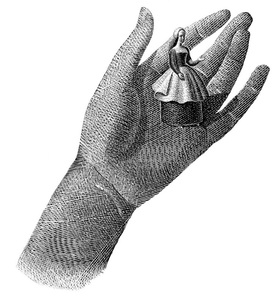
There was a woman who had been married for many years, but despite all her wishes and prayers and fertility remedies, she could not have children. One day she said, “Oh, if I could have a little girl, I would be so happy! It would be enough even if she was only as big as my pinky finger.”

“WIthin nine months you will be satisfied,” replied a voice that seemed to come out of the roof or down the chimney.

"Who said that?” said the astonished woman. “If it is a genie that brings me such good news, it is blessed.”

But she saw and heard nothing more of the genie. Nine months afterwards she had a little girl. No one had ever seen a baby more beautiful or more minuscule. She was the size of her mother’s pinky fingers, so they called her simply Pinkie Finger, or Ditu Migniulellu; Pinkie or Mignola for short. The midwife was barely out of the bedchamber when the mother looked up and saw four beautiful and powerful fairies standing around her.

The first fairy came forward. "I will make Ditu Migniulellu so beautiful that nowhere in the world could anyone find a more beautiful maiden.”

The second fairy added, “And I give her a singing voice so sweet and so agreeable that everybody else will sing along in admiration."

“But before she sings, she must learn speak,” said another fairy. “So she will speak fluently from this moment forward.”

"Thank you, my lady, thank you," replied the little baby.

But there was one more fairy in the room. The mother turned toward her. “And you, beautiful fairy, what gift do you bring?”

“I will give her nothing yet, but I will come to her aid whenever she needs me.”

The fairies then vanished, leaving the woman alone with her newborn daughter, who began to look around and chatter excitedly.

“You’re so pale, mama! You must be tired.” She noticed the brand new baby clothes, of a size meant for a normal baby, laid out nearby and squealed. “Is that bonnet with pink ribbons for me? Can I wear it?”

“Certainly, my daughter,” said the woman. She tried to place the bonnet, sized for a normal baby girl, on the girl’s head, but Ditu Migniulellu was completely covered up and began to cry and kick.

And as the mother took off the bonnet carefully, she thought to herself, “Why couldn’t the fairies have made her bigger? Oh, why didn’t I ask the fairy to make her a little larger? But she’s less than a day old. I must be calm. In a year or two, surely she’ll be the same size as other children her age.”

But Ditu Migniulellu never grew to normal size. By the time she was sixteen years old, she was still only the size of a finger, although perhaps a larger middle finger. Still everyone called her Mignola, though. Her mother, now widowed and having to work twice as much, began to resent her and then to fret a lot about her.

“What can I do with her?” she said. “She can’t garden, she can’t clean, she can’t cook. She’d literally drown to death in a glass of water.”

When it came time to go to market shopping for groceries one day, the mother’s heart was filled with shame and anger, not to mention the pressure. Ditu Migniulellu worked merrily in the garden, trying to pull up weeds as tall as she was, and talking to all of the flowers and the bees. She was so busy talking that she didn’t even hear her mother sneaking up behind her until it was too late. A terracotta flower pot came down over her, closing her in what was to her an unbreakable prison.

“You’ll be safe in there until I get back,” said her mother, and walked away.

Ditu Migniulellu shrieked and pounded her tiny fists against the inside of the pot. “Mama! Let me out at once! You can’t leave me here!”

But her mother was already gone grocery shopping. When the tiny girl realized that she was stuck until her mother returned, she made up her mind to be patient. To entertain herself, she began to sing.

As luck would have it, the king’s and queen's only son happened to be passing by. You just can't keep up a prince cooped up in his room, especially during adolescence. He heard her singing.

“Who could that be?” he asked. “I swear that if it's a woman I will marry her.”

He entered the garden and searched for the singer. The tiny girl continued to sing:

I am a girl
Singing, singing,
I am a girl
Singing, singing,


“What a sweet melody! You sing so well that anyone would be glad to hear it.”

Mignola shook her head and sang,

My stressed-out mother
put me in here;
My stressed-out mother
put me in here.


“Where are you? I’ll die if I don’t find you.”

It is not far
to the beautiful young girl,
It is not far
to the beautiful girl.


"Can it be? There is nothing that will prevent me from finding you.” The prince began to search, but quickly grew frustrated.

Blushing, Mignola continued to sing.

She's at your feet,
The charming girl;
She is at your feet,
The charming girl.


The prince looked down and immediately flushed with anger. "But there’s nothing here but this ugly old plant pot!” With that, he kicked the pot and shattered it into large shards.

Mignola shook off the dust and said politely, “How are you today, good sir?”

“I’m doing quite well; but who was that person who was singing just now? Have you seen her?”

“It was me, Ditu Migniulellu, but you can call me Mignola,” she bragged. “Isn’t my voice clear and pure? It has no equal in this kingdom.”

“It was you singing?” He laughed. “Really, you must be joking.”

“No, no, I do not deceive you. I was bored and I started to sing. Do you really think me such a little nothing? You’ll see quickly that . . .”

“You’re very talkative,” he said. “I don’t wonder that you were bored, trapped in a pot with no one to talk to . . . But sing a little, and we’ll see if you’re right.”

Ditu Migniulellu cleared her throat and began to sing more sweetly than ever.

Yes, it's me
The beautiful girl;
Yes, it's me
The beautiful girl
Who sang in the pot,
who sang in the pot.

“You are right,” said the prince in awe. “I have never heard such a voice as yours.”

“So you see that I did not deceive you!” the girl said triumphantly.

“Oh, hush, you little chatterbox. Tell me, what am I supposed to call you?”

“Like I said before, everyone calls me Ditu Migniulellu, but you can call me Mignola.”

“Well, Ditu Migniulellu, I am the king's and queen's only son, and I gave my word that I would marry you.”

“Then I am to be queen? Thank you, your highness, thank you. I don’t deserve such an honor. You may be certain, my prince, I’ll always—”

“Yes, yes, of course.” So the prince put Mignola in his shirt pocket and went back home. As he walked, the little girl was bounced up and down and squeezed in the folds of cloth, deafened by his pounding heartbeat, and it wasn’t long before she cried out, “I’m suffocating in here! Please take me out!”

So he took her out of his pocket and carried her in his hand the rest of the way to the castle. He took her straight to his mother the Queen and said, “Good Mother, this is the maiden I have chosen as my wife. I would like to celebrate the wedding as soon as possible.”

“What? That little dolly will be the next queen? What can you mean by this, my son? You can’t possibly marry her.”

“To tell you the truth, I’m not happy about it; but I promised her that I would be her husband.”

“Well! Keep her, I suppose, as she will not take up much space.”

The prince did so; but his new little friend was so small that she could not go out to dances or deer hunts or dinners. The prince quickly grew bored with her. On a day which was even slower and duller than any that had gone before, he became exasperated.

“What good is it to be a prince, if I have to be bored like everyone else? I want to give a ball which lasts three days. Then I can meet all the most beautiful marriageable women of this kingdom and beyond.”

In all directions went messengers blowing on trumpets and banging on drums, announcing the feast given by the king and queen to find a bride for their son. On the appointed day, fine gentlemen and charming ladies flooded in great crowds to the feast.

The feast was in the summer residence, on the other side of town from the palace. Richly dressed and prepared for the feast, the prince left the palace and prepared to mount his finest horse. As he was about to leave, he heard a high voice and looked down to see Mignola down at his feet.

“Take me with you. I want to go to the ball, too, please!”

“Leave me alone; what would I do with you at a ball?”

“I’d behave myself. You wouldn’t even know I was there.”

“Go back to your room. I’m in a hurry.”

“No, I want to go with you!”

“Ah! This is how you obey me?” And the prince threatened her with the bridle that he held in his hand. Crying as if her heart would break, the tiny girl ran back into the palace. And the prince galloped away on his horse on his way to the ball.

Mignola reached her room and continued to cry. But her tears were interrupted when a bright light shone from the ceiling of the closet and began to sink slowly towards her. As it neared her, she saw that it was a beautiful fairy, the one who had not given her anything at her birth.

“What is wrong, little one? What do you wish?”

“Oh, my lady, I want to go to the ball more than anything! You can’t imagine how much I want it! If I could just—”

“No more tears, child. I am the fairy who at your birth, was responsible for your happiness. If you want to go to the ball, then you shall go.” With a wave of her wand, the fairy godmother transformed Ditu Migniulellu into the most beautiful maiden-sized girl imaginable. She was tall, slender and dressed in golden silks.

She waved her wand once more, and they were immediately transported into a golden coach drawn by beautiful butterflies. The coach raced off to the ball and they arrived within minutes.

The good fairy said, “If you need me, you have only to clap your hands three times and I will come; you can also make yourself as small as before by saying, ‘Let me again become Ditu Migniulellu.’”

The girl thanked the fairy gratefully and then went into to the ball. The crowd murmured in astonishment at the sight of her and she held her head higher at the sound.

“Ah,” said the prince, already weary of shallow partners, “never has there been a more beautiful creature than this girl. I must make her my wife.”

He approached her with a deep bow. “How beautiful you are! Are you of this kingdom? I have never seen you in court before.”

“That’s not surprising, my lord, for I am not from your country,” said the girl demurely.

“Then what country do you call home? Please, I must know.”

An idea occurred to the girl, and with a smirk in the corner of her mouth she answered, “From the kingdom of Bridle.”

“Listen, the violins are beginning to play. Would you do me the honor of dancing the first waltz with me?”

“It is I who am honored, your highness,” said the girl. But in the middle of the dance, with people all around them, she became flustered and thought, “Let me again become Ditu Migniulellu.”

In a flash she dwindled down to her former size, slipped between the feet of the dancers and disappeared. The astonished prince sought the lovely foreigner everywhere, but without any success. Yet no one had seen her leave. Then Mignola quickly ran to her room where she undressed down to her undershirt, waiting for the prince to return soon.

“How was your evening, my love? Did you enjoy yourself?”

“Leave me in peace!” snarled the prince, exhausted and cranky.

“Why are you angry? Did something bad happen?”

 “Will you soon be finished?”

“Ah! I am very sorry to see you in such a bad mood. Will you say nothing?”

“What do you want me to say, you nasty chatterbox?”

“I see you are sad. I’ll be silent, since you wish it; but I’d willingly give my own blood to bring a little happiness into your eyes. You seem tired. You must be worn out from too much dancing. Tomorrow, I beg you, take care of yourself a little; you could be seriously ill and then I would be—”

“If you say one more word, I’ll strangle you,” hissed the prince. “Go, tell the servants to scour the library. Find every map and book of geography in the palace. I must find the kingdom of Bridle.”

Now Mignola went to wake the queen, who arrived a few moments later laden with books from the royal library.

“I have never heard of such a country as Bridle,” the queen complained, but the lovestruck prince spent the whole night in the library searching every volume from beginning to ending. He questioned the courtiers and scholars but none had ever heard of the kingdom of Bridle.

He fretted all night and all day, but as soon as evening fell and it was time for the second ball, he was merry and forgot the ache in his tired eyes, and threw on his finest robes and ran to his horse. He was on the verge of mounting when Ditu Migniulellu ran up to his feet and the hooves of his steed.

“I beg you,” she cried, “let me see the ball just this once.”

“No, go away!”

The determined Mignola leapt up to catch his stirrup, but he pushed her away so abruptly with his spurs that she went rolling across the floor. She stood in blood and tears and went to her room. Once there, she wiped her eyes dry and clapped three times.

The good fairy appeared. “What troubles you now, child?”

“I want to go to the ball again tonight; please, let me be as tall and as beautiful as I was yesterday.”

The fairy touched her with the wand, and the girl was immediately as tall as before, dressed in a gown the color of roses, crowned with a rose wreath, and holding a rose bouquet. A few moments later she entered the ballroom and found the young prince waiting impatiently. As soon as he saw her, he ran to her.

“I hoped to find you again! Ah, madam, you deceived me last night. Why did you lie? Oh, it’s not important, just tell me the truth, where are you from?”

Laughing, the maiden answered, “From the kingdom of Spurs.”

As they began to dance, the prince went on, “I intend to go to your kingdom and ask your parents for your hand in marriage. In the meantime, please, accept this ring as a token of my love for you.”

She looked down at the touch of something cold, and saw that he had slipped a glittering golden ring onto her left ring finger. A huge diamond, a gemstone the size of a cherry, flamed with light.

She admired it for a moment but then frowned. “But, prince, you can’t propose to me. Aren’t you already married?”

“Well, I did promise to marry Ditu Migniuellu, but we haven’t even celebrated our wedding yet.”

The maiden tilted her head. “And you’ll leave her, after letting her believe that you would marry her?”

He hummed and hawed and spun her around to the music. “It’s not like that. She sings so beautifully, the world’s never heard such a marvel. But you’re the one I love with all my heart. We can keep Ditu Migniulellu around to amuse us from time to time, as a pet. You have never heard such a voice.”

“I have to go,” said the maiden.

“Please don’t leave so soon! Stay at least a little while longer.”

Without replying, she whispered, “Let me be again Ditu Migniulellu.” And she disappeared instantly. Once more she looked around to see what had become of her, but he saw more. He began to despair and then to fume.

A once more tiny Mignola met him once more at the gate. The gem on her ring had now dwindled to poppyseed size. “Have you been happier tonight? You still look so angry. What hap—”

“Shut up! Go! Get me all the books and all the scholars who are in this palace!”

The scholars soon began to arrive, and the prince asked them in the library, “Has no one heard of the Kingdom of the Spurs?”

No one answered; no one was aware of such a country existing. The prince distributed the books and ordered everyone to search. They looked all night, but found not even a single note of any kingdom, county, province, or town known as Spurs or anything of that ilk.

The prince made a plan. “The third night of the ball is tonight. The beautiful girl is sure to return. I’ll surround the ballroom with soldiers. I’ll hold tight to her. She will not escape me again!”

That night, having sent soldiers ahead to guard the gates, he dressed more handsomely than ever and mounted his fiery steed.

At that moment Ditu Migniulellu appeared, in her usual pocket size. “Twice now you have refused me. This is the last night of the ball. I will ask one last time—take me to the ballroom. Show me this one kindness.”

“I have no time for you,” he said. “If I’m late, I’ll miss the beautiful stranger.”

She protested loudly. In his impatience, the prince lashed out at her, “I’m sick of your talking! Go!” He struck her with his riding whip in his haste and then galloped out of the courtyard.

He was not there to watch Mignola jump up and run to her room without crying at all, and of course he could not know how she closed herself in her room and clapped her hands three times.

For the third time, the good fairy appeared. “You still wish to go to the ball?”

“Yes, my good fairy.” The girl instantly became once more a tall and beautiful young lady, dressed in a rich cobalt blue gown with a diamond necklace and a matching diamond belt.

“Never will the world see anyone as beautiful as you are,” said the fairy. “Now hurry quickly to the ball. Everyone is expecting you.”

Shortly afterwards, Ditu Migniulellu entered the ballroom to general admiration. Her royal suitor was at the door to meet her.

Here you are,” he said. “You’re late this evening. But please tell me, why did you mislead me? Why did you run away from me? Why did you not tell me your true homeland?”

“The Kingdom of Whiplash,” she said. “I am from the kingdom of Whiplash. I was just teasing you before.”

“Dare I believe it? You've already deceived me twice . . . But what happiness! You’re wearing the ring I gave you yesterday? Thank you, thank you so much!”

They danced for one hour before the maiden vanished. The prince searched for her on all sides. When he asked the soldiers who guarded the gates, they had noticed nothing, and certainly not a tiny girl running past their feet.
The prince promised a huge reward to anyone who could locate the kingdom of Whiplash. They looked, they asked, they searched, but no one had heard of it. The prince had lost his beloved stranger forever, and fell seriously ill. At first his mother thought he was only sulking, but she found that he was deathly white and refused to eat or drink. The physicians all tried their best, but nothing could rouse him.

Finally Mignola herself arrived. “Let me make a cake for you. If you promise to eat it, I’ll find the woman you seek.”

“Leave me in peace,” said the prince. “All my scholars and all my soldiers have not been able to find her. What can you do?”

“Do not worry about it. Promise me, just eat the cake that I bring you.”

“Fine,” he said. “But I’ll kill you if I find out you’re trying to play a trick on me.”

Ditu Migniulellu asked for flour and water and sugar, and then fashioned a beautiful little brioche that she baked in the ashes. But before she baked it, she carefully wrapped the prince’s diamond ring, now grown with fairy magic to normal size (with the cherry-sized diamond) inside. When all was ready, the girl sent a servant to deliver the cake, and then she went to her room. The prince began to eat eagerly. When he had reached the middle, he clutched his throat, face turning blue. A vigorous pat on the back and a coughing fit later, he brought up and found the ring, which he quickly recognized. He began to yell out, “Mother! Mother!”

The queen thought that he must have been poisoned, and ran to strike Ditu Migniulellu. “Do you hear? My son is delirious. What did you do to him?”

“I didn’t do anything. Let me be!”

“Mother, Mother!” the prince continued to shout.

“There, there; I’m coming right away. "And the queen ran to see her child, whom she found so joyful he was completely well again and was practically dancing.

“Look, I have found the ring that I gave to the beautiful stranger. She must be somewhere in the palace. Give orders to search everywhere!”

But just then, in a flash, Mignola was transformed by the fairy and stood before the prince, tall as a normal maiden and beautiful again. She was wondrous to see.

“It is her—what happiness!” the prince exulted, and he fell on his knees before her. “I beg you, my love, do not abandon me again.”

But the maiden frowned. “Then you love me, my dear prince?”

Do I love you!”

“And yet you rejected me many times. You even struck me.”
“I struck you?”
“Yes, you threatened me with your bridle, and then threw me down with your spurs, and finally hit me with the riding whip in your hand.”
“But then . . . you are Ditu Migniulellu!”
At last the maiden smiled. “That’s right, I am she. Slightly changed, it is true, but I don’t think that size will displease you.”
“And you sing as well as ever?”
“Yes, I still sing well.”

Imagine the joy of the prince to have a bride so beautiful, so clever, and so accomplished. That very same day, they celebrated their wedding and invited all the people of the neighbouring towns.
But as for me, I arrived too late and had to sit under the table, where I received only the scraps. What did you do that day?

Sources

Les contes populaires de l'île de Corse by Jean-Baptiste Frédéric Ortoli, published 1881. Retold by Marie Ortoli, d’Olmiccia-di-Tallano.

jueves, 9 de agosto de 2018

LA VACA CEGA / THE BLIND COW (COMPARISON)


“La Vaca Cega”, de Joan Maragall, fue traducida por una servidora en febrero de este año en su blog, con el título “The Blind Cow”:

LA VACA CEGA
THE BLIND COW
Topant de cap en una i altra soca,
avançant d'esma pel camí de l'aigua,
se'n ve la vaca tota sola. És cega.
D'un cop de roc llançat amb massa traça,
el vailet va buidar-li un ull, i en l'altre
se li ha posat un tel: la vaca és cega.
Ve a abeurar-se a la font com ans solia,
mes no amb el ferm posat d'altres vegades
ni amb ses companyes, no; ve tota sola.
Ses companyes, pels cingles, per les comes,
el silenci dels prats i en la ribera,
fan dringar l'esquellot, mentres pasturen
l'herba fresca a l'atzar... Ella cauria.
Topa de morro en l'esmolada pica
i recula afrontada... Però torna,
i baixa el cap a l'aigua, i beu calmosa.
Beu poc, sens gaire set. Després aixeca
al cel, enorme, l'embanyada testa
amb un gran gesto tràgic; parpelleja
damunt les mortes nines i se'n torna
orfe de llum sota del sol que crema,
vacil.lant pels camins inoblidables,
brandant llànguidament la llarga cua.
Now stumbling on this tree-trunk, now on that,
instinctively towards the waterway
ambles a lonely cow: she's wholly blind.
The cowherd lad, throwing too well a rock,
put out her right eye, and a cataract
veils the left one: the cow is wholly blind.
She seeks the cooling fountain, like before,
but not with the resolve of yesteryear,
nor with her friends; no, but all on her own.
Her friends, upon the valleys and the hills,
the meadows and the riverbank, in peace,
ring, as they ruminate fresh grass, their bells,
by chance: if she did so, she would fall down.
She stumbles face-first into the hard pipe
and, wavering, reels back; yet she returns,
lowers her head to drink and drinks, serene.
She merely sips, without much of a thirst,
then raises to the skies the horned head
with a most tragic gesture, as she blinks
with dead eyes, ere away she wends her way,
bereft of light beneath the burning sun,
wavering down a path that knows no end,
listlessly flicking her tail to and fro.

Lo primero que hay que destacar en este caso es el hecho de que el texto meta está en pentámetro yámbico, en blank verse, al estilo de Shakespeare y otros clásicos literarios anglófonos. Es el ritmo intrínseco que posee la lengua inglesa, y el más afín al endecasílabo del original catalán. El pentámetro yámbico es la estructura musical eufónica por naturaleza de la lengua inglesa. A cada idioma le sale un esquema prosódico eufónico diferente (en el caso del español, se trata del octosílabo). “Oh yeah” (yambo) es eufónico en inglés, mientras que “Thank you” (troqueo) no lo es tanto.
Por ende, el que la traducción esté en blank verse nos proporciona un claro ejemplo de opción de la traducción del verso que Holmes denomina forma analógica: la adopción de una forma que, en la tradición de la literatura meta, tenga una función paralela a la de la forma utilizada por el original en su tradición respectiva.
El poema original fue escrito por Joan Maragall en el Pirineo catalán en 1893; la vaca ciega existió en realidad, y tanto ella como el joven vaquero que le sacó el ojo de una pedrada procedían de Sant Joan de les Abadesses (comarca del Ripollés). A una ocurrencia tan mundana como una vaca ciega que bebe agua, la reacción de Maragall le da un aire de tragedia y de fatalidad, llegando a transmitir la fuerza revitalizadora que tiene la compasión.
Sandra Dermark se topó con “La vaca cega” en un libro de Lengua Valenciana de Secundaria: como friki, o geek, trilustre acosada en clase por sus compañeros debido a sus gustos y aficiones, buscando refugio en la literatura y en los estudios. No tardó en ver reflejada su propia situación en la de la vaca distanciada del rebaño. Seis o siete años después, con la mudanza temporal de Castellón a Valencia y el máster, se le vino a la mente la idea de traducir el poema al inglés en pentámetro yámbico, la contraparte inglesa del endecasílabo en las lenguas de la Península Ibérica.
Lo primero que cabe señalar en esta traducción es el léxico empleado en la versión inglesa. Se trata de un léxico en ocasiones más elevado que en el del texto origen: donde la vaca de Maragall “se'n va”, la de la traducción “ambles;” la vaca del texto origen está “vacil·lant” donde la de Dermark está “wavering;” “se'n torna” en el poema catalán donde “she wends her way” en la traducción; y “el ferm posat d'altres vegades” de Maragall se ha anglicizado con maestría y destreza como “the resolve of yesteryear” en el texto meta.
También se han tenido que sacrificar o distorsionar locuciones y metáforas en aras de la métrica, ya por culpa de la cuenta de sílabas (“d'esma” => ”instinctively”), ya de la acentuación de las palabras, siendo la intención de la traductora la de crear, en este caso, un blank verse sin irregularidades (“orfe de llum” => ”bereft of light”).
La versión de Dermark también añade ciertos detalles, aprovechando los yambos libres que le deja en la plantilla del pentámetro el monosilabismo de la lengua inglesa al verter de una lengua románica. Siendo el más sobresaliente que el texto meta explica que fue el ojo izquierdo en el que se le puso una nube, o catarata, a la vaca; y el derecho, el que perdió a causa de una pedrada demasiado certera lanzada por un joven mayoral. Este detalle, añadido debido a las exigencias del pentámetro, se halla ausente en el poema original de Maragall. Nunca sabremos si la vaca ciega real de los Pirineos que inspiró el poema perdió qué ojo por qué causas. Y, teniendo en cuenta que tanto “left” como “right” son monosílabos, también podría haber sido el ojo izquierdo el que le sacó aquella pedrada a la vaca dermarkiana, entonces tuerta; pero tal vez subconscientemente asociando “put out her right eye” con “put out the light”, Dermark encontró la solución más eufónica, eufonía que repite con las fricativas al decir que la catarata “veils her left one.
Otro detalle que merece recalcar es la traducción de “l'embanyada testa” como “the horned head,” que barniza el verso original de Maragall con una brillante capa de intertextualidad, ya que se trata de una alusión al poema de A.E. Housman “Terence, This Is Stupid Stuff:”

The cow, the old cow, she is dead;
It sleeps well, the horned head:
We poor lads, 'tis our turn now
To hear such tunes as killed the cow.

Asociando a la vaca de Maragall con la de Housman, el texto meta la dota, presintiendo su destino, de una nota aún más trágica.
El poema también describe, en ambas versiones, rasgos de un paisaje rural montañoso (de los Pirineos catalanes): laderas, precipicios, colinas falderas (“foothills”), valles, troncos de árboles, además de un riachuelo y una fuente de régimen nival. Es por defecto un paisaje diurno donde hace buen tiempo, cuya belleza y frescura crean un vívido contrapunto a la invidencia de la vaca, sobre todo porque sus compañeras son conscientes del entorno. Tanto la sed como el tacto (los troncos de los árboles, la afilada pica de acero de la fuente), a falta de vista, espolean a la vaca ciega, y el énfasis en estos estímulos (¿quién no se ha levantado a por un vaso de agua de noche?) queda magistralmente reflejado en la traducción dermarkiana.

Para finalizar, y a modo de resumen, sería interesante hacer énfasis en los últimos versos para ver qué se ha ganado, perdido y alterado al realizar su traducción:

LA VACA CEGA
THE BLIND COW
Beu poc, sens gaire set. Després aixeca
al cel, enorme, l'embanyada testa
amb un gran gesto tràgic; parpelleja
damunt les mortes nines i se'n torna
orfe de llum sota del sol que crema,
vacil.lant pels camins inoblidables,
brandant llànguidament la llarga cua.
She merely sips, without much of a thirst,
then raises to the skies the horned head
with a most tragic gesture, as she blinks
with dead eyes, ere away she wends her way,
bereft of light beneath the burning sun,
wavering down a path that knows no end,
listlessly flicking her tail to and fro.

De “l'embanyada testa” adquiriendo nuevas connotaciones intertextuales con la traducción como “the horned head” ya hemos hablado. En aras de la métrica, también se ha sacrificado el adjetivo “enorme” aplicado a la cabeza de la vaca, pero la alusión a Housman compensa esta omisión con creces.
Mientras que la vaca de Maragall “beu poc”, la de Dermark “merely sips”, acentuando aún más su falta de sed. La métrica también ha obligado a Dermark a prescindir de la metáfora “orfe de llum” y traducirla como “bereft of light”, compensando con el adjetivo arcaico. Notemos también la aliteración en “bereft of light beneath the burning sun.”
Comparando “i se'n torna” con “ere away she wends her way,” este verso pone más énfasis en la primera mitad en el texto origen y en la segunda en el texto meta, que hace énfasis en que la vaca se da la vuelta y se marcha, distanciándose de la fuente.
“Camins inoblidables” se ha vertido, en aras de la métrica, como “a path that knows no end”: no haciendo énfasis en que el camino es imposible de olvidar para la vaca ciega, sino en que no sabe dónde el camino de su vida acabará, como animal discapacitado que es.
Por último, cabe hablar de la traducción del verso final, con esa omisión de “la llarga cua”, que Dermark compensa al traducir parcialmente el sentido de “brandant” con las palabras finales “to and fro”, expresión que sugiere y describe un movimiento pendular. El efecto de las palabras finales de los dos textos es diferente: “la llarga cua” de Maragall se centra en la longitud de su cola, mientras que Dermark, con “to and fro”, pone énfasis en dicho movimiento pendular y dota de más ritmo, musicalidad y melancolía al verso final.

lunes, 19 de febrero de 2018

THE BLIND COW (MARAGALL)

THE BLIND COW
Joan Maragall
Translated by Sandra Dermark
16th of February, MMXVIII

Now stumbling on this tree-trunk, now on that,
instinctively towards the waterway
ambles a lonely cow: she's wholly blind.
The cowherd lad, throwing too well a rock,
put out her right eye, and a cataract
veils the left one: the cow is wholly blind.
She seeks the cooling fountain, like before,
but not with the resolve of yesteryear,
nor with her friends; no, but all on her own.
Her friends, upon the valleys and the hills,
the meadows and the riverbank, in peace,
ring, as they ruminate fresh grass, their bells,
by chance: if she did so, she would fall down.
She stumbles face-first into the hard pipe
and, wavering, reels back; yet she returns, 
lowers her head to drink and drinks, serene.
She merely sips, without much of a thirst,
then raises to the skies the horned head
with a most tragic gesture, as she blinks
with dead eyes, ere away she wends her way,
bereft of light beneath the burning sun,
wavering down a path that knows no end,
listlessly flicking her tail to and fro.

-------------------------------------------------------------------------------------------------
LA VACA CEGA
Topant de cap en una i altra soca,
avançant d'esma pel camí de l'aigua,
se'n ve la vaca tota sola. És cega.
D'un cop de roc llançat amb massa traça,
el vailet va buidar-li un ull, i en l'altre
se li ha posat un tel: la vaca és cega.
Ve a abeurar-se a la font com ans solia,
mes no amb el ferm posat d'altres vegades
ni amb ses companyes, no; ve tota sola.
Ses companyes, pels cingles, per les comes,
el silenci dels prats i en la ribera,
fan dringar l'esquellot, mentres pasturen
l'herba fresca a l'atzar... Ella cauria.
Topa de morro en l'esmolada pica
i recula afrontada... Però torna,
i baixa el cap a l'aigua, i beu calmosa.
Beu poc, sens gaire set. Després aixeca
al cel, enorme, l'embanyada testa
amb un gran gesto tràgic; parpelleja
damunt les mortes nines i se'n torna
orfe de llum sota del sol que crema,
vacil.lant pels camins inoblidables,
brandant llànguidament la llarga cua.
 

domingo, 9 de abril de 2017

FLUSTERED WITH FLOWING CUPS

Abstract
This essay examines William Shakespeare's Othello as an example of early modern narrative prosthesis. Rather than look to visual markers of difference and abnormality upon which claims of narrative prosthesis frequently rely, the essay examines the way Othello presents such difference and abnormality as an inward aspect of the psychosomatic construction of the humoral self. Drawing upon classical, medieval, and early modern views that correlate a medical relationship between wine and the black bile of humoral melancholy, the essay engages Shakespeare's numerous representations of drunkenness, especially Hamlet's formulation (in the context of his uncle, Claudius) of the disease-model of drunkenness we today term alcoholism. The essay then turns to Othello to explore how Shakespeare's representation of Lieutenant Cassio's alcoholic "infirmity" serves as both a characterological and narrative prosthetic model for Othello's propensity to jealous rage that Iago both manipulates and confounds.
The most valuable contribution Disability Studies has yet made in the field of narratology has been David Mitchell and Sharon Snyder's concept of the prosthetic narrative. The formulation is one in which aberration from the "norm" at the level of character serves as a catalyst for narratives that seek to account for that aberration. Drawing upon the children's tale of a conspicuously one-legged toy soldier entitled The Steadfast Tin Soldier, in which a child protagonist selects to engage a disabled soldier's tale over those of countless able-bodied soldiers, Mitchell and Snyder offer that
The very need for a story is called into being when something has gone amiss with the known world, and thus the language of a tale seeks to comprehend that which has stepped out of line. In this sense, stories compensate for an unknown or unnatural deviance that begs for an explanation. (Narrative Prosthesis 20)
The prosthetic narrative thus involves the situatedness of the social world that fictions provide: "a narrative prosthesis evolves out of this specific recognition: a narrative issues to resolve or correct … a deviance marked as abnormal or improper in a social context" (20). In this way, Mitchell and Snyder suggest that the schematic of a prosthetic narrative structure is frequently four-part: "1. deviance is exposed to a reader; 2. narrative calls for the origin of deviance and formative consequences; 3. deviance is brought to center-stage; and 4. there is rehabilitation or an effort to fix the deviance in some manner, shape, or form" (22). There are two ways narratives grapple with such devices: since "Disability cannot be accommodated in the ranks of the norm(als), … there are two options for dealing with the difference that drives the story's plot: a disability is either left behind or punished for its lack of conformity" (23). This formulation has come to be known as the "cure or kill" phenomenon of difference as it engages such narratives.
While any number of early modern narratives present themselves as fruitful for such analysis, we face two immediate problems in doing so: the first is Lennard Davis's suggestion, among others, that disability fails to constitute a discrete identity category until the eighteenth and nineteenth-centuries; and the second, closely related, is the truism that the early modern English humoral theory of psycho-physiology implicitly presents a version of normalcy — that of a static, humoral equipoise — which is essentially and practically unattainable. For each of these concerns, humoralism thus comes to offer a sort of receding horizon of normalcy that is generally lacking in post-Cartesian concepts of the self. Disability, in this loose sense, is thus an implicitly ubiquitous feature of early modern English life, and in pursuing disability in early modern literature and culture we confront from the outset a rather different terrain for prosthetic narratives, at once less visibly overt than inward and covert, than that which Mitchell and Snyder propose.
One way we might engage this concept of prosthetic narrative in terms of otherness within a Shakespearean framework is to turn to Othello. Its engagement of explicit representations of aberration stems most generally in a visual sense from the way in which a majority Venetian culture handles its invited "others." Indeed, the play's representation of the Moorish Othello at the center of either a frustrated conventional marriage-plot or a successful conventional battle-plot, and the simultaneous overt racism and war heroics that ensue, suggests as much. What is not so apparent is the way we might treat such concepts as, in any sense, disability. While Othello and Desdemona's marriage frustrates Roderigo at the play's outset as one of deviance, and while Cassio and Desdemona's supposed relationship subsequently frustrates Othello as one of deviance, Iago complicates these views of deviance over the course of the play. As Roderigo's sense of Othello and Desdemona's deviancy is rooted in emotional spurs respectively involving explicitly racist and Petrarchan traditions, that is, Cassio and Othello's precipitancy to emotional extremes differs from theirs in that it involves a material, corporeal groundwork that Iago's rhetoric exploits.
Indeed, Iago's manipulation of Cassio's precipitancy to drunkenness and Othello's to jealous rage hinges upon humorological emotional reactions that he effects within them as what we might consider an environmental contaminant. Such contamination manifests in each case as what early modern medical theorists refer to as adustion: the sudden caloric escalations that shift the humors from formally "natural" to "unnatural" states. This essay will explore the way in which this proper medical concept of "unnaturalness" registers in an early modern disability framework, and specifically how Iago's insinuation at the somatic level utilizes the porousness of early modern concepts of the self to dominate Cassio and Othello by relying upon the age-old link between wine and heroic forms of humoral melancholy. Drawing on the humoralism through which the early modern medical field operates, I address questions involved with identifying the early modern distinction between what is "normal" and what is "disabled" — what is "natural" and what is "unnatural" — in terms of the prostheses that develop in the relationship between aspects of literary character and specific narrative forms.

Wine and Melancholy in Early Modern Humoral Theory

Cassio's propensity to drunkenness plays a central role in the tragedy of Othello. But to be clear: it is not drunkenness per se that is at issue in this essay. Cassio's drunkenness, after all, registers uniquely in that it is repeatedly identified as an alcoholic "infirmity" — the term is used three times in 2.3 alone: at 41, 127, and 140 — one that leads him to plead with Iago that "I have very poor and unhappy brains for drinking. I could well wish courtesy would invent some other custom of entertainment" (2.3.33-36). As in early modern England generally, heavy drinking and drunkenness are, of course, pervasive in Shakespearean drama: from the ribald shenanigans of Sir John Falstaff (in the second Henriad and The Merry Wives of Windsor), to the dissipate enervation of Mark Antony (Antony and Cleopatra); from the besotted but successful, politically elite usurpers, Macbeth (Macbeth) and Claudius (Hamlet), to the drunken and commoner, would-be usurpers Stephano and Trinculo (The Tempest); from the early modern English contemporary lush, Christopher Sly (The Taming of the Shrew), to the classical backdrop that serves as the setting for the "heat … [of] Greekish wine" in Troilus and Cressida (5.1.1) — the excessive drinking of alcohol is ubiquitous in Shakespeare's plays. Significantly, Shakespeare's representations of alcohol and its effects correspond with medical theorizing on the topic from the period, which demonstrates that Shakespeare's investment in mimetic characterization hinges on his use of available discourses for such characterization. Although the manner by which alcohol affects early modern selves involves contemporary medical views that are unsurprisingly different than science and addiction specialists perceive the phenomenon today, the social effects of such drunkenness prove in many ways to be quite similar, as we shall see.
The principal caution these early modern treatises present with regard to alcohol and its effects centers upon its propensity to emotional rousing through sudden caloric escalations. The relationship of time, temperature, and the humors thus lies at the root of these matters: the etymologically related Latin concepts of tempus, temperatura,and temperamentum. From Aristotle onward, through Galen into Avicenna, and thus integrated into the texts of Renaissance theorists Marcilio Ficino (1489), Timothy Bright (1586), Philip Barrough (1596), Thomas Wright (1603), Thomas Walkington (1607) and, most importantly, Robert Burton (1621), the influence of caloric increases upon the humoral self became a central element in diagnosing a range of psycho-physio-theological troubles. True to form, Thomas Wright propounds, pithily enough, that "Animi mores corporis temperaturam sequuntur, the manners of the soule follow the temperature of the body." Within this context of the role caloric economies play in somatic health, adustion, the sudden scorching of the humors due to a range of possible causes either inwardly or externally derived, facilitates an implicitly volatile aspect to early modern humoral theory that is captured in humoral theorists' qualitative division of the humors by the terms "natural" and "unnatural."
According to early modern humoral theory, each humor in its natural state tends inherently toward a specific temperature — sanguinity and choler toward the hot, phlegm and melancholy toward the cool. If an individual's ideal temperature becomes altered in any way, shifting the humors out of their ostensible balance, then the individual's health and emotional bearing are understood to transform in a similar fashion. In particular, if a humor which, in its natural state, tends toward the cool (phlegm or melancholy), turns suddenly adust — producing an unnatural humor — then a terrific altering in the health and character of the affected individual results. The shift from natural to unnatural humoral forms, likewise, is understood to produce material, humoral excrements and crudities, as well as noxious vapors and fumes which, rising to the brain, transform individuals either by suddenly or progressively leading them into a variety of dangerous, affective states. The inward trauma of a scorched humor, accordingly, manifests outwardly through commensurately traumatic effects in that person's outward show of character.
The causes of such adustion center on the porous conceptualization of the self that early modern humoral theory propounded, which maintains that the environment poses stark hazards to health. This marked link between the macrocosm of the world and the microcosm of the human is one we see repeatedly in early modern medical texts. A range of such influences is involved here, such as the influences of sound, color, air, and alcohol. As John Sutton observes, "The state of the [Galenic] naturals, the humours and spirits, depended directly on the influences picked up, usually through the blood but also directly through the skin, from climate, environment, nutrition, and emotion" (39). Galen, for example, established early on the dangers certain forms of air can pose to corporeal health (41-2), and these cautions tend to center upon thermal elements. Early modern theorists pick up on this issue. Stephen Batman's translation of Bartholomaeus Anglicus's De Proprietatibus Rerum (1582), a thirteenth-century encyclopedic compendium, for example, cites Hippocrates on the effects caloric volatility causes within humoral selves. He stresses the unique dangers that the suddenness of caloric increases poses to humoral bodies in that "sodayne chaunging of cold into heate, chaungeth and appayreth [wastes] bodyes: and that is, for that kinde suffereth not sodayne chaungings, as he sayth. Therefore ofte sodaine chaunging of time is cause of sicknesse" (7.4). Such attention to caloric economies within an environmental context (time apparently referring here to change of season) extends to the suddennesses alcohol poses to such volatile selves.
For Thomas Wright and many other early modern humoral theorists, alcohol's psychosomatic influence upon the thermal status of the self was thus understood within this paradigm to be especially dangerous and jarring to human health. While such authors frequently caution against ale or beer, often strong wine draws their more emphatic warnings. Barrough, for example, writing in The Method of Physic (1596), stresses the specific dangers wines pose to human health, for reasons that center upon the caloric. Indeed, Barrough even suggests that hot humors in and of themselves can cause drunkenness:
The causes and signes of drunkennesse are evident inough, chiefly hote wines, & strong drinks are causes thereof, for that they fill the braine with vapours, and that so much the more (as Galen sayd) if the braine be hote by nature: sometime also hote humours ascending to the head, do cause drunkenness…. (1.10)
Such descriptions are typical within humoral theory, and thus to read such treatises on wine's effects upon humoral selves is to view the wine we think we know as virtually unrecognizable. While early modern theorists generally agree that wine does have its place in a healthy diet for people of certain humoral dispositions, and even can be beneficial, it is helpful to ascertain specifically why and how such writers caution against its use by others.
From Aristotle down though the early modern period, medical treatment of wine within the humoral paradigm is thus decidedly complex. As an imported item for the early modern English, wine's complexity stems from the array of ways in which it is freighted with significations simultaneously theological, political, moral, and medical: theologically, for example, due to its sacramental role in Catholic ritual; politically, from its derivation largely from the Catholic nations of Italy, France, and Spain; and both morally and medically, its tendency to abuse (as we shall see in the Elizabethan "Homily on Gluttony and Drunkenness"). For medical theorists, especially, wine serves as a special environmental case that poses a unique challenge in the salubrious regulation of the body by the early modern subject, especially due to red wine's ostensibly physical resemblance to blood and the humors.
One of the foundational texts of classical humoral theory, the Aristotelian Problem XXX, I, explicitly comments on the marked effects wines inflicted upon humoral selves, and these effects appear to have played a significant role in shaping subsequent literary and cultural traditions. In this treatise, the author maintains that "dark wine more than anything else makes men such as melancholics are" (22); however reductive, such a totalizing, materialist explanation for aberrant behavioral psychology typifies classical humoral theory. Aristotle suggests that this comparability obtains because the corporeal effects of both the black bile of the melancholy humor, acting from within, and of wine, acting from without, hinge on their relative potency as a function of the caloric, and that applied heat thus determines the unique "character" of the corporeal impact of either fluid within the body (21). Indeed, as Aristotle explains,
raw temperature itself determines the character (for heat and cold are the factors in our bodies most important for determining our character): like wine introduced in larger or smaller quantity into the body, it makes us persons of such and such a character …. (28-9)
The perceived homology between wine and the black bile of melancholy, formulated by this text and maintained down through the ages, is reflected in Helkiah Crooke's Mikrokosmographia (1616), for example, which observes that "Melancholy juyce" is "like unto the lees of Wine" (138).
By means of this variability, black bile thus becomes understood as the material cause not only for a range of depressive psycho-physiological illnesses, but also for the series of outstanding qualities that comprise the heroic identity, as the material cause for heroic "greatness." Problem XXXI explores how abnormality (in the context of excesses of black bile) can lead to genial forms of melancholy that comprise subjects perceived to be superior in heroic exploits, as well as in politics, poetry, and artistic endeavors, to those possessed of a presumably ideal balance of humoral equipoise. While such a concept surely complicates the humoral theory, it also frustrates concepts of, and definitions for, early modern disability. Indeed: if the abnormal can register as superior or ideal, what exactly does this concept of aberration do to categories that distinguish the "normal" from the "disabled"? And what role does the humoral variability caused by adustion play in such categorizing? The issue casts a long shadow, as the link forged between wine and humoral melancholy is not merely limited to classical texts.
Barrough, for example, stresses the specific dangers wines pose to one who suffers from melancholic diseases, warning "Let him altogether abstaine from wine" (1.6). In his chapter "De Insania Et Fvrore," Barrough writes of those who tend toward madness, "you must forbid them altogether the drinking of wine" (1.27). In "De Melancholia," as well, he prescribes for those affected: "let them eschue wine that is thicke and blacke …" (1.28). Such caution regarding these wines deemed "thicke" and "blacke" stems presumably from the material likeness they share with the perceived qualities of melancholy's black bile itself. Robert Burton, likewise, who identifies himself as "no wine drinker" (24), notably insists that hot wines are indeed most deleterious to subjects afflicted with melancholy. He cautions against: "All black wines, overhot, compound, strong thick drinks … and the like … all such made drinks are hurtful in this case, to such as are hot, or of a sanguine cholerick complexion, young, or inclined to head-melancholy. For many times the drinking of wine alone causeth [such diseases]" (1.2.2.1). The medical tradition involving the relationship between wine and the melancholy humor deliberately highlights this correlation, synthesizing likeness between such corporeal influences to human health.
Among medical writers, the largest concern at issue in such discussions is wine's relationship within the context of volatility — the nexus of time, temperature, and the humors. Jarring influences caused by heat and the vapors of wines and other alcohols were understood to destabilize the humoral subject in ways that could be uniquely catastrophic. As John Sutton observes, the "Animal spirits were … susceptible to the spirits of wine, and the aerial spirits which carry melody, thus explaining physiological responses to alcohol and to music" (36). So while early modern English culture offers ample cautions relating to abuse, other cautions are more pointedly related to the disposition (age, character) of the drinker. Due to the innate heat associated with youthful males, for example, Walkington suggests that "a young man in the hot Meridian of his age ought to be abstemious" (49). While wine can while away cares and lead to creative literary ability (51-52), its tendency to abuse leads him to suggest that it is to be avoided by all of hot temperaments: "as for a Cholerick man to abstain from all salt, scorched dry meats, from mustard, and such like things, as will aggravate his malignant Humor, all hot drinks & enflaming Wines" (60). Shakespeare's representation of wine's effects upon humoral selves engages the issue in a range of ways, including a disability context.

Drunkenness and Alcoholic "Infirmity" in Shakespearean Drama

Indeed, Shakespeare's drunken dramatic characters confirm that thermal escalations play a central role in the way in which the early modern English conceived of drunkenness. These psycho-physiological effects include the flushing of the face and other caloric descriptors accompanying the drinking of alcohol. Such commonplaces are ubiquitous in Shakespeare's plays. In Antony and Cleopatra, for example, Charmian observes "I had rather heat my liver with drinking" (1.2.24); and indeed, such a description of drinking's inward effects can lead to outward ones, too: as Caesar observes, well in his cups, "You see, we have burnt our cheeks. Strong Enobarb / Is weaker than the wine" (2.7.122-23). In Henry 5, the French Constable contrasts the diets of the English and French soldiers, concluding of English valor: "Can sodden water, /A drench for sur'rein'd jades, their barley-broth, / Decoct their cold blood to such valiant heat? / And shall our quick blood, spirited with wine, / Seem frosty?" (3.5.18-22). Twelfth Night's representation of the pervasive drunkenness of Andrew Aguecheek and Sir Toby Belch thrives on such formulations (1.3.36, 1.5.130-33), as does Troilus and Cressida, in which Achilles vows of Hector, "I'll heat his blood with Greekish wine tonight, / Which with my scimitar I'll cool tomorrow" (5.1.1-2). In Coriolanus, too, Menenius refers to the drinking of "hot wine" (2.1.48). Other Shakespearean representations of drunkenness as a caloric environmental exchange are similarly straightforward: from the Porter's bawdy description of the various effects of drunkenness in Macbeth (2.3.28-36); to that of Christopher Sly's commoner's plea for "small ale" over "sack" in The Taming of the Shrew(Ind. 2.1-2); to Portia's analysis of the drunken German duke of Saxony's nephew, who Portia supposes would choose over her a "deep glass of Rhenish wine" (Merchant of Venice1.2.96), leading to her ultimatum: "I will do anything, Nerissa, ere I will be married to a spunge" (98-99). This final term brings us to Sir John Falstaff, who couples his famed drunkenness with its corresponding political implications, as a Shakespearean Lord of Misrule.
Falstaff's encomium to sack, for example, sweet white wine from Andalucia, Spain, engages contemporary medical theory to a marked degree, albeit comically. The passage centers upon the caloric as the causative element for a range of positive attributes: from intellectual wit to valor in battle. Falstaff conspicuously ignores the negatives, promoting sack as the cause of Prince Hal's martial prowess, and himself as a kind of progenitor of the future king. He suggests that:
A good sherris-sack hath a two-fold operation in it. It ascends into the brain; dries me there all the foolish and dull and crudy vapours which environ it; makes it apprehensive, quick, forgetive, full of nimble, fiery, and delectable shapes; which, deliver'd o'er to the voice, the tongue, which is the birth, becomes excellent wit. The second property of your excellent sherris is, the warming of the blood; which, before cold and settled, left the liver white and pale, which is the badge of pusillanimity and cowardice; but the sherris warms it and makes course from the inwards to the parts extreme: it illuminateth the face, which as a beacon gives warning to all the rest of the little kingdom, man, to arm; and then the vital commoners and inland petty spirits muster me to their captain, the heart, who, great and puffed up with this revenue, doth any deed of courage; and this valour comes of sherris. So that skill in the weapon is nothing without sack, for that sets it a-work; and learning a mere hoard of gold kept by the devil, till sack commences it and sets it in act and use. (2 Henry 4 4.3.96-116)
In contrast to the deleterious environmental effects associated with air, which move from the macro- to the microcosm, from environment to humoral self, wine's environmental influence extends frequently enough in a recursive, behavioral process from the macrocosm to the microcosm and back to the macrocosm. Indeed, this pattern is one we see, with overt political ramifications, throughout Shakespearean drama, especially as causative for drunken rebellion: in The Tempest, Stephano, Trinculo, and Caliban, "red-hot with drinking" (4.1.171), finally locate Prospero but suffer such hangovers as to be utterly ineffective as usurpers; in As You Like It, Old Adam claims he owes his health to abstinence from alcohol: "I never did apply / Hot and rebellious liquors in my blood …" (2.3.48-49); and in Henry 5, King Henry famously makes great show to Cambridge, Scroop, and Grey in pardoning a drunken man who through "excess of wine" (2.2.42) had "rail'd against our person" (41). Falstaff's praise of sack, in other words, confirms his character. In this way, the alcoholic "infirmity" Cassio evokes, and demonstrates, is implicitly imbricated with political insurrection, as in Philip Sidney's representation of the drunken Phagonian revolt, for example, in the Old Arcadia. Each depicts rashness as drunkenly motivated, reworking the well-worn connection between the body and body politic; thus Iago had engineered the watch on the night of Cassio's demotion to be peopled by a "flock of drunkards" (2.3.59), one he had ensured to be "fluster'd with flowing cups" (58). Such politically pointed representations of drunkenness thus involve for Shakespeare deadly earnest representations of it in some as a disabling disease that should properly be termed alcoholism.
For such characters, caloric escalations brought on by alcohol severely affect character. When Mark Antony notes, for example, "Come, let's all take hands, / Till that the conquering wine hath steep'd our sense / In soft and delicate Lethe" (Antony and Cleopatra 2.7.106-08), Shakespeare undermines his ethos, indicting him as a triumvir of empire. Macbeth, as well, incorporates a notable amount of problematical drinking and references to it both literal and metaphorical: "Was the hope drunk," Lady Macbeth famously demands of her husband, "Wherein you dress'd yourself? Hath it slept since? / And wakes it now, to look so green and pale / At what it did so freely? From this time, / Such I account thy love" (1.7.35-39). This signification of Macbeth awaking "green and pale," consumed by a metaphorical hangover of anticipated guilt, is suggestive of Enobarbus's observation of the literally hungover Lepidus, who, after a night of heavy drinking in Antony and Cleopatra, too, "is troubled / With the green sickness" (3.2.5-6). Lady Macbeth's plan to murder Duncan, of course, involves relying upon the "drenched natures" (1.7.68) of Duncan's "spungy officers" (71), whom, "with wine and wassail [she will] so convince, / That memory, the warder of the brain, / Shall be a fume, and the receipt of reason / A limbeck only" (64-67). While Macbeth himself drinks heavily throughout the play (2.3.95-96; 3.4.11-12; 3.4.86-89), Lady Macbeth, for her part, observes her own drunkenness at the time of the murder of Duncan ("That which hath made them drunk hath made me bold,/ What hath quench'd them hath given me fire!" [2.2.1-2]), and subsequently blames her husband's outbursts in the face of Banquo's ghost on his "strange infirmity," his "fit," and his "passion" (3.4.85, 54, 56).
In Hamlet, Claudius too is famous for his drunkenness, and in a remarkable passage where Hamlet ponders his uncle's infirmity, he explores the way that Claudius's weakness affects the state of Denmark as a whole. Hamlet observes that "The king doth wake to-night, and takes his rouse, / Keeps wassail, and the swaggering up-spring reels; / And, as he drains his draughts of Rhenish down, / The kettle-drum and trumpet thus bray out / The triumph of his pledge" (1.4.8-12). Such, as he indicates to Horatio,
… is a custom
More honor'd in the breach than the observance.
This heavy-headed revel east and west
Makes us traduc'd and tax'd of other nations:
They clip us drunkards, and with swinish phrase
Soil our addition, and indeed it takes
From our achievements, though perform'd at height,
The pith and marrow of our attribute.
So, oft it chances in particular men,
That for some vicious mole of nature in them,
As in their birth (wherein they are not guilty
Since nature cannot choose his origin),
By their o'ergrowth of some complexion
Oft breaking down the pales and forts of reason,
Or by some habit, that too much o'er-leavens
The form of plausive manners — that these men,
Carrying, I say, the stamp of one defect;
Being nature's livery, or fortune's star,
His virtues else, be they as pure as grace,
As infinite as man may undergo,
Shall in the general censure take corruption
From that particular fault: the dram of [ev'l]
Doth all the noble substance of a doubt
To his own scandal. (15-38 emphasis added)
Here Hamlet settles on a number of possibilities upon which to assign blame for the "vicious mole," the particular fault," the "one defect" that leads to what he refers to as the status of "drunkard": birth (nature), complexion (humoral disposition), or habit (weakness of will). This list traces the contours of current views on humoralism as either deterministic or as self-fashioning, associated most often in the contrasting work of Gail Paster and Michael Schoenfeldt, respectively.
The passage, too, thus goes to the heart of questions pertaining to alcoholism's status as a disability: should society pity the "drunkard" as the sufferer of a genetic disease? Alternatively, should society blame the individual for his or her weakness? Is it in fact within that person's scope of willpower to amend such a fault, or sin? According to Hamlet, it is this "stamp of one defect," that renders the individual corrupt and unable to control his or her drinking. In doing so, as Rebecca Lemon has shown, Hamlet offers a theory of heavy or habitual drinking that would appear to exonerate Claudius, condemning not him but his drunkenness as disease. We should observe, in this light, how Hamlet's words suggest that the contamination or corruption stands apart from the otherwise virtuous man, one who is granted "grace." This strikingly modern disease-model of drunkenness that Hamlet offers, as Lemon observes, is "one that locates the phenomenon of addiction in biology, particularly in issues of genetic predisposition or allergic response (arguments characteristic, for example, of certain neurobiological studies and some AA discourses)."
These issues thus point from the early modern cultural moment simultaneously both forward to our current medical climate and back to the classical past: to Shakespeare's decision to evoke such representations, as disjunctive as they may at first appear, in the Greco-Roman context of classical heroism. In Henry 5, for example, Fluellen, that arbiter of precision, compares and contrasts his King Henry with Alexander the Great. In doing so, he notes that "If you mark Alexander's life well, Harry of Monmouth's life is come after it indifferent well, for there is figures in all things" (4.7.31-33). Indeed, observes Fluellen, the famously melancholic Alexander, "being in his ales and cups" (45-46), and "in his rages, and his furies, and his wraths, and his cholers, and his moods, and his displeasures, and his indignations, and also being a little intoxicates in his prains, did, in his ales and his angers, look you, kill his pest friend, Clytus" (32-39). While the reformed King Henry lacks such drunkenness, Fluellen compares his actions with Alexander's, pointing out that, nevertheless, "being in his right wits and his good judgment, [he] turn'd away the fat knight," Sir John Falstaff (46-48). In this wistful context, we might recall Falstaff's claim of drink's salubrious effects, and its convivial warmth, as he reflects on the youthful Hal in 2 Henry 4:
Hereof comes it that Prince Harry is valiant; for the cold blood he did naturally inherit of his father, he hath, like lean, sterile and bare land, manured and husbanded and tilled with excellent endeavour of drinking good and good store of fertile sherris, that he is become very hot and valiant. If I had a thousand sons, the first humane principle I would teach them should be, to forswear thin potations and to addict themselves to sack. (4.3.86-125)
While martial valor just might suffuse the reformed King Henry, the conviviality that drink had presumably once afforded him — along with his "humane principle" perhaps — is long gone. And Falstaff, of course, finds himself banished along with it.

Caloric Economies in Othello

This essay has been tracing the implicit volatility of drunken humoral selves in Shakespearean drama to demonstrate the ways in which inward markers of embodied aberration (such as those of alcoholic infirmity) register in early modern medical and social contexts. In doing so, I have been documenting that such latent aberrations, like their more obvious visual counterparts, confirm Mitchell and Snyder's proposal that a narrative prosthesis evolves "to resolve or correct … a deviance marked as abnormal or improper in a social context" (20).In this sense, Mitchell and Snyder's totalizing observation that narrative prosthesis thrives upon the "unnatural" can be seen as crucial to early modern narratives such as Othello:
The very need for a story is called into being when something has gone amiss with the known world, and thus the language of a tale seeks to comprehend that which has stepped out of line. In this sense, stories compensate for an unknown or unnatural deviance that begs for an explanation. (20 emphasis added)
The play's evocation of "unnatural deviance" in Cassio's propensity to drunkenness, after all, uncannily anticipates Othello's propensity to emotional volatility; in linking the two, Shakespeare portrays the disabling unnaturalness of both Cassio and Othello's humoral adustion and its overt political results in the play. In this sense, Mitchell and Snyder's suggestion that the schematic of a prosthetic narrative structure is frequently four-part is thus readily workable in the context of Othello in a number of ways. One way of engaging this template is that 1. Othello weds (deviance is exposed); 2. Othello proceeds to the Venetian council (origin of deviance explored); 3. Othello defends himself at the council (deviance brought to center-stage); and 4. the Venetian need for Othello's military might trumps the rage of his father-in-law (deviance is rehabilitated). But insofar as Iago proceeds to rely upon disabling humoral forms to break both Cassio and Othello, the clarity of this schema appears to weaken. Indeed, the palpable drama of difference staged in Othello perhaps paradoxically comes to center on an aberration best conceived as inward rather than outward. This link the play maintains between wine and the black bile of melancholy originates in the disease-model of drunkenness, and such forms of inward abnormalities serve as a complex part of classical humoral theory, as we have seen.
In Othello, of course, Shakespeare pursues this line by stressing Iago's ability to read and compel a range of depressive masculinities: whether in Roderigo's thwarted love interest, or Othello's dual heroics and jealousy. However, early modern humoral theory suggests that these diagnoses too must be seen as of a piece both with Cassio's "infirmity" at his wine and the depressive remorse that attends it. The nature of Cassio's complex relationship with wine unfolds in a crucial passage of Othello, 2.3, which highlights the significance of volatility upon this man described earlier in the play as one "rash and very sudden in choler" (2.1.266). Critical exploration of the passage has tended to center on Iago's apparent nationalistic concerns, in his drinking songs, largely ignoring the fundamental issues I have traced that shape this scene: contemporary views on the causes and effects of drunkenness itself. Relying on this tendency and Cassio's self-professed "poor and unhappy brains for drinking" (2.3.33-34) as the cause for a breach of civil peace, Iago remarks of him: "If I can fasten but one cup [of wine] upon him / With that which he hath drunk to-night already, / He'll be as full of quarrel and offense / As my young mistress' dog" (48-51). And Iago reads Cassio rightly: Cassio's drunken brawling and subsequent demotion serves as the spur to the narrative of the play's events even as it provides an humoral template for Othello's destruction.
Due to the tough justice Othello metes out in 2.3, a reeling Cassio is left to contemplate the effects of wine upon his life, to explore precisely what it has wrought upon him in one brief evening: "O thou invisible spirit of wine," he exclaims, "if thou hast no name to be known by, let us call thee devil!" (281-83). He proceeds to denote the process of effects that led to his drunkenness: "To be now a sensible man, by and by a fool, and presently a beast! O strange! Every inordinate cup is unblest, and the ingredient is a devil" (305-08). Further, on Cassio's frank inability to recall precisely why it was he found himself fighting with Roderigo and Montano in the first place, he laments, "O [God], that men should put an enemy in their mouths to steal away their brains!" (289-93). Personifying wine with the terms "devil" and "enemy" embodies the ready influence — not only physiologically, but also morally and ethically — that misuse of this beverage was understood to impart to early modern subjects. That is, against the comic elements of drunkenness (his need to insist that "this is my right hand, and this is my left" [114-15]), Cassio's demonization of wine — and ethical ability to discern right from wrong — leads Iago to come to its defense, providing his usual dash of rational, relativistic, and wry, common sense: "Come, come, good wine is a familiar creature if it be well used. Exclaim no more against it" (309-10). By returning Cassio's focus to himself, to the reestablishment of his occupation and sense of honor, Iago thus both maps out and engages the precise pattern as a narrative prosthesis he will subsequently employ with Othello to wrest back his occupation, his honor, and his perceived injured merit.
The turbulent nature of wine's effects upon Cassio leads him into an unfortunate pattern of turbulent behaviors evidenced in his civil strife and fighting. But this turbulence, or volatility, is not limited to medical texts or concepts. The Elizabethan "Homily on Gluttony and Drunkenness" comments, for example, that "Wine drunken with excesse, maketh bitternesse of minde, and causeth brawling and strife." Of the anonymous drunkard, it notes:
hee knoweth not himselfe, hee stumbleth and stammereth in his speech, staggereth to and fro in his going, beholding nothing stedfastly with his staring eyes, beleeveth that the houre runneth round about him. It is evident that the minde is brought cleane out of frame by excessive drinking, so that whosoever is deceived by strong drinke, becommeth as Solomon saith, a mocker or a madde man, so that hee can never be wise. (100)
This passage presents a number of features that touch incidentally on matters central to Othello, revolving around concern with civil disorder. In Cassio's own estimation, too, to be drunk is to "speak parrot! And squabble! swagger! swear! and discourse fustian with one's own shadow!" (2.3.279-81). Such a view, linking inward turmoil with outward, accords nicely, of course, with the other portrayals of drunkenness we have seen in Shakespeare and other early modern writing. Cassio's actions are manifested in the term Othello uses to name all who engage in such drunken insubordination, identifying them as a "foul rout" (210).
But this homily is concerned with more than mere issues of "brawling and strife." Indeed, this excerpt touches on alcohol's relationship to issues of self-knowledge, to the drunken subject's metamorphosis into a madman, from acts of stumbling, stammering, and staggering, to a focus on the eyesight, and, perhaps most interestingly, to a critical concern with subjective temporal experience. In this sense, the homily reads nearly like Othello in miniature, especially when read as a disability narrative. The specific lexicon through which Cassio discusses his drunkenness thus begs comparison with other forms of passion that boil up throughout the drama: even before Iago can work his worst, Cassio claims his previous drinks "have given [him] a rouse already" (2.3.64-65). This use of the term "rouse" complements the other uses of rousing in the play: not only in Othello's use of the word "rout," but also that of Desdemona during Cassio's drunken dereliction of duty (2.3.250). In the character of the drunken, emotionally roused Cassio, then, we are presented with the principle of environmental infection within the disease model of drunkenness that Hamlet perceives in Claudius and his fellow Danes. And thus Cassio's behaviors, which demonstrate one roused to wrath by the sudden influx of heat, whatever the means, offer a model of emotional volatility that Iago applies to Othello in moving him to the murder of Desdemona.

Narrative Prosthesis in Othello

Recent scholarship on Othello has stressed, and rightly so, the role of its titular hero's racial otherness as a product of his "geohumoral" provenance, contrasting this otherness with Iago's and that which Italy as a whole signified to the early modern English. The work of Mary Floyd-Wilson, in particular, has afforded us a crucial reading of the play that was clearly lacking in previous scholarship. But what we still need is a way of grappling with Othello that preserves this geohumoral, racial otherness while acknowledging, even foregrounding, his humoral, heroic otherness. Such a diagnosis reflects not merely the range of characteristics found in contemporary medical treatises, but also centers on the tradition of the tragic, melancholy hero Shakespeare adapts from the classical tradition of Homer, Sophocles, Euripides, and Seneca, among others. To be sure, Othello's melancholic qualities read like a formal list of melancholic symptoms drawn from any standard classical or early modern medical text, including: bouts with epilepsy (twice he is "fall'n in an epilepsy" [4.1.50]), solitariness ("leave me but a little to myself," and "Leave me, Iago" [3.3.85, 3.3.240]), halting speech ("Pish! … Is't possible? Confess? Handkerchief? O devil!" [4.1.42-43 and 245-56]), and bizarre facial contortions (Desdemona notes he is "fatal … When his eyes roll so" [5.2.36-37] and asks, "why gnaw you so your nether lip?" [43]). In addition, Othello's designation, like Hamlet, as one of the "great ones" (3.3.273), having been singled out as "such a man" (4.1.77), and of so "great of heart" (5.2.361) as to have pursued a classically honorable suicide, positions him additionally in the long line of heroic types reaching back to antiquity.
The trajectory of Othello's fall, from that of a self-sufficient ideal to the basest of men, a "monster and a beast" (4.1.62), is, of course, new neither to the Western tradition of tragedy as a whole nor to early modern tragedy in particular. In Othello, however, this path uncannily reflects Iago's shrewd manipulation of Cassio in the drama. The fears that early modern medical writers register regarding sudden caloric increases, after all, function transferably, or fungibly, with regard both to excesses of alcohol and to other methods of scorching the humors. In working Othello to the point where his emotional framework may be negatively affected by humoral heat, Iago repeatedly tests the status of his effect on raising Othello's passion with overt temporal ramifications: "I see this hath a little dashed your spirits," (3.3.215) he says, then tests him again, "But I do see y'are moved" (217), and yet again, "My lord, I see y'are moved," (224). Othello responds tersely, "Not a jot, not a jot" (215), and "No, not much moved" (224). But with the suddenness of revelation, however, Othello's creeping doubts reduce into a frenzy, and he finally bellows the words "O monstrous! monstrous!" (427), and "I'll tear her all to pieces!" (431). Iago offers knowingly in soliloquy that
Dangerous conceits are in their natures poisons,
Which at the first are scarce found to distaste,
But with a little act upon the blood
Burn like the mines of sulphur. (326-29)
With the application of this conceit "upon the blood," again, as an infective action, Iago thus constructs the conditions by which he can subsequently greet the erratic Othello with the words "I see, [Q sir,] you are eaten up with passion" (391). Othello's explosive bodily shift thus facilitates his unswerving jealousy, and with that shift comes a commensurate shift in his very being-in-time: "my bloody thoughts," he utters, "with violent pace, / Shall nev'r look back" (457-58). Iago, in contrast, observes he ought "Dull not device by coldness and delay" (3.2.388). Iago's words, in this sense, make an important correlation between temperature and time, equating coldness with delay, and, implicitly, heat with both urgency and action. This manipulation of the caloric suggests the means by which Iago's mastery of Othello, just as with Cassio, thrives upon the utilization of adustion to create usefully "unnatural" humors.
Thus it is that Shakespeare's Othello bears the glance of Mitchell and Snyder's theory that "stories compensate for an unknown or unnatural deviance that begs for an explanation" (2). The surprise that this prosthetic reading of Othello has uncovered is that this play that relies so heavily upon the ocular proof of visual difference and deviance centers equally upon the covert and the latent in its inward representations of difference and deviance. In this inward sense, at the humorological level, we observe confirmation of Katharine Eisaman Maus's claim that Othello is a play devoted to "making the invisible manifest." Toward this end, Mitchell and Snyder's contention that "a [prosthetic] narrative issues to resolve or correct … a deviance marked as abnormal or improper in a social context" (20) helps demonstrate that it is within this social context, after all, that the play demonstrates the link between affectivity and what Cassio identifies as the social drinking he prefers to avoid: the Venetian "courtesy" as a "custom of entertainment" (2.3.35-36). Mitchell and Snyder's views on the concluding moves by which narrative prostheses tend to resolve themselves are thus worth engaging in this light.
They argue that since "Disability cannot be accommodated in the ranks of the norm(als), … there are two options for dealing with the difference that drives the story's plot: a disability is either left behind or punished for its lack of conformity" (23). This cure or kill element is complicated in Shakespeare's play, however. Precisely who is cured at the end of the narrative? Precisely who is killed? The answers, in a sense, belie the questions. Shakespeare's play complicates the responses, in that where Cassio of course finishes the play triumphant, as governor of Cyprus, he remains "uncured" of his alcoholic infirmity; and that while Othello's suicide certainly registers as a "kill," it also serves as a problematically classical heroic assertion. Where alcoholism, in other words, in so many ways the most insidious of disabilities, comes to thrive in this play and, perhaps, in the real world, on its latent status, heroic melancholy ultimately maintains its characteristically overdetermined volatility to the end.
The latency of alcoholism thus shapes Othello via the historicized associations between wine and the black bile of melancholy. Cassio's propensity to drunkenness — insofar as it offers a humorological model of emotional rousing, of humoral adustion, at the level of both the individual and the state — ultimately serves as a model for Othello's sympathetic representation. This correlation is one that serves as a prosthesis for Othello, in that narratologically it presents a deviancy that propels the narrative motion of the play, while alluding to the means by which Othello will come unhinged. Such a historicized reading of how alcoholism signifies thus presentsOthello in a sense anew, as a play in which deviancy is simultaneously an explicit and latent feature involving both racial difference and contemporary concepts of inward aberration: both the pre-Cartesian comprehension of psycho-physiology and the classical inheritance of the tradition of heroic melancholy that links black bile with wine.
Thus Othello as a play, and perhaps alcoholism itself, offers a complex engagement with disability theory. Where in their treatment of the story of the Tin Soldier, Mitchell and Snyder insist that "The journey and ultimate return home embody the cyclical nature of all narrative (and the story of disability in particular) — the identification of deficiency inaugurates the need for a story but then is quickly forgotten once the difference is established" (24), such appears to be precisely the case with Cassio. In this sense, Cassio's 4-fold prosthetic schema might run as follows: 1. Iago leads Cassio to drunkenness (deviance is exposed); 2. Cassio demonstrates his ongoing trouble with alcohol (origin of disease); 3. Iago uses Cassio's efforts to redeem himself as a narrative prosthetic to confound Othello (deviance is brought to center stage); and 4. Cassio rules Cyprus (deviance is cured or killed). Cassio's conclusive and concluding rule in Cyprus seems to demonstrate in this sense an ostensible triumph, however temporary, over a genetically determined adversity. We might note as well that Mitchell and Snyder suggest that "while stories rely on the potency of disability as a symbolic figure, they rarely take up disability as an experience of social or political dimensions" (16). But if we accept alcoholism as fulfilling the terms of a disability, as I think we should, then Shakespeare's play suggests that alcoholism can indeed fulfill a social and indeed political role in early modern culture. And presumably without Iago at his side, Cassio might retain a kind of sobriety. But that is the subject for another narrative.
As a conclusion with some faint questions marks, I can't help but think of Stephen Greenblatt's recent biography of Shakespeare, Will in the World, in which he hypothesizes the central role alcoholism might possibly have played in Shakespeare's family life. Greenblatt envisions in his father John Shakespeare's sudden fall from grace in 1570s Stratford an air of quiet mystery that alcoholism seems to clarify. I have no idea how to respond to such a theory. I do think it is an intriguing one, given the pathos — the shame, the redemption — which Shakespeare invests into his version of Michael Cassio. That it is he who rules Cyprus at the play's end, too, given his theological preoccupation with his "elect" status in conversation with Iago (2.3.102-10), suggests a kind of success in spite of himself that we might expect here in the faulted, human representation Shakespeare offers of him. In significant ways, such an ending both evokes and repels the prosthetic narrative model figured by Mitchell and Snyder, and in doing so characterizes one way in which narrative prosthesis might be employed in a canonical early modern text. As for Lennard Davis, there does indeed seem to be an early modern category for the disabled drunkard in Jacobean England; and as for humoralism, it proves to be a remarkably supple explanatory system of health and emotion, not static at all but dynamic and even volatile. Within that system, disability means differently: but disability does mean.

Works Cited

  • Aristotle. Problem XXX,I. Saturn and Melancholy. Trans. and Ed. Raymond Klibansky, Erwin Panofsky, and Fritz Saxl. Liechtenstein: Klaus Reprint, 1979. Print.
  • Batman uppon Bartholome, his booke De Proprietatibus Rerum. Trans. Stephen Batman. London, 1582. Print.
  • Barrough, Philip. The Method of Physic. London, 1596. Print.
  • Bright, Timothy. A Treatise of Melancholie. London: Thomas Vautrollier,1586. Print.
  • Burton, Robert. The Anatomy of Melancholy. Oxford: Henry Cripps, 1628. Print.
  • Certain Sermons or Homilies Appointed to be Read in Churches In the Time of Queen Elizabeth I (1547-1571). Mary Ellen Rickey and Thomas B. Stroup, Intro. Gainsville, Florida: Scholars' Facsimilies & Reprints, 1968. Print.
  • Crooke, Helkiah. Mikrokosmophagria a description of the body of man, together with the controversies and figures thereto belonging. London: W. Iaggard, 1616. Print.
  • Davis, Lennard J. Bending over Backwards: Disability, Dismodernism, and Other Difficult Positions. New York: New York UP, 2002. Print.
  • ---. Enforcing Normalcy: Disability, Deafness, and the Body. Brooklyn, NY: Verso, 1995. Print.
  • Fitzpatrick, Joan. Food in Shakepeare. Aldershot: Ashgate, 2007. Print.
  • Floyd-Wilson, Mary. English Ethnicity and Race in Early Modern England.Canbridge: Cambridge UP, 2003. Print.
  • Floyd-Wilson, Mary and Garrett Sullivan, Jr.,eds. Environment and Embodiment in Early Modern England. New York: Palgrave, 2007. Print.
  • Galen. On Uneven Bad Temperament. Galen on Food and Diet. Ed. Mark Grant. London: Routledge, 2000. Print.
  • Greenblatt, Stephen. Will in the World. New York: Norton, 2004. Print.
  • Kezar, Dennis. "Shakespeare's Addictions" 30.1 (Autumn 2003) 31-62. Print.
  • Klibansky, Raymond, Erwin Panofsky, and Fritz Saxl. Saturn and Melancholy.Liechtenstein: Klaus Reprint, 1979. Print.
  • Lemon, Rebecca. "Drunkenness in Hamlet." "Politics and Bodily Life in early Modern Drama." Shakespeare Association of America meeting. Dallas, TX. (unpublished). Print.
  • Light, George Evans. "All Hopped Up: Beer, Cultivated National Idenitity, and Anglo-Dutch Relations, 1524-1625." JX 2.2 (1998): 159-78. Print.
  • Martin, Lynn A. Alcohol, Sex, and Gender in Late Medieval and Early Modern Europe. Basingstoke: Palgrave, 2001. Print.
  • Maus, Katharine Eisaman. Inwardness and Theater in the English Renaissance.Chicago: U of Chicago P, 1995. Print.
  • Mitchell, David and Susan Snyder. Narrative Prosthesis: Disability and the Dependencies of Discourse. Ann Arbor: U of Michigan P, 2001. Print.
  • ---. ""Narrative Prosthesis and the Materiality of Metaphor," The Disability Studies Reader, Lennard Davis, ed. Second edition (New York: Routledge, 2006): 205-16. Print.
  • Neely, Carol Thomas. Distracted Subjects: Madness and Gender in Shakespeare and Early Modern Culture. Ithaca: Cornell UP, 2004. Print.
  • Paster, Gail Kern. The Body Embarrassed: Drama and the Disciplines of Shame in Early Modern England. Ithaca, NY: Cornell UP, 1993. Print.
  • ---. Humoring the Body. Chicago: Chicago UP, 2004. Print.
  • Radden, Jennifer. The Nature of Melancholy: From Aristotle to Kristeva. Ed. Jennifer Radden. Oxford: Oxford UP, 2000. Print.
  • Schleiner, Winfried. Melancholy, Genius, and Utopia in the Renaissance(Wiesbaden: In Kommission bei Otto Harrassowitz, 1991). Print.
  • Schiesari, Juliana. The Gendering of Melancholia: Feminism, Psychoanalysis, and the Symbolics of Loss in Renaissance Literature. Ithaca: Cornell UP, 1992. Print.
  • Scodel, Joshua. Excess and the Mean in Early Modern English Literature.Princeton: Princeton UP, 2002. Print.
  • Schoenfeldt, Michael. Bodies and Selves in Early Modern England: Physiology and Inwardness in Spenser, Shakespeare, Herbert, and Milton. Cambridge: Cambridge UP, 1999. Print.
  • Shakespeare, William. As You Like It. The Riverside Shakepeare. Ed. G. Blakemore Evans. 2nd edition. Boston: Houghton Mifflin, 1997. Print.
  • ---. Antony and Cleopatra. The Riverside Shakepeare. Ed. G. Blakemore Evans. 2nd edition. Boston: Houghton Mifflin, 1997. Print.
  • ---. As You Like It. The Riverside Shakepeare. Ed. G. Blakemore Evans. 2nd edition. Boston: Houghton Mifflin, 1997. Print.
  • ---. Coriolanus. The Riverside Shakepeare. Ed. G. Blakemore Evans. 2nd edition. Boston: Houghton Mifflin, 1997. Print.
  • ---. Hamlet. The Riverside Shakepeare. Ed. G. Blakemore Evans. 2nd edition. Boston: Houghton Mifflin, 1997. Print.
  • ---. Henry V. The Riverside Shakepeare. Ed. G. Blakemore Evans. 2nd edition. Boston: Houghton Mifflin, 1997. Print.
  • ---. Macbeth. The Riverside Shakepeare. Ed. G. Blakemore Evans. 2nd edition. Boston: Houghton Mifflin, 1997. Print.
  • ---. The Merchant of Venice. The Riverside Shakepeare. Ed. G. Blakemore Evans. 2nd edition. Boston: Houghton Mifflin, 1997. Print.
  • ---. Othello. The Riverside Shakespeare. Ed. G. Blakemore Evans. 2nd edition. Boston: Houghton Mifflin, 1997. Print.
  • ---. The Second Part of Henry the Fourth. The Riverside Shakepeare. Ed. G. Blakemore Evans. 2nd edition. Boston: Houghton Mifflin, 1997. Print.
  • ---. The Taming of the Shrew. Ed. G. Blakemore Evans. 2nd edition. Boston: Houghton Mifflin, 1997. Print.
  • ---. The Tempest. The Riverside Shakepeare. Ed. G. Blakemore Evans. 2nd edition. Boston: Houghton Mifflin, 1997. Print.
  • ---. Troilus and Cressida. The Riverside Shakepeare. Ed. G. Blakemore Evans. 2nd edition. Boston: Houghton Mifflin, 1997. Print.
  • ---. Twelfth Night. The Riverside Shakepeare. Ed. G. Blakemore Evans. 2nd edition. Boston: Houghton Mifflin, 1997. Print.
  • Sidney, Philip. The Countess of Pembroke's Arcadia (The Old Arcadia). Ed. Katherine Duncan Jones. Oxford: Oxford UP, 1999. Print.
  • Smyth, Adam, ed. A Pleasing Sinne: Drink and Conviviality in Seventeenth-Century England. Cambridge: D.S. Brewer, 2004. Print.
  • Sullivan, Garrett, Jr. and Mary Floyd-Wilson, eds. Renaissance Drama 35. (Northwestern UP, 2006). Print.
  • Sutton, John. Philosophy and Memory Traces: Descartes to Connectionism.Cambridge: Cambridge UP, 1998. Print.
  • Walkington, Thomas. Optick Glass of Humours. London, 1607. Print.
  • Wright, Thomas. The Passions of the Minde in Generall: a reprint based on the 1604 edition. Urbana: University of Illinois Press, 1971. Print.

Endnotes

  1.  Othello 2.3.58. All citations from the works of William Shakespeare are drawn from The Riverside Shakespeare, G. Blakemore Evans, ed. 2nd edition. While the textual situation for Othello is complex, I have followed The Riverside Shakespeare in adhering to the First Folio (1623) text of the play, and indicated use of the Quarto version (1622) by utilizing brackets and inclusion of the letter Q. Though there are numerous differences between the two versions of the play, only one instance impacts my citation in this analysis. This essay has benefitted significantly from circulation and feedback at the 2008 Shakespeare Association of America (SAA) seminar in Dallas, entitled "Shakespeare and the Politics of Bodily Life," co-chaired by David Glimp and Daniel Juan Gil. In addition, I want to thank especially for their feedback Allison Hobgood, Rebecca Lemon, Gina Bloom, Gail Kern Paster, Lindsey Row-Heyveld, and Lesley Larkin. Finally, I would also like to thank all of the participants in the 2009 SAA seminar, entitled "Disabled Shakespeare," which I co-chaired with Allison Hobgood in Washington, D.C.
  2.  See David Mitchell and Sharon Snyder, Narrative Prosthesis: Disability and the Dependencies of Discourse 20; and Mitchell and Snyder, "Narrative Prosthesis and the Materiality of Metaphor," 205-16. All references to Mitchell and Snyder in this essay refer to Narrative Prosthesis.
  3.  See Lennard J. Davis, Bending Over Backwards 52-53, and Enforcing Normalcy 3.
  4.  While Robert Burton, in The Anatomy of Melancholy (1st edition: 1621), refers to these humoral states as either "natural" or "unnatural," Timothy Bright, in A A Treatise of Melancholie (1586), identifies them as either "kindly" or "unkindly." Since "kind" in late medieval and early modern English refers to "nature," these terms as used by Burton and Bright may be construed as synonymous. Avicenna formalized the significance of the caloric within humoral theory as it entered Europe, though the origins of its significance, as this essay will demonstrate, are promulgated in much earlier works by Hippocrates, Aristotle, and Galen. Owing to the large number of editions of Burton's work, all quotations will be numbered as Burton himself divided his work: first, by Partition; second, by Section; third, by Member; and, fourth, by Subsection, except as noted.
  5.  For other scholarship on Iago's role as contaminator, see esp. Mary Floyd-Wilson, English Ethnicity and Race 150-57; and Dennis Kezar, "Shakespeare's Addictions," 31-62.
  6.  Thomas Wright, Passions of the Minde, 38.
  7.  Raymond Klibansky, Erwin Panofsky, and Fritz Saxl 10-11.
  8.  Two collections of essays address this issue in detail: Renaissance Drama 35 (2005), Garrett A. Sullivan Jr. and Mary Floyd-Wilson, eds.; and Environment and Embodiment, Mary Floyd-Wilson and Garrett A. Sullivan, Jr., eds.
  9.  See Walkington, Optick Glass of Humours (1607): "the Infection of the Air, as in the extinguishing of some blazing Comet, the eructation of noysom Vapours from the bosom of the Earth, the disastrous constellation, or bad aspect of some malevolent Planet, the damping fumes, that the Sun elevates from bogs, and fennish grounds, the inflammation of the Air by the intense heat of the Sun … this infection causeth our Bodies first to be badly qualified, and tainted with a spice of Corruption, and so consequent our very Souls to be ill-affected" 28.
  10.  Note the nationalistic concerns at work here. On this issue of alcohol and nationalism, see George Evans Light, "All Hopped Up," 159-178. For a more thorough treatment related to the issue of alcohol and the symposiastic tradition, see Joshua Scodel, Excess and the Mean.
  11.  See Adam Smyth, ed., A Pleasing Sinne, on the healthful effects, both medically and culturally, alcohol is understood to effect in 17th century England.
  12.  The authorship of this treatise remains a contested issue. While Klibansky, Saxl, and Panofsky maintain that the text was written by Aritotelian adherent, Theophrastus (41), I have followed Juliana Schiesari in attributing the work to Aristotle. The text is translated in full in both Jennifer Radden, Nature of Melancholy, and Klibansky, Saxl, and Panofsky. For more on this text, see Winfried Schleiner, Melancholy, Genius, and Utopia, and Carol Thomas Neely, Distracted Subjects. All quotations in this paper are taken from Klibansky, Saxl, and Panofsky.
  13.  This connection was made through a conflation of the Platonic concept of "divine frenzy" and Aristotelian ideas relating to physical determinism; see Klibansky, Saxl, and Panofsky, esp. 38-42. This page number refers to the introductory essay entitled "Democritus to the Reader," with which Burton begins his second edition of the Anatomy (1628).
  14.  The following works deal with early modern representations of alcohol in varying degrees: Scodel; Lynn A. Martin, Alcohol, Sex, and Gender; Joan Fitzpatrick, Food in Shakespeare; and Smyth.
  15.  Such as Walkington's, that "For drinks, we must not like Bowzers carouse Bowl after Bowl to Bachus his Deity, like the Graecians, not use smaller Cups in the beginning of our Banquet, more large and capacious Bowls at the later end. We must not, like Lapithes, drink our selves horn-mad" (47). This final reference is to Ovid's treatment of the drunken Lapiths in the Metamorphoses.
  16.  A servant also noted earlier in the scene that "Lepidus is high-[color'd]" (4).
  17.  See Gail Kern Paster, Body Embarrassed and Humoring the Body; and Michael Schoenfeldt, Bodies and Selves.
  18.  I am indebted for this reading on Claudius's drunkenness to Rebecca Lemon, whose insightful paper, "Drunkenness in Hamlet," was presented at the 2008 SAA meeting in Dallas.
  19.  See Charles O'Brien, "New Developments in Addiction Treatment," Journal of Clinical Psychiatry 67.11 (2006): 1801-12; and Eric J. Nestler and Robert C. Malenka, "The Addicted Brain" Scientific American (March 2004). Both texts are quoted in Lemon.
  20.  See Light, esp. 159-63.
  21.  Not to mention nationality. As others have noted, Iago's rigid compartmentalizing typifies his ostensible view of the world. See Light regarding early modern perceptions of wine versus ale / beer, as well as regarding drunkenness itself as a foreign import for the early modern English, 160.
  22.  See Certain Sermons.
  23.  See Mary Floyd-Wilson, English Ethnicity and Race. On Othello in particular, see 132-60.
  24.  See Problem XXX, I, in which, citing Hippocrates on Heracles' "mad fit," Aristotle names epilepsy "the sacred disease," 18. Also see Burton, 3.3.2, where he notes that the man dominated by melancholy engages in "strange gestures of staring, frowning, grinning, rolling of [the] eyes, menacing, ghastly looks, broken pace, interrupt[ed], precipitate, half-turns. He will sometimes sigh, weep, sob for anger … swear and belie, slander any man, curse, threaten, brawl, scold, fight."
  25.  See Klibansky, Saxl, and Panofsky 17-42, who explore this tradition in detail. Also see Schiesari, 1-32.
  26.  See Katharine Eisaman Maus, Inwardness and Theater, 126-27.
  27.  See Stephen Greenblatt, Will in the World, 67-79.


...and he drank. Thrice he gave it to him, and thrice he drank, not knowing what it was, and how it would work within his brain.