Mostrando entradas con la etiqueta frozen vs the snow queen. Mostrar todas las entradas

viernes, 20 de septiembre de 2019

TSQ-IV ECHOES IN FROZEN


A Prince and Princess — Part I


In the fourth “The Snow Queen” story, “The Prince and the Princess,” there is told a story about a clever princess who wanted to get married as soon as possible: “And she made up her mind to marry as soon as she could find the sort of husband who could give a good answer when anyone spoke to him, instead of one of those fellows who merely stand around looking impressive, for that is so tiresome.”
The explanation of the princess and her willingness to be married is kind of reminiscent of Anna and Hans’s relationship. Anna was so quick to agree to marry someone who understood her quirkiness. But it is a bit of a stretch since there are no real romantic relationships in the original fairytale. It may be for the best since the whole Hans thing didn’t really work out for Anna anyway. However, that also means no Kristoff in the original fairytale. Say it ain’t so!


A Prince and Princess — Part II

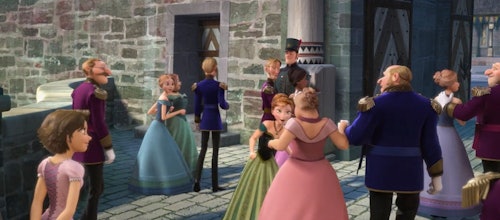
... the princess mentioned in the previous slide has found her prince .... Turns out it’s not him, but the princess and prince are very kind to ... and take care of .... Wouldn’t it be cool if this kind princess and prince were the inspiration for the Rapunzel and Eugene "Flynn Ryder" cameo in Frozen, eh? Eh?


Images: Walt Disney Pictures


REMARK BY DIAMOND GRANT
In an interesting parallel between movie and tale, in the fourth section of The Snow Queen, ... is told a story of marriage ..., about a princess who was fixated on getting hitched.


CRITIQUE BY Glory of Frozen vs. TSQ-IV

The different adventures (in TSQ) ... all represent a progression of love, of possession. ... the Princess who thought love was choosing a man who was handsome and talked well, ...

Anna (in Frozen) meets many people on her adventure and on the journey to locate her sibling, all of them representing love in its different forms: Hans, like the Princess of the tale, is almost shallow in his view of love, "true love" found so quickly and from nothing more than a day's meeting and a quick-witted word. 


FROZEN VS TS IN DISNEYFIED OR DISNEYTRIED, ON THE OTHER HAND, SEES KRISTOFF AS THE PRINCE (INSERT REMARK HERE):


miércoles, 30 de enero de 2019

THE SNOW QUEEN - REVIEWS

THE SNOW QUEEN - REVIEW BY ALTHEA ANN

This was one of my favorite stories as a very young child.

I hadn't re-read this short tale in many many years. My thoughts upon rereading:

Well, it's more sentimental than I remembered, and the tone, especially at the beginning, is almost verging on patronizing in the way it addresses the (presumably young) reader/listener. As a child, I don't think I picked up on that at all.  think as a kid I just tuned that stuff out, but took it for granted.

The imagery: still so beautiful! The shards of glass, the snowflakes, the roses... This is why the story has endured so long. It is simply gorgeous. 

As a child, I perceived Andersen's Snow Queen as the same character as Jadis, the White Witch in CS Lewis' 'The Lion, The Witch and the Wardrobe.' As an adult, well, yeah, it is definitely the same character. Lewis took her, whole cloth, and her sleigh too....

Vivid memory - this story was the first time I'd ever heard of "Lapland," and it seemed like such a fantastic land. Interesting to realize that this portrayal of northern Finland was probably much more 'realistic' & contemporary (if remote) to children reading the story when it was first published, and people there still did depend on reindeer and travel by sleigh...

The robber girl!!!! How on earth did I ever forget about her! Her practical and self-interested, but not quite 'bad' character is simply amazing.

I've seen modern criticism of 'The Snow Queen' accusing it of being an apologist tale for domestic abuse, encouraging women to pursue relationships with men who mistreat them. It is possible to read the Snow Queen as the homewrecker, and Gerda as the good wife who must faithfully pursue her errant husband, represented by Kai, but I don't think Andersen intended that, or that the story actually is that. I think it's more likely that Andersen intended another possible reading: that of an allegory, where both Gerda and Kai are, at times, led astray and forget what is right (Kai due to the shard of glass; Gerda due to the witch's enchantment), but eventually find their way back to the redemption and live in innocence and purity. However, I personally like the simplest and most direct reading: that the story is what it says it is, a narrative of bravery and friendship. That the enchantment on Kai is real, and not his fault, and that Gerda's dedication to her quest, and her achievement, is admirable. 

I think that one of Andersen's main intentions here is, clearly, to show women as brave, capable, and self-sufficient. Throughout the story, they keep appearing: First, of course, there's Gerda and her quest to rescue her friend. But there's also the childrens' grandmothers, who are more vivid characters than the childrens' parents; the springtime witch, who keeps her cottage all on her own; the princess, who had no intention of marrying until she met a man who appreciated her intellect; the knife-wielding bandit girl, whose mother seems to be the leader of the robbers; & the Lapp woman, who gives Gerda help & directions on her quest, to meet a Finnmarkish wise woman. Of course, the Snow Queen herself wields her power alone...

The biggest takeaway I believe I had from this story, though, is from the very beginning. The imps' twisted mirror which shows everything as ugly and rotten, and its shard of glass that, in someone's eye or heart, does the same, took hold for me in the idea that the world is the world, but that how we look at it can be an option. We can focus on the mean and the corrupt in all things - or we can look for the beauty and the redeeming qualities of the world. It is up to us. (We don't have to see everything as boiled spinach or vast barren wastelands of decay.) ;-) 

Along with the evocative imagery of winter, there is a very emotional and spiritual love story. Kai and Gerda share a strong emotional bond, but that bond is damaged by Kai's infection with the slivers from the shattered evil mirror. His eye and his heart are pricked, and it changes the way he sees the world, and makes his loving heart grow cold towards poor Gerda. But Gerda doesn't give up on him. When the Snow Queen steals away Kai, she goes searching for him, going on quite an odyssey and meeting some very unusual people along the way. But she never gives up on him.

The lesson of sacrificial love never gets old. That kind of love can melt the fiercest frozen heart and claim back those who are lost. I loved rereading this, and the illustrations I had in my version was a lovely adjunct. 

If one has not ever read this book, I highly recommend it.

Many thanks for the opportunity to revisit this tale. As always, my opinions are solely my own. 


REVIEW BY BIONIC JEAN

I remember being bored when I read this story as a child, and reading it again now, nothing has really changed for me. The Snow Queen starts out interestingly enough, and the imagery throughout is good, but as for the actual storyline... It is very long and discursive, and as in many fairy tales, the events seem very random, and the reader tends to lose the main thread. It is the sort of story which could make a marvellous stage production, with all its imaginative possibilities, or a film or TV adaptation - as indeed it has, many times over the years. There are also many beautifully illustrated versions of the tale.

The Snow Queen, or "Snedronningen", by Hans Christian Andersen, is one of his longest original fairy tales, which was first published in 1844. At its core it is about the struggle between good and evil as experienced by two children, a girl, Gerda and her friend, a boy, KaI. It is told in seven parts, or chapters:

1. The Mirror and the Splinters
2. A Little Boy and a Little Girl
3. The Old Woman's Flower Garden
4. A Prince and a Princess
5. The Little Robber Girl
6. The Lapp Woman and the Finn Woman
7. What Happened at the Snow Queen's Palace and What Happened After That


The first part starts in Hans Christian Andersen's delightfully chatty way,

"Listen! This is the beginning. And when we get to the end we shall know more than we do now."

The storyteller tells of an evil troll, who made a magic mirror which distorted the appearance of everything it reflected. It would never reflect the good and beautiful aspects of people and things, but instead magnify their bad and ugly aspects. The villain thinks this is a great joke. He is the headmaster at a school for demons, who all decide to carry the mirror into heaven with the idea of making fun of the angels or gods... But, 

"the mirror shook and grinned, and grinned and shook" until eventually all the demons dropped it, and it broke into "a million billion splinters", some no bigger than a grain of sand.

These glass splinters "blew everywhere, getting into people's eyes, and making them see everything ugly and twisted. Some splinters even got into people's hearts and that was awful, because their hearts became like blocks of ice."

The first part is quite a short chapter, explaining the underlying moral thread which is to run throughout the story. The next chapter introduces the two characters, the little boy Kai, and the little girl Gerda. They live next door to each other in a large but provincial town, in the garrets of buildings which have adjoining roofs. They play among the window boxes there, which are full of herbs and roses. It was easy to get from Gerda's to Kai's home, just by stepping over the gutters of each building. The two become great friends.

Kai's grandmother tells them stories about the Snow Queen, who is ruler over the "snow bees" — snowflakes that look like bees. Just as honeybees have a queen, so do the snow bees. So wherever the snowflakes clustered the most, there you would find the Snow Queen. Looking out of his frosted window one winter's day, Kai sees the Snow Queen, who beckons to him to come with her. Kai is frightened and draws back from the window. 

The days pass and there is a thaw. But one day in Spring, something happens, 

"Oh! What's that pain in my heart! And oh! What's that in my eye?" 

Even though the child blinks and thinks it has gone, we can tell from their behaviour that one of the glass splinters from the evil troll's mirror has become lodged. The child becomes cruel and aggressive, and the other cannot understand the change in their friend, who teased them, "kicked the window box, and tore off the rose blooms", made fun of the kind grandmother, and did all sorts of horrid things. Everything seemed distorted and ugly to this enchanted child now, and the only interesting and beautiful things, are the tiny snowflakes to be seen through a magnifying glass.

While Kai and Gerda are playing with their sleds in the snow, the Snow Queen appears as a woman in a white fur coat, driving a curious white sleigh carriage. The enchanted child is tempted to go back with the Snow Queen to their palace.

If this is all beginning to sound familar to you, perhaps it reminds you of C.S. Lewis. The first part of this story, with the adjoining garrets and crossing over the rooftops, was very reminiscent of the first (or prequel) Narnia story, "The Magician's Nephew" At the beginning of that story, the Victorian children are neighbours in a similar type of building, and this aspect is crucial to the story's plot. Then in a similar way, C.S. Lewis clearly took his inspiration for the witch "Jadis" Queen of Charn, (who called herself the "Queen of Narnia") from Hans Christian Andersen's Snow Queen. The first meeting between Jadis and Edmund, one of the children in "The Lion the Witch and the Wardrobe" is almost a rerun of Hans Christian Andersen's idea.

Just as C.S. Lewis's stories are clearly moral allegories, this earlier story is also a tale of good and evil. And all the subsequent story follows the child who is under the mirror's spell. It involves an evil sorceress, a clever crow, a pair of doves, a Prince and a Princess, a frightening robber girl, and a captive reindeer. There is a "Mirror of Reason", and a Puzzle. There is a beautiful flower garden, an old Finnish woman and an old Lapp woman. Throughout, the child is determined to rescue the friend, showing loyalty, great courage and tenacity. Eventually the children's adventures are over and the enchantment is dispersed by the power of love. Kai and Gerda make their way back to their home, where they find that everything is just the same, except that they themselves have grown through their experiences. 

At the end, the grandmother reads a passage from the Gospel of Matthew,

"Except ye become as little children, ye shall not enter the Kingdom of Heaven"

and Kai and Gerda realise that they were saved by their goodness and innocence. They will always remain children at heart.

This story was originally included in the same book of fairy stories as "The Nightingale" which was a tribrute to Jenny Lind. But in the meantime, Jenny Lind had spurned Hans Christian Andersen's affections. The author subsequently - and rather unfairly - modelled the Snow Queen on what he saw as her icy manner towards him. The Snow Queen is a story of high fantasy, and usually included in most anthologies including works by Hans Christian Andersen; it is considered one of his greatest stories. However it does not really capture my imagination. I am extremely glad though, that he inadvertently provided the inspiration for part of C.S. Lewis's Narnia Chronicles, which I do enjoy enormously.

"I can't give her any more power than she has within her. Don't you feel how strong that is? Humans and beasts are at her service as she makes her way through the wide world on her own two bare feet. But she must not learn of her power from us."

(The Finn woman talking to the reindeer)


DAVID

It's not a particularly thrilling fable - boy meets girl, boy loses girl, boy gets girl back - though really, it's the boy who is lost and the girl who does the getting.

The story starts with an evil hobgoblin (also referred to as a demon) who goes to magic school (why did Rowling not find a way to hook this into her mythology?) and creates a magic mirror which shows "reality" in the harshest, ugliest way possible. It is shattered into a million pieces, and spread around the world, where it becomes smaller mirrors, spectacles, or tiny specks of glass getting caught in peoples' eyes, creating mischief and cold-hearted misunderstanding.

One such shard gets in the eye of a little boy named Kai, who then spurns his childhood sweetheart, Gerda. One day he goes wandering in the woods and is picked up by the Snow Queen. Gerda, convinced that he is not dead, goes on a quest to find him.

There are talking flowers, talking crows, and a not-really-wicked witch, and of course, the Snow Queen herself.

A cute story with perhaps a few too many elements thrown in for the fantasy-minded modern reader, but it would certainly entertain children. Andersen does wrap this tale up with a rather saccharine moral, but it's a story to please those in search of adventuresome girls and magical talking animals.


JAROM

I. LOVE. THIS. STORY.
Yes, this is a fairy tale that I plan to tell my children before I tuck them into bed at night. Holy cow.
This is the tale of a boy and a girl. Simple enough, right? The story hasn't even begun and you know it will be good.
It all begins with a mirror. Made by demons in the pits of the Realm of Hades, this mirror takes everything good that looks into it and makes it the exact opposite. The better of a person you are, the worse it makes you look.
This mirror shatters. Shards fall to the earth, and one of them pierces the heart of a boy. It poisons him, freezes his heart over, and he is spirited away by the mysterious Snow Queen.
The girl, his close friend in childhood, notices his change in behaviour and when he goes missing, she embarks on a quest to save him.
Following several encounters, she finally finds him deep in the Snow Queen's frosted palace, frostbitten and numb to the world.
He doesn't recognize her.
It is here that she realizes just how much he means to her, now that he looks at her with dead eyes.
She can't get him to remember her, so she hugs him and turns to leave.
And the shard of mirror falls out of his heart, and it all suddenly comes rushing back.
He sweeps her off her feet and they live happily ever after, the end :)
Perfect.
This is a fairy tale that puts into perspective the journey. Everyone expects a happily ever after to fall into their lap as soon as they fall in love.
We often overlook the dragons, the orcs, the goblins and imps that lie in the way to everlasting happiness, don't we?
Well folks, love is easily found.
Pure, true love, however, is what remains when the knight sheathes his sword for the last time. After the last bandit surrenders and the troll lies slain, that is when two lovers decide on a happily ever after.
So the million dollar question: is love worth it? Is it worth the fight?
I'm with Hans Christian Andersen: Heavens yes it is!
Great story. Loved it.


MILICA

One day, when the king of all goblins was feeling very good about himself, he created a special mirror. The mirror took everything that was good and beautiful in the world and turned it into bad and ugly, and when things were bad and ugly it did the opposite. When the goblins – the villain’s pupils tried to fly to Heaven, to mock angels, the mirror laughed so much that it slipped from goblins’ hands and shattered into millions of pieces when it hit the ground. Some of those pieces were so small that they could fly all around the world, and every time they got in someone’s eye or their heart, they made that person only see what’s wrong and bad about everything. That’s what happened to Kai.

Kai was a small boy who had spent all his life playing with his best friend Gerda. Shortly after he was struck with the piece of mirror, the Snow Queen came and kidnapped him. Everybody thought that he was lost, everybody except of Gerda. In order to find Kai, with only innocence of a child as her power, Gerda will travel through dangerous places and meet all kinds of people, some good, some bad. But, what will happen when she finally finds him?

The Snow Queen is a story about friendship, the purest kind, about children's innocence, and about love. I think I would have loved it more, had I read it as a child. This way some parts were boring to me, and the final resolution was painfully anticlimactic. Still, it was nice story and I’m glad I read it. This edition contains illustrations, and I found them nice addition to the story.


Glory (reviewer): 

How does The Snow Queen relate to Frozen?

I won't go into huge detail over particulars, just name a few things that both film and book share, especially thematically. Both tales carry a theme about love and its many forms (the Andersen tale also includes a strong moral on the smearing of innocence that leads to destruction, and the perils of innocence's opposite -- industrial progress). The different adventures of Gerda all represent a progression of love, of possession. The old lady who wanted to hoarde her, the Princess who thought love was choosing a man who was handsome and talked well, the robber maiden who captured her pets for her own amusement. And then there is Gerda, a legion of angels in her breath, Prayer on her lips, a power within her worth more than a dozen men and lasts longer than all the creations of humanity: true love.

That's where this little tale threads to the Disney film that claims origin to its story. Anna and Elsa's love are as Gerda and Kai's. Their childhood of fun is turned to separation when winter comes, with Anna (Gerda) only able to see her sibling (in blood or in spirit) through a small peephole of a window, or a keyhole. Anna meets many people on her adventure and on the journey to locate her sibling, all of them representing love in its different forms: Hans, like the Princess of the tale, is almost shallow in his view of love, "true love" found so quickly and from nothing more than a day's meeting and a quick-witted word. The stone trolls are unconventional, rude, unlikeable, like the robbers Gerda meets along the way. Yet like the robber maiden and her mother, the trolls have a "pure love" within their clan. Olaf the snowman is the pure representation of a child's love and innocence, like Gerda is in Andersen's tale. Kristoff is the representation of a pure romantic love, which was not quite represented in the original tale, but acts as a foil to the Hans romance.

There is a reindeer, a homely house that is warm and gives her supplies against the cold, living snow creatures that defend the Snow Queen's home, a blizzard-swept finale on a frozen lake, and, of course, the expression of love that thawed little Kai's frozen heart and Elsa's cold soul. And as with the love of Gerda and Kai, so with Anna and Elsa:
"and wherever they went, the winds ceased raging, and the sun burst forth."

Brandyn:
Suprised by the evil elements in the story! For instance the kidnapping, the robbers and the little girl robber who threatened to kill! Full of danger and mystery and bad characters. We were wanting resolve with the snow queen but the end left it up to our own imagination...


Drew Graham:

Little Kai and little Gerda were best friends who lived just a rooftop-jump away from each other. When a shard of a mischievous demon's viciously cursed mirror falls into Kai's eye and heart, he is soon whisked away by the Snow Queen to her icy domain, and it's up to Gerda to go on a journey to find him and bring him home.

Ah yes, I've finally reached the most recent Disney release in my source material read-through. This is a story I knew well as a kid, but I think I'd forgotten most of it over the years, so it was nice to read this faithful retelling. I'm of two minds about this story: On one hand I think it's beautiful and melancholy and even fairly epic, but on the other hand it meanders and has a lot of filler and sometimes just makes no sense. The story itself is fairly simple, but it gets distracted along the way by long-winded flowers sharing irrelevant stories, a red herring prince and princess, and of course the perhaps-homicidal robber-girl. But I don't know, maybe it's all some deep symbolic thing and I just don't get it. In any case, I love how it's wintry and cozy at the same time, and how the seasons are such a big part of the storytelling, and even though Gerda and Kai (and most of all the Snow Queen herself, who appears in basically TWO scenes and says and does almost nothing) aren't the most developed of characters, their relationship feels like something worth trekking to the chilly north to save. Maybe the Snow Queen isn't the most dynamic or threatening villain ever, but maybe that's the point... the danger of the snow and cold is well-established, and really the whole mess started with that little demon in the first place. Angela Barrett's illustrations in this edition were pretty lovely, though I think there could have been a few more of them.

(Also of note, apparently this is also the only fairy tale that has only female principal characters, but I really don't think HCA was trying to say something when he made that decision... I think that's just how this story happens to play out.)

Regarding Disney's interpretation, this is definitely one of the loosest adaptation jobs they've done. They took one part of the premise of this story, adjusted it almost beyond recognition, and then wrote their own completely different story around it. I know they've always taken liberties, but Frozen is so beyond recognition as based on this story that it almost seems like a joke to say the movie's based on it. Don't get me wrong, I liked Frozen okay (I mean... OKAY), but when you consider their original treatment and some of the concept art they did, which aligned a lot more closely to the actual story of the Snow Queen, it feels kind of like a wasted opportunity. Oh well, at least we have access to some of that stunning artwork.

Hans Christian Andersen's tribute to all seasons but mostly winter is wonderful reading for this time of year. At its heart it's a little bit scattered and doesn't always make sense as a story, but the themes and imagery are interesting and evocative. The illustrations by Angela Barrett complemented the translated text nicely, and I was glad to refamiliarize myself with this favorite fairy tale (which bears almost zero resemblance to a certain recent cinematic adaptation, alas).

martes, 3 de julio de 2018

FROZEN VS. THE SNOW QUEEN

Frozen vs. The Snow Queen


Christmas can be full of excitement, snowy landscapes, and family bickering. So what better time to look at Disney’s Frozen?
Based upon The Snow Queen, it’s about two sisters forced apart by fear and together again by love, and the story enjoyed a similar bout of see-sawing. There were talks about an adaptation way back in 1943, but it was only after 70 years of extensive fiddling that it finally saw the light of day. Luckily it was worth the wait: Frozen has been an incredible success and even ousted  The Lion King from its throne as the highest-grossing Disney film of all time. But was the original book left out in the cold?
The source text is yet another gem from the vault of Hans Christian Andersen, a failed thespian actor, singer, and ballet dancer (ballerino?) who became one of the most famous and well-travelled Danish writers of his time. His many fairytales fanned out from Germany in the 1840s, reaching as far as England and the Americas, and included works like The Little Mermaid and The Emperor’s New Clothes. He penned The Snow Queen, or Snedronningen, in December 1844, so he was probably feeling the Christmas vibe too, especially since he was a committed Christian who believed the world and nature were intertwined with divinity in a holistic worldview.
You’d be right in thinking Disney watered down the religious aspects for a secular audience, but that’s not all. For instance, instead of a kooky snowman, reindeer, and rugged mountain boy... our supporting characters include a stab-happy robber girl, a bearded lady, a couple of talking crows, and creepy old women obsessed with amnesiac children.
If that didn’t make you shudder, a freezing spoiler wind is about to strike, so if you need to wrap up warm, I’d hop to another post. But if the cold never bothered you anyway, let’s plough ahead.

A Tale of Two Siblings

For our original “siblings”, playtime is spared the drama of cryokinesis.


Andersen version


This inseparable pair are a little boy called Kai and a little girl called Gerda. They aren’t brother and sister but they play together as if they were siblings, and live opposite each other in attic rooms joined by an outside gutter. In the springtime and summer, flower boxes with rose bushes are planted in the gutter, forming a mini garden where they can play. The roses are their favourite, and Gerda teaches Kai part of a hymn about them, which probably won’t be important in any way:

“Where roses deck the flowery vale,
There, infant love will sure prevail!” 


In winter, they communicate via peepholes through the windows or by physically traipsing down the stairs, into the street, and up into the other’s house. One day while sitting inside, one of their grandmothers tells them about the “white bees” of snow (the snowflakes), and the “queen bee” who appears in the thickest of swarms and makes ice patterns on the windows. Gerda asks if this “Snow Queen” could ever come into the house, but Kai shrugs and says he would just melt her on the stove if she did.


Forgetting for a moment the change from normal, unrelated peasant children (ersatz siblings/best friends) to royal sisters, one of whom is the Snow Queen, there are a couple of similar themes here. One half of the pair is fearless, either threatening to burn a snow spirit on the stove or leaping up too high, and the other half is more cautious, either about said snow spirit or when her powers go too far. Neither snow queen has the best introduction, but Elsa is only a little girl with abilities beyond her control and non-threatening, making her more sympathetic than a ghostly apparition who could spell trouble. Regardless of their intentions, both snow queens will test the incredibly strong bond between the children.

Cold Shoulder


Pop quiz: what’s worse, being cruel to be kind, or intentionally being an arse?  Little Gerda’s about to find out.

Andersen version


This time it’s the more adventurous child who throws up a wall. One night, Kai is looking out of the window when a snowflake suddenly materialises into the Snow Queen. She is a tall, beautiful woman (rather than an insect-like monster) made entirely out of ice and has eyes that have no peace or kindness in them. Still, she’s nice enough to give him a wave, and he runs away pretending he saw a big white bird, something like an eagle.


During the springtime, while playing in the roof garden with Gerda, he feels a grain of something in his left eye, and his heart suddenly turns into a lump of ice. Strangely enough, it’s nothing to do with the Snow Queen.

There are no good-natured trolls in the original, but instead we have demonic hobgoblins, trolls in the original tale, whose leader creates a cursed mirror. The mirror gives modern day gossip columns a run for their money, magnifying anything bad and belittling anything good, and when it’s dropped and smashed, pieces of it rain all over the world. Just one tiny grain is as powerful as the whole, and Kai cops two of them, one in his eye and one in his heart. He suddenly decides to trash their beloved roses, kick over the flower box, tease a confused and tearful Gerda, and then make a name for himself mimicking anyone else he meets. The only thing he sees as unworthy of ridicule or perfect are snowflakes.
Both Elsa and Kai change their behaviour because of magic, but the former does this out of fear and to protect her sister rather than involuntarily, as well as to obey her parents’ wishes. Neither Anna nor Gerda have any clue why their playmate’s behaviour has changed so radically, and it’s hard to decide who has the worst deal. Anna’s whole family are hiding something from her and she has no explanation for it. All she has is happy memories which no longer make any sense. Kai doesn’t shut Gerda out for most of her childhood, and there is no conspiracy going on, but then again, the boy is actively an ass-hat to her and makes her cry.
Fortunately, neither girl will have to put up with this behaviour for much longer.

The Cold Light of Day


Elsa’s not the only one stretching her wings. After the way Kai has treated Gerda and everyone else around him lately, you’d think the town would also want to get shot of him. Their wish is about to be granted.

Andersen version


Kai is now allowed to play on a sled with the bigger boys in town (obviously, the local bullies), but when a large, white sled appears, he ends up playing sled-conga and is led out of the kingdom and away into the snowy wilderness. When they finally stop, the other driver is revealed to be the Snow Queen, apparently pulled along by white snow chickens. When she sees Kai shivering, she kisses him to take the cold feeling away, and then again so he forgets all about Gerda and his home. She then casually mentions that if she kisses him again it will kill him, so she’d better not. The boy doesn’t seem to mind because the Snow Queen is the only thing that looks perfect to him and his warped view of the world, and he willingly goes back with her to her palace, sleeping at her feet during the day and staring up at the moon at night.


Back in the town, people eventually believe that Kai is dead, possibly drowned in the river. Gerda believes this too until the spring sunshine and the swallows (birds of passage), and the flowers in the roof garden, tell her otherwise, so she sets off to find him herself.


A coronation day and being allowed to play with the big boys or bullies are obviously different in importance, but they are both “coming of age” events, and result in Elsa and Kai leaving their lives behind and embracing the ice and snow. For Elsa it’s a release and freedom after years of hiding herself, and for Kai, brain-washing aside, it’s something that he can finally see as flawless after his run-in with a shard of goblin mirror. Whether they’ve done anything wrong or not, both “sisters” take off after the other, but Anna has the foresight to leave someone in charge of her kingdom and to tell people where she’s going. She didn’t wait until spring to get her skates on either, but then again, she’s a bit more impulsive when it comes to boys. Will both girls survive alone out in the wide world?


Northbound

It turns out Olaf isn’t the only one oblivious to his surroundings and the seasons.


Andersen version


Gerda’s first port of call is the river, and while looking for Kai she is swept away by the stream and rescued by an old lady who lives in a riverside cottage. Whether the girl likes it or not, the old woman, a good witch, wants to keep Gerda, and magically removes any roses from her garden so she forgets all about her playmate. Luckily, she forgets to remove the one on her hat, and after some time Gerda’s memory is jolted. Her exasperated tears bring back the real roses, and she asks them and the other flowers if they know anything. While the roses can confirm that Kai isn’t dead, the other flowers can only impart stories like a Hindu woman burning to death on her husband’s funeral pyre, a medieval damsel yearning for her true love, and three beautiful sisters who run away into the forest to die. Helpful.


By the time Gerda has fled the garden, it’s now late autumn in the outside world. Fortunately, the snowy wastes further on yield more effective companions: a male wild crow and his tame mate who may have seen Kai getting married to an eccentric, intelligent princess recently. Said princess decided she fancied a husband one day and extended the invitation to any eligible bachelors around. Any who could speak well and comfortably to her would be her husband, and the one who succeeded where many awkward suitors had failed before, winning her heart and hand through his clever liveliness, a rugged chap with long hair and bright eyes, may have been Kai. Gerda really did take her sweet time!


After sneaking into their bedchamber, Gerda realises it’s a false sighting (it's not Kai, but still a dashing young man), but the prince and princess are cool with a peasant girl wandering into their private quarters, actually ask if she wants to stay with them, and when she regretfully refuses, give her some supplies for her journey. They spoil her with a muff (the type for your hands, stop sniggering), winter boots, and a golden chariot with horse, outriders, footmen, and coachman. And away she goes, with the crows, prince and princess waving a tearful goodbye. Her destination isn’t exactly set, but going somewhere is better than nowhere I suppose.
The wolves are the only Disney characters who want to capture the sister for themselves, and everyone Anna meets seems to want to help her, either out of genuine friendliness or possible reward. She herself is quite similar to Andersen’s husband-hungry princess, and at a push you can see the rugged Kristoff in the prince, but otherwise the aid is reversed – royalty is helped by the peasantry rather than vice versa, and a talking snowman rather than a crow gives hope to the search party, to link back to Anna and Elsa’s childhood. In Gerda’s case,  it’s the roses that keep her memory of Kai alive and spur her on, and this is all she has to go on for now, as no one has a clue where he went.
Sadly, not everyone they meet will be as endearing (or harmlessly creepy) on their trip.

Cold Snap


Our motley Disney crew have each other and a goal in mind. Although Gerda’s about to get both of these things, one of them gets worse before it gets better.

Andersen version


Don’t recognise any of the characters so far? Don’t worry, the reindeer's still in it.


Sort of.


Once her friends the crows are out of sight, Gerda is ambushed by robbers who massacre her entire entourage. A bearded, alcoholic old woman, the leader of the pack, drags her out of the chariot and decides to cook her for lunch, until her equally crazy daughter nearly bites off the woman’s ear and demands that Gerda be her playmate. Under the threat of stabbing, Gerda plays with and sleeps next to the robber girl, who has imprisoned a collection of woodland pigeons and a reindeer called Be. In between shaking the pigeons upside down, the girl tickles Be with a knife to scare him and stop him from running away.


When the pigeons reveal that they know of the Snow Queen (she killed their siblings by blowing on them), and that Be knows where to find her in Lapland, the robber girl relents and lets Be take Gerda further north to find her.


Their first stop is the Lapp lady, who gives Gerda a note written on a stockfish, a dried and salted codfish, a.k.a. this hellish abomination:
IT TASTES AS WEIRD AS IT LOOKS
...to take to the Fin woman, who can better direct them because the Snow Queen is staying even further north at the moment.


Gerda and Anna both experience backhanded affection from their sister or a supposed “friend”, who, paradoxically, almost hurts them to protect them from getting hurt. The Snow Queen also drops a little in our estimation, with Elsa unleashing a monster on her sister, and Andersen’s version killing baby pigeons on top of the whole “child abduction” thing. Although both sisters have a time limit slapped on them, Gerda would only be inconvenienced if she missed the Snow Queen, as opposed to dead in Anna’s case. Happily, the girls are helped by more experienced mountain folk and get to ride a kick-ass reindeer, so it’s not all bad. Not yet, anyway.

Ice in the Veins


Thirteen is definitely unlucky for some.

For Gerda, it seems that a strange power can actually protect you for once.

Andersen  version


She and Be finally arrive at the Fin woman’s house, a hobbit-hole-like home so warm that she practically walks around naked on all fours. For some reason Gerda lets a reindeer do all the talking for her, and Be asks the woman if she can give Gerda anything to help on her journey. She takes the caribou to one side and whispers that if Gerda can’t find the Snow Queen herself she’s already doomed, explaining that everyone on her journey has served her one way or the other, all because of her love for her “brother” and her child-like innocence. And to keep her innocence, and therefore safe, the girl must never be told that she has this power.

The Fin woman’s solution, therefore, is for Be to take her as far as the edge of the Finmark and dump her there. If you’re not sure how far north this is, the Fin(n)mark is where you find the North Cape, one of the most northern points of Europe and one of the last shreds of inhabited land before the North Pole.


Fortunately, Gerda has become as non-plussed as Anna in the face of adversity and turns the ice and snow to her advantage. The further she walks, the bigger the snowflakes get until they take on the sinister shapes of the Snow Queen’s guards. By reciting her evening prayer, she manages to conjure up her own ice soldiers to cut them up and protect her from the cold, so as far as she’s concerned she’s just out for a chilly and apparently magical walk.
Once Anna is unwittingly abandoned by her friends, she has as much chance surviving as a snowball in hell, and not least because Hans proves to be a million times more of a bastard than Kai was. Conversely, Gerda is deliberately abandoned by her friends – but not maliciously – and discovers her inner power. As for the Snow Queen, one only has a young girl on the warpath, while the more sympathetic one has half a kingdom and a power-hungry prince after her blood, on top of the knowledge that her sister is missing and possibly dead. Stress certainly isn’t good for the heart, but it’s no match for ice.

Come in from the Cold


Thankfully for Gerda, she needn’t bother with swords or ice statues, because she’s armed with three of the most powerful things in the world – love, words, and nostalgia.

Andersen version


Kai has been just as oblivious to danger as Gerda, and has spent all this time living in the Snow Queen’s vast palace. It’s a complete waste of space – some rooms go on for miles, but there’s not an animal or drunken royal shindig to be seen anywhere.  While the Snow Queen spends her days jet-setting all over the world, the boy spends his time sitting on the frozen lake floor, arranging ice patterns in a puzzle. If he can arrange them into the word “eternity” inside a sun shape, the queen will let him go and give him a brand new set of skates, because priorities. Thanks to the grains of mirror in his eye and heart, he’s obsessed with these ice shapes, and is cyanotic, almost black, with cold.

Gerda could saunter her way into the palace if she so wished because there’s absolutely no one to stop her from getting inside. When she finds Kai before the empty throne (the Queen had just left to bring the winter south again, to frost the grapevines and the citrus crops), he neither acknowledges nor recognises her, so she hugs him, cries, and sings the rose hymn they used to know. The combination warms him up and melts his heart, expelling the mirror shard inside a teardrop, turning him back into the sweet surrogate brother she once had. Kai and Gerda are so happy that they’ve found each other again that the ice pieces start dancing about too, and coincidentally fall to the ground arranging a sun which contains the word “eternity”. So, even if the Snow Queen came back, she could do bugger all – by the terms of an arbitrary agreement, Kai is now free.


A frozen lake is obviously the place to break an icy spell, and it’s an act of sibling rather than romantic love that does the trick. Anna and Elsa’s situation is more desperate, thanks to a falling sword and freezing heart, but in either case, it’s partially the Snow Queen’s fault that one half of the pair is going the way of Olaf the snowman. Snow and ice also end up helping them in the end, in the form of Olaf rescuing Anna, ice deflecting a sword, or actual pieces of ice becoming sentient and helpful. With Anna and Kai revived, what’s next for our snow sorceresses?

Summer of Love


Will Andersen’s Snow Queen be accommodating to Gerda and Kai?

Andersen version


The answer is “no”, because the Snow Queen never shows her face, allowing an elated Gerda and Kai to walk back completely unhindered by storms or adverse weather. When they reach the border of Finmark, Be and a younger reindeer are waiting for them. The latter has baps full of milk to feed them, and they run with them back down south, stopping for directions at the Fin woman’s home and then a quick snack, change of clothes and a new sledge at the Lapp woman’s. Once they reach their own country’s border with the first green buds, they bump into the robber girl – now riding a horse from Gerda’s chariot, whose footmen her family murdered – and she reports that the male crow is dead, and the female crow is wearing black ribbons on her feet for widow's weeds. In other equally happy news she is off to explore the world and promises to call in on them if she passes them (while also wondering if Kai is worth going to the ends of the Earth for!). The prince and the princess are also travelling through foreign countries, surely on their honeymoon. Lucky them.


On Kai and Gerda’s return to their hometown in late spring/early summer, the book is as subtle as a brick and sees the grandmother reading from the Bible, the Gospel of Matthew to be more precise. She simply says to them:

Without ye become as little children ye cannot enter into the Kingdom of Heaven


Ignoring her lack of greeting, recognition, or abject joy at their return, Gerda and Kai look at each other and realise they are now both all grown up, and that the hymn they once sang each other had a deeper meaning. By staying innocent children in their hearts, they are protected from evil, and from then onwards, springtime and summer also seem to last forever.

Conclusion


This time, it’s sibling love that conquers all.

The years of forgiveness, understanding and death-defying actions given by Anna and Gerda for their respective sister or brother show a stronger love than that felt by any of the romantic characters present. While Kristoff and Anna are certainly smouldering, their feelings can’t yet compete with the above, and you can forget Hans’s red herring romance. For Gerda’s part, she isn’t at all jealous when it’s revealed Kai may have married a princess, and they don’t kiss or marry (at least in the Andersen original; the Dumas version ends with the birth of their twin children) when they return home either.  As for Elsa, she has shut herself away, both mentally and physically, for a large chunk of her life in order to protect her sister, and while this was done out of love, fear was the overriding emotion. In Kai’s case, he was a prisoner too, but this time at the mercy of evil magic. He and Elsa are only truly free when they remember or allow themselves to feel love.

The other story themes are where the book and the film diverge. In Andersen’s The Snow Queen, faith is the ultimate protector. Gerda is the one who teaches Kai the hymn about the roses, and by reciting her Prayer she is shielded from the Snow Queen’s powers. It’s also a hymn that revives Kai, and by remaining innocent and childlike, untouched by temptation, Gerda is able to survive several potentially lethal situations on her own. Once the pair are back together again, and remain children in their hearts, the world always seems warm and summery to them. The Snow Queen in this story represents temptation, and she strikes when Kai is vulnerable after being touched by evil, or in this case a cynical adult’s view of the world. Rather unconventionally, the boy is rescued by the girl, and most of the wise and helpful people on Gerda’s journey are female. Then again, so are the creepiest ones.

In Frozen, we’re shown how fear can cripple and affect someone’s behaviour, and the perils of running away from your problems rather than trying to solve them, i.e. Elsa trying to stifle rather than experience and control her powers. Interestingly, it’s also implied that taking risks once in a while isn’t a bad thing. Despite the extreme likelihood of rejection, accidental injury and death, Anna persists in trying to spend time with her sister over the years, and charges off into the wilderness to find her when she makes her escape. Her whirlwind romance with Hans came to no good, but in the end she uncovered a royal conspiracy and found someone better in the interim. Her unfortunate spat with Elsa, while nearly fatal, showed her sister how powerful love could be and how to lift the spell. So Disney’s Snow Queen character represents overcoming fear and how to stop it from controlling you, hence the title “Frozen”.

The ultimate lesson of both stories is to give people the benefit of the doubt, to look on the bright side where possible and try to retain a childlike wonder when walking through the world. In other words, if you encounter a problem, a dilemma, or an idiot, remember there are more important things in life, and that there’s only one thing you should do.
Let it go.