Mostrando entradas con la etiqueta rap battle. Mostrar todas las entradas
Mostrando entradas con la etiqueta rap battle. Mostrar todas las entradas
martes, 5 de noviembre de 2019

miércoles, 14 de febrero de 2018
Honolulu Theatre for Youth's Rap Othello
Honolulu Theatre for Youth's Rap Othello
"You can lead a student to Shakespeare, but you cannot make him quote": so wrote a student in response to a survey about his previous experiences with Shakespeare in perhaps the most challenging of classroom settings: a prison (Bates 2003, 161). If the setting was unusual, the response was not, and it echoed similar sentiments and experiences from more traditional classrooms. As early as 1914, Ellen FitzGerald, a teacher writing in The English Journal lamented that for students "in the grammar grades" (i.e., up to junior high school), Shakespeare had become "tedium itself" (FitzGerald 1914, 345). In fact, even teachers, she acknowledged, experienced "the burden of this toilsome march through the plays" (346). By 1979, little seems to have changed; the journalist Gerald Nachman was surely echoing the experiences of several generations of secondary school students when he noted that in the schools, "Shakespeare becomes theatrical spinach: He's good for you. If you digest enough of his plays, you'll grow up big and strong intellectually like teacher" (1979). The comments above are linked by more than a distaste for Shakespeare, however; they are part of a narrative of discovery (both reported or hoped for) in which the initial resistance to Shakespeare is overcome. In the prison example, the inmates experienced a sea-change, leading one of them to declare, "I dig this Shakespeare stuff" (Bates 2003, 158). Another is reported to have said, using metaphors of ingestion that are curiously widespread in talking about Shakespeare,"We would rather eat the bread of this knowledge than the chicken in the cafeteria" (155). Again, these declarations of enthusiasm are echoed in any number of similar narratives about teaching Shakespeare in schools. Such narratives thus naturally contain strategies for overcoming the veritable gag reflex to the force-feeding of Shakespeare that is pervasive in educational systems.
It would be safe to say that one dominant trend in the past century for making Shakespeare more palatable to students has been to make Shakespeare their contemporary and to stress his continuing cultural relevance, and as a corollary, his capacity to reflect what Marcia Williams, the author of (brilliant) comic book adaptations of Shakespeare for children, calls their "preoccupations" (2003, 33). In fact, the prison teaching venture began as a conscious "test" of the "limits of Shakespeare's alleged 'universality'" (Bates 2003, 152) — his capacity, that is, to be relevant culturally and personally to even such hardened students. And Shakespeare seems to have passed with flying colors, at least as judged by a student remark about Shakespeare: "Maybe he ain't no different from what is going on in my own life!" (Bates 162). Perhaps the most revealing part of the prison experiment, however, was that the students were not deemed to be at the very outer limit only by virtue of being inmates. As the narrative made clear by casually dropping nuggets of biographical information and using fictionalized names such as "Juan" and "Antwon," many of the students came from ethnically mixed districts and had been affiliated with gangs. I mention this not to suggest biases in the writer, but to highlight the pervasive perception, and depressing social reality, that race is tangled up in America not only with incarceration rates, but also educational performance. Indeed, it is not unusual to see in accounts of classroom experiences the implicit assumption that teaching Shakespeare undergoes another test of limits when simply students, and not inmates, are involved. If they can learn Shakespeare, then anyone can. A representative triumphant remark from this setting is "Yo! A hit! A very palpable hit!" — an exclamation that is reported in, and that forms the subtitle of, an account of a Folger Library program in Washington, D.C. that was itself a palpable hit (O'Brien 1993, 40). In its union of Shakespeare's language with hip-hop argot, it suggests that a form of integration that brings the sensibility of the street to Shakespeare is possible. This form of integration, it further suggests, is not a one-way street: it is not only that Shakespeare lifts up these kids; it's equally that the spirit of hip-hop can breathe life into something as musty as Shakespeare.
Abstract
This review of Honolulu Theatre for Youth's rap Othello considers the production in the broader cultural effort to integrate high and popular culture. It studies in particular how rap offers a new, inverted version of "blackface" by reworking the racial, and racist, dynamic of earlier minstrel Shakespeare parodies. More specifically with regard to the production, the review considers how the adaptation tapped into the outsiderliness associated with the alternative discourse of centro-urban youth, not only to reconfigure Shakespeare in a fresh way but also to reassert the cultural power of rap.
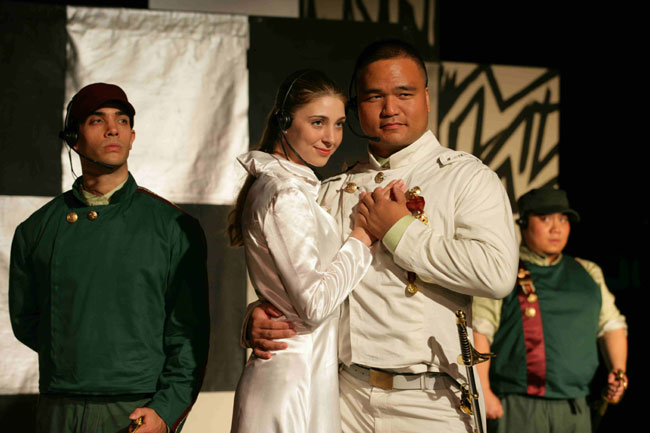
Othello, adapted by Y York in collaboration with BullDog on raps. Honolulu Theater For Youth. Tenney Theatre, Honolulu, Hawaii. February 25, 2006. Director, Tony Pisculli. Set, Alfredo Lista Garma. Lighting, Dan Anteau. Costumes, Nara Cardenas. Sound, Mathias Maas. Peformed by Charles Kupahu Timtim (Othello), BullDog (Iago), Elizabeth Wolfe (Desdemona), and Reb Allen (Cassio). Recorded version (for clips): Tenney Theatre, Honolulu, Hawaii, 2002. Director, Mark Lutwak. Music, DJ Jedi. With Charles Kupahu Timtim (Othello), BullDog (Iago), Nara Springer (Desdemona), and Jonathan Clarke Sypert (Cassio).
 |
Integration of this kind is not, of course, without its problems and anxieties. There is in all this more than a hint, for example, of the pastoral in William Empson's sense of the term (1974, 3-23, esp. 14); in the way that pastoral reinforces the hierarchical distinction between the court and country even as it celebrates the country, the accommodation of hip hop by high culture can end up emphasizing the distance between high and low, and indeed, by extension, white and minority. However, attempts at such integration highlight, in a highly focused way, a broader cultural effort in the teaching and adapting of Shakespeare to bring together a number of often antithetical elements: elite and popular culture; adult wisdom and youthful experience; and even the twin Horatian objectives for literature (filtered for educators mostly through Matthew Arnold) of instruction and pleasure. Indeed, one might say that a successful instance of integration puts Arnold to antithetical uses. On the one hand, it maintains his vision of high culture — "a study of perfection" (Arnold 1965, 91) that enables "intellectual deliverance" (Arnold 1960, 5) from the anarchy of modernity; on the other hand, it adapts Arnold's notion of the past communicating with the present to make Shakespeare a contemporary who gives voice to, and is steeped in, precisely the anarchy that Arnold deplored.
It is no wonder, then, that so many stage adaptations of Shakespeare for younger audiences feature rap. Rap certainly offers an adapter the alluring prospect of instant street credibility. But an "ad(r)aptation," to borrow a term from Richard Burt (2002, 209), also proceeds from the premise that the characters as well as the audience share something of the oppositional energy and outsiderly status of centro-urban youths. This holds true whether or not the cast or the intended audience is ethnically mixed. In the way that consumers of rap are overwhelmingly white and suburban, rap on the Shakespearean stage for younger audiences is decidedly not confined to the proletariat. (In fact, in the above Folger program that proved a palpable hit, participants included white students from rural and suburban areas.) What rap offers, as much for the audience as the performer, is an inverted version of "blackface." It reworks the dynamic seen, for example, in nineteenth-century minstrel or "Ethiopian" burlesques of Shakespeare (such as Hamlet the Dainty [Griffin ca. 1880] and Dar's De Money [Williams ca. 1870]) in which "high" content is travestied by white performers in blackface who rely on racist caricatures; this form of blackface works to "reinforce," as Douglas Lanier has noted, "the image of blacks and black culture as irredeemably 'low'" and thus also to "undermine African American aspirations to cultural legitimacy" (2005, 4-5). Rap offers the performer a new form of blackface that, first, trades on and thus attempts to legitimize the alternative discourse of urban youth, and second, makes the claim that an interactive cultural exchange across time with the classics can fend off the danger of their growing inert. At the same time, the presence of rap casts the audience as chosen cultural outsiders to whom and in whose language Shakespeare comes to speak. In the context of a performance for youth, "blackface" provides a revisionary idiom that acknowledges a student's resistance to Shakespeare while enabling unexpected engagement.
This brings us to a 2006 performance of Othello by the Honolulu Theatre for Youth (HTY), a professional company with a fifty-year history that performs a variety of dramas for younger audiences in Hawaii. The Othello was an adaptation by Y York (Y is her actual given name) that cut the play down to sixty minutes and four characters (Iago, Othello, Desdemona and Cassio), but that retained a great deal of Shakespeare's language. Its defining feature, as might be guessed, was a series of eight raps distributed among the characters, including Desdemona. Because of their dramatic importance, I will focus exclusively on the raps, though other features of the adaptation (like York's skill in assimilating invented dialogue with Shakespeare's text) deserve attention. As I proceed in this review, I will refer to and provide links to clips from an earlier production (2002) of the same adaptation that was staged by a different director and that featured a slightly different cast (same Iago and Othello, but different Desdemona and Cassio). As happens with plays in production, some of the language, especially in the raps, went through changes. Notwithstanding all the interesting differences, the two are sufficiently similar that I will treat them as one continuous performance, noting differences only when significant.
As the artistic director Eric Johnson and the playwright both told me in an interview (2006), HTY staged this show, not for any young audience, but a specifically Hawaiian young audience. This meant, for one, that they expected a multiethnic cast and an audience that would understand the racial tensions in the play in Hawaiian terms. More specifically, the actor cast as Othello (Charles Kupahu Timtim) in both the 2002 and 2006 production was Native Hawaiian, whose ethnicity was very visibly highlighted in the earlier production by Polynesian tattoo markings on his face. As a result, though references to Othello's blackness were almost entirely removed from the text (no "black ram" [Shakespeare 2005, 1.1.91], or "Haply for I am black" [Shakespeare 2005, 3.3.294]), and though eliminating Roderigo also meant that the hostile racializing of the Othello-Desdemona relationship was removed, Othello's outsiderliness was still palpable. (Native Hawaiians, it should be noted, are very much outsiders in socio-economic terms; as a group, Native Hawaiians have the lowest mean income and suffer the highest rate of poverty in Hawaii.) That is to say, the vulnerability and rage that Othello experienced were subtly, but visibly, inflected by the actor's ethnicity and came through most forcefully in his raps. But it was not only Othello for whom this was true. Iago was played by an Asian actor (BullDog), which meant that in the production that I saw live, which cast white actors as both Desdemona and Cassio, Iago was partly linked to Othello as an outsider. Being rather short and stocky, moreover, he did not have the most prepossessing of physical features. However, he had the actorly skill and stage presence to use his body to create a highly conflicted persona whose drama was deeply engaging: on the one hand, especially in his outward dealings with others, he often displayed a loser's sheepishness that masked a deep bitterness; on the other hand, as he stage-managed his plots, he moved and packed his words with the vitality and focused rage that came from deep pain and harbored grievances. Once again, his particular combination of vulnerability and rage came through most engagingly in his raps. The clip below shows an early rap (loosely based on Shakespeare 2005, 1.3.387-408 and2.1.286-312) in which Iago releases his anger in the following refrain:
This, too, was a version of "blackface," in which he used the aggression associated with rap to articulate his pent-up rage for action.
As for me — I hate the moor to infinity
          He's not for me a divinity — you're kidding me
        He's a devil 'twixt me and supremacy — it's killing me
          The rage is filling me — Action! What will it be
        For me — I hate Othello to infinity.
If Iago assumed control of the stage action with his raps early in the play, Desdemona, in her one rap in the show, became the play's emotional center. In one of her most effective maneuvers, Y York created a monologue for Desdemona that incorporated Othello's speech before the Senate about the course of their wooing (1.3.142-84). With the lyrical plangencies of the verse transferred to Desdemona's voice, what is in Othello's voice an eloquent fable became a dreamy, giddy, and even hypnotic love poem. The following clip comes directly after Desdemona recounts the "disastrous chances" and "moving accidents" of her courtship with Othello:
I must confess that this Desdemona (Nara Springer) was a more versatile and powerful performer than the Desdemona I saw live (Elizabeth Wolfe). Wolfe didn't quite catch the tremulous anticipation that brought innocence and a bourgeoning sexual power together in Springer's performance. A part of this had to do simply with ability, but I think the fact that Springer is also a native Hawaiian contributes an element of vulnerability to her performance. Indeed, if Desdemona became the emotional center of the play with this rap (even in the live version), it was partly by virtue of the open vulnerability she displayed — the complete submission to love, repeated in the refrain of "I loved him," that was at once buoyant, lyrical, gutsy,and informed by the steady urgency of the beat. Put another way, the confluence of lyrical confession and a rap beat gave a unique color to Desdemona's vulnerability and set the melodic beat associated with her rap as the emotional undersong of the play.
Indeed, versions of "I loved him," sometimes accompanied by the same melodic beat, would recur at key moments in the play. In the rap that followed, Iago confessed his love for Desdemona in lines that revealed his vulnerability, but that also reeked of his grotesque sexual envy. It is as if, into the jolting and demonic line, "Now I do love her too" (Shakespeare 2005, 2.1.291) in Shakespeare's original play, Iago had integrated the pathos of Roderigo's comically pathetic romantic aspirations:
It was in the end more telling that Iago returned to his true theme — "What to do?" — indicating that a rage for action and revenge ultimately drove him; nonetheless, the rap revealed also that Iago was as much caught in the web of Desdemona's love as she was in his web of treachery.
I love the lady in equal measure
  As I hate the man who mounts her for pleasure
 Cause I loved her, truly love her.
Of course, the character who was most deeply caught in Desdemona's love still remained Othello. Significantly, York did not give Othello any raps until he fell into jealousy. His first was an adapted version of "Why did I marry?" (Shakespeare 2005, 3.3.273), which included as a refrain the question, "Who's to blame?" In the following clip, one can see what was the defining characteristic of Othello in this adaptation — something an adolescent would recognize, but recoil from because it hit too close to home: a vulnerability that expressed itself in obtuseness. Though he engages in a degree of self-reflection as he ponders the question "Who's to blame?" Othello eventually places the blame squarely on Desdemona:
Othello was very much a character burdened by the weight of his own collapse. But this collapse also suggested something else — that Othello was an outsider through and through: as a warrior, he was an outsider to the intimacies of love; as someone called the "hot-blooded thick-lips," an outcast in his deepest fears; as a gullible dupe, an outsider to security. In the following clip, Othello has fallen into his epileptic fit, which in the live version was rapped as a duet, with Iago and Othello variously sharing the spasmodic line, "Lie with her? Lie on her?" (Shakespeare 2005, 4.1.44):
Othello can be a wretched play to watch, becoming ever more painful as Othello is reduced to the state of an animal, yelping and writhing in pain even as he abuses Desdemona with progressively greater fury and blindness. Certainly this version was painful to watch, especially with a relatively young Othello, whose somewhat rough acting skills actually reinforced his character's unhinged pain.
The play's final rap, a version of the "It is the cause" speech (Shakespeare 2005, 5.2.1-22) that Othello utters before killing Desdemona, was the culminating rap in that it brought together many of the refrains and melodic beats that were woven throughout the play. Othello continually repeated "She is the cause" and "She is to blame," thus answering for and by himself his earlier question, "Who's to blame?" If in giving such an answer, he revealed how debilitated he had become because of his sexual jealousy and warrior mentality, his abiding love and vulnerability also surfaced in the counter-refrain of "I loved her," backed by the melodic beat of Desdemona's theme:
The 2006 production ended with a blackout on the "tragic loading of this bed" (Shakespeare 2005, 5.2.414), but the recorded version ends with a slow, elegiac break dance by Cassio to Desdemona's theme, which I include below because it would have been a fitting ending to the live version I saw as well:
It's hard to imagine that break dancing to a rap beat could be so elegiac, but the dance captures with exquisite precision the central emotion and sensibility of the adaptation. It has a power that comes from an alternate, adversarial culture, but that power, precisely because it is of that culture, contains within it a fragile and melancholy beauty. The dance is, in this respect, an emblem of the entire production.
Seen from their dramaturgical function in the adaptation, the raps in the HTY Othello were very much like arias in mature classical opera; though they were set pieces that offered individual characters the opportunity to display their emotions in their largest shape, they were also integrated very well into the narrative and thus advanced the story effectively. Looking more broadly, the raps were the heart of the adaptation in that they embodied the larger cultural effort that theaters for youth engage in to integrate high artistic greatness with popular culture. Significantly, the raps were also the parts of the adaptation that departed most freely from Shakespeare's original and in which Y York collaborated the most closely with her cast (principally BullDog, who is a musician in his own right). The raps, quite simply, offered the most direct access for the audience into the adapted play. Of course, given how common the use of rap has become in Shakespeare adaptations for younger audiences, it would be understandable if one felt the urge to roll one's eyes on hearing of yet another version. One would also be forgiven if he or she merely looked on with skeptical bemusement, as Bill Cosby's Dr. Huxtable did with his characteristic dead-pan look as he watched his Shakespeare-challenged son Theo rap a speech from Julius Caesar in the 1986 "Shakespeare" episode of "The Cosby Show" (1986). However, rap led the HTY audience to Shakespeare, and far from gagging, they relished the offering with deep enthusiasm.
jueves, 3 de diciembre de 2015
REELING AND WRITHING III: DISSES
REELING AND WRITHING
or,
Miss Dermark's 2015 Advent Calendar
DAY THREE
DISSES
or,
HOW TO DISS ONE'S OPPONENTS DERMARK STYLE
Today, we'll be looking at disses, showing you my Othello parody, a rap battle I have written, and one of my favourite Swedish songs done into English (by myself): Evert Taube's "Seventeenth Ballad", written in his youth as a bohemian... a caustic, Voltairian "take that" at Stockholm high society that has had an interesting history as a song.
First we'll look at Othello: the Shakespearean play, Charles Lamb's short story, Boito's libretto, Kalbeck's translation of said libretto into German, and my own parody, the Travesty. To see how Iago disses Cassio in all of these versions and how I manufactured my own Dermark brand of Iago's rant of disses to Cassio:
SHAKESPEARE:
CHARLES LAMB:
This promotion gave great offence to Iago, an older officer who thought he had a better claim than Cassio, and would often ridicule Cassio as a fellow only for the company of ladies, and one that knew no more of the art of war or how to set an army in array for battle, than a girl. Iago hated Cassio, and he hated Othello as well for favouring Cassio, as for an unjust suspicion, which he had lightly taken up against Othello that the Moor was too fond of Iago’s wife Emilia.
BOITO:
KALBECK:
das aufgestutzte Offizierchen,
Verdrängte mich vom Platz, von meinem Platz,
Den ich in hundert ehrlich geschlag'nen Schlachten
Verdiente. Das war das Werk Othellos.
Ich bin der Fähnrich seiner Mohrenschaft
geblieben.
THE TRAVESTY:
IAGO (to himself): I have fought by his side in countless battles, on the frontline itself, risking life and limb by his side, and yet... (Pause.) That frilly little upstart... that stripling of this new kind of "educated officers", who knows as much of tactics as a novice in a nunnery... has just usurped the rank which is mine by right! He should rather die! Er... Why not? (He gives the audience a mean death glare)
And there you have it. The Shakespearean mention of Cassio as a book-learned officer without the field experience Iago has, scare-quoted for irony; the "frilly little (officer)" from Kalbeck's translation; the word "stripling" for a young man, especially a slender and/or feminine seeming one, which I learned from a Joyce story (used to describe English artiste Weathers, one of my favourite Joyce characters); and "upstart", which, referring to Cassio as a newcomer suddenly risen to power, has all the connotations of a slur. How eclectic a combination! As for Cassio's field experience... Shakespeare compares it to an old maid's, Lamb's to a young girl's, while my Iago goes the extra mile by comparing it to a novice nun's, quoting à propos a verse from the Modern Major General Song in The Pirates of Penzance. The climax, the jewel of the crown, comes from Iago saying Cassio "has usurped the rank which is mine by right." the use of "usurp", a pretty loaded verb, is from Boito's libretto, while Iago's entitlement and defense of his claim recall Stannis Baratheon's attitude towards his brother Renly ("The Iron Throne is mine by right."). There you have my version of the lieutenancy rant, an eclectic, intertextual, intelligent, ironic, and savvy rant so typical of the Travesty Iago.
Now on to the next example: Joffrey "Baratheon" vs. Dellinger.

Honestly, rap battles haven't been my cup of tea until, a month ago, I saw Romeo and Juliet vs. Bonnie and Clyde. Then came Julius Caesar vs. Shaka Zulu, Marilyn Monroe vs. Cleopatra, Asian philosophers vs. Western philosophers, Shakespeare vs. Doctor Seuss, Gandalf vs. Dumbledore, Rasputin vs. Stalin (feat. Lenin, Gorbachov, and Putin), Donald Trump vs. Ebenezer Scrooge (feat. J.P. Morgan as the Ghost of Xmas Past, Kanye West as Xmas Present, and the Grim Reaper as Xmas Future), Mrs. Claus vs. Mary Poppins (feat. Santa and Bert), Maleficent vs. Daenerys, and most recently Hermione vs. Katniss.
Why I chose Joffrey and Dellinger? Because they're uncannily similar and yet foils to one another. Both of them are arrogant blond male teenage sociopaths, yet there are contrasting differences: Joff is the fruit of twincest, while Dellinger is half-human (and half-fishman). Joff had a tough childhood with his dysfunctional royal family, while Dellinger was happily adopted since early infancy by a pirate crew/syndicate. Joff is always sharply dressed, while Dellinger wears pretty eccentric attire (a baseball cap, a turtleneck, shorts, and... stiletto heels?). Joff sticks to gender roles, while Dellinger was raised as a girl and, though identifying himself as male, is pretty effeminate. Moreover: Dellinger's pumps are purple just like Joffrey's wedding, and he's got an attack called Decapitation High Heel, which can reference the fate of Ned Stark (for revealing Joff's true parentage)... and Dellinger is horned, while Joff wears a crown of antlers (referring to his "Baratheon" heritage, but also subtly to his own bastardry and "los cuernos" Cersei put on Robert). Also, Dellinger is bull-horned like the helmet of Joffrey's blacksmith stepbrother Gendry (who may be, in turn, a reference to the Cretan Minotaur), who is a royal bastard though on Robert's side instead of Cersei's.
With all of this in mind, no surprise that I wrote the rap battle...
(Before you continue: this rap battle contains SPOILERS for the Dressrosa arc of One Piece, and EVEN MORE SPOILERS for A Storm of Swords and Game of Thrones Season 4. If you wish not to have any of these stories spoiled, skip the rap battle entirely and go on to the next reference.)
EPIC RAP BATTLES OF MISS DERMARK!
JOFFREY BARATHEON!
VERSUS!
DELLINGER!
BEGIN!
Joffrey:
Pay heed to the disses (though the swag is also worth the pain). The things both Joff and Dellinger spew at one another.
"The Seventeenth Ballad", Sjuttonde balladen, has a fascinating story to tell:
When Evert Taube was a young man recently arrived in the capital to seek his fortune as a bohemian poet, it did not last long from the time he found a sponsor that he began to receive society commissions for writing songs and poetry and performing them in public at high class events. Like the Art Professor at the University in the Wilde tale, and like most other Art Nouveau figureheads of the West, young Evert was an angry rebel who supported art for art's sake. To call a spade a spade and prove that he would not prostitute himself and execute commissions to earn money, but express himself freely, he wrote the seventeenth poem/song of his complete works as his own creed, full of caustic disses towards Stockholm high society. Indeed, he felt out of place in this context. And Taube never sang the song in public, recorded it, or published it in any book, to avoid controversy, during his own lifetime. In 1969, the year of the moon landing, at the height of the youth revolution and counterculture, singer-songwriter Cornelis Vreeswijk discovered the song and recorded it, and, ever since, other Swedish bands like the Hootenanny Singers (1974), Eldkvarn (1990)... in 2011, Evert's son Sven Bertil Taube performed the song live for the first time in his life on TV.
As a child, I was introduced to the Cornelis version of the Seventeenth Ballad when I was around 8-10, at the turn of the millennium, but my translation is far younger, in fact, it was planned and typed in Gothenburg in the summer of this year 2015.
Now note how caustic Evert Taube is against Stockholm high society (my translation captures the spirit of the original Swedish poem perfectly). Every stanza until the last one (on Evert's artist pride) is chock-full of disses...:
or,
Miss Dermark's 2015 Advent Calendar
DAY THREE
DISSES
or,
HOW TO DISS ONE'S OPPONENTS DERMARK STYLE
Today, we'll be looking at disses, showing you my Othello parody, a rap battle I have written, and one of my favourite Swedish songs done into English (by myself): Evert Taube's "Seventeenth Ballad", written in his youth as a bohemian... a caustic, Voltairian "take that" at Stockholm high society that has had an interesting history as a song.
First we'll look at Othello: the Shakespearean play, Charles Lamb's short story, Boito's libretto, Kalbeck's translation of said libretto into German, and my own parody, the Travesty. To see how Iago disses Cassio in all of these versions and how I manufactured my own Dermark brand of Iago's rant of disses to Cassio:
SHAKESPEARE:
A fellow almost damn'd in a fair life;
That never set a squadron in the field,
Nor the division of a battle knows
More than a spinster; unless the bookish theoric,
Wherein the toged consuls can propose
As masterly as he: mere prattle, without practise,
Is all his soldiership. But he, sir, had the election…
He, in good time, must his lieutenant be,
And I--God bless the mark!--His Moorship's ensign.
This promotion gave great offence to Iago, an older officer who thought he had a better claim than Cassio, and would often ridicule Cassio as a fellow only for the company of ladies, and one that knew no more of the art of war or how to set an army in array for battle, than a girl. Iago hated Cassio, and he hated Othello as well for favouring Cassio, as for an unjust suspicion, which he had lightly taken up against Othello that the Moor was too fond of Iago’s wife Emilia.
BOITO:
Quell'azzimato capitano usurpa
il grado mio, il grado mio che in cento
ben pugnate battaglie ho meritato;
tal fu il voler d'Otello,
ed io rimango
di sua Moresca Signoria.... l'alfiere!
KALBECK:
das aufgestutzte Offizierchen,
Verdrängte mich vom Platz, von meinem Platz,
Den ich in hundert ehrlich geschlag'nen Schlachten
Verdiente. Das war das Werk Othellos.
Ich bin der Fähnrich seiner Mohrenschaft
geblieben.
THE TRAVESTY:
IAGO (to himself): I have fought by his side in countless battles, on the frontline itself, risking life and limb by his side, and yet... (Pause.) That frilly little upstart... that stripling of this new kind of "educated officers", who knows as much of tactics as a novice in a nunnery... has just usurped the rank which is mine by right! He should rather die! Er... Why not? (He gives the audience a mean death glare)
And there you have it. The Shakespearean mention of Cassio as a book-learned officer without the field experience Iago has, scare-quoted for irony; the "frilly little (officer)" from Kalbeck's translation; the word "stripling" for a young man, especially a slender and/or feminine seeming one, which I learned from a Joyce story (used to describe English artiste Weathers, one of my favourite Joyce characters); and "upstart", which, referring to Cassio as a newcomer suddenly risen to power, has all the connotations of a slur. How eclectic a combination! As for Cassio's field experience... Shakespeare compares it to an old maid's, Lamb's to a young girl's, while my Iago goes the extra mile by comparing it to a novice nun's, quoting à propos a verse from the Modern Major General Song in The Pirates of Penzance. The climax, the jewel of the crown, comes from Iago saying Cassio "has usurped the rank which is mine by right." the use of "usurp", a pretty loaded verb, is from Boito's libretto, while Iago's entitlement and defense of his claim recall Stannis Baratheon's attitude towards his brother Renly ("The Iron Throne is mine by right."). There you have my version of the lieutenancy rant, an eclectic, intertextual, intelligent, ironic, and savvy rant so typical of the Travesty Iago.
Now on to the next example: Joffrey "Baratheon" vs. Dellinger.

Honestly, rap battles haven't been my cup of tea until, a month ago, I saw Romeo and Juliet vs. Bonnie and Clyde. Then came Julius Caesar vs. Shaka Zulu, Marilyn Monroe vs. Cleopatra, Asian philosophers vs. Western philosophers, Shakespeare vs. Doctor Seuss, Gandalf vs. Dumbledore, Rasputin vs. Stalin (feat. Lenin, Gorbachov, and Putin), Donald Trump vs. Ebenezer Scrooge (feat. J.P. Morgan as the Ghost of Xmas Past, Kanye West as Xmas Present, and the Grim Reaper as Xmas Future), Mrs. Claus vs. Mary Poppins (feat. Santa and Bert), Maleficent vs. Daenerys, and most recently Hermione vs. Katniss.
Why I chose Joffrey and Dellinger? Because they're uncannily similar and yet foils to one another. Both of them are arrogant blond male teenage sociopaths, yet there are contrasting differences: Joff is the fruit of twincest, while Dellinger is half-human (and half-fishman). Joff had a tough childhood with his dysfunctional royal family, while Dellinger was happily adopted since early infancy by a pirate crew/syndicate. Joff is always sharply dressed, while Dellinger wears pretty eccentric attire (a baseball cap, a turtleneck, shorts, and... stiletto heels?). Joff sticks to gender roles, while Dellinger was raised as a girl and, though identifying himself as male, is pretty effeminate. Moreover: Dellinger's pumps are purple just like Joffrey's wedding, and he's got an attack called Decapitation High Heel, which can reference the fate of Ned Stark (for revealing Joff's true parentage)... and Dellinger is horned, while Joff wears a crown of antlers (referring to his "Baratheon" heritage, but also subtly to his own bastardry and "los cuernos" Cersei put on Robert). Also, Dellinger is bull-horned like the helmet of Joffrey's blacksmith stepbrother Gendry (who may be, in turn, a reference to the Cretan Minotaur), who is a royal bastard though on Robert's side instead of Cersei's.
With all of this in mind, no surprise that I wrote the rap battle...
(Before you continue: this rap battle contains SPOILERS for the Dressrosa arc of One Piece, and EVEN MORE SPOILERS for A Storm of Swords and Game of Thrones Season 4. If you wish not to have any of these stories spoiled, skip the rap battle entirely and go on to the next reference.)
EPIC RAP BATTLES OF MISS DERMARK!
JOFFREY BARATHEON!
VERSUS!
DELLINGER!
BEGIN!
Joffrey:
"The Seventeenth Ballad", Sjuttonde balladen, has a fascinating story to tell:
When Evert Taube was a young man recently arrived in the capital to seek his fortune as a bohemian poet, it did not last long from the time he found a sponsor that he began to receive society commissions for writing songs and poetry and performing them in public at high class events. Like the Art Professor at the University in the Wilde tale, and like most other Art Nouveau figureheads of the West, young Evert was an angry rebel who supported art for art's sake. To call a spade a spade and prove that he would not prostitute himself and execute commissions to earn money, but express himself freely, he wrote the seventeenth poem/song of his complete works as his own creed, full of caustic disses towards Stockholm high society. Indeed, he felt out of place in this context. And Taube never sang the song in public, recorded it, or published it in any book, to avoid controversy, during his own lifetime. In 1969, the year of the moon landing, at the height of the youth revolution and counterculture, singer-songwriter Cornelis Vreeswijk discovered the song and recorded it, and, ever since, other Swedish bands like the Hootenanny Singers (1974), Eldkvarn (1990)... in 2011, Evert's son Sven Bertil Taube performed the song live for the first time in his life on TV.
As a child, I was introduced to the Cornelis version of the Seventeenth Ballad when I was around 8-10, at the turn of the millennium, but my translation is far younger, in fact, it was planned and typed in Gothenburg in the summer of this year 2015.
Now note how caustic Evert Taube is against Stockholm high society (my translation captures the spirit of the original Swedish poem perfectly). Every stanza until the last one (on Evert's artist pride) is chock-full of disses...:
It's really hard, I confess, to agree,
with one who begs me to amuse him singing
and flatters me before th' auditory,
but whose backstabbing whispers I hear ringing.
It's really hard to accept and drink his wine...
I put the cup to my lips hesitating...
He boasts he's payed for all the celebrating,
and, behind my back, he calls me a swine!
But I am free, you old and wicked fox,
and you, Your Ladyship, with all your cackle...
I'm free to sing for you, old poppycocks.
With poetry, your balderdash I tackle.
I drink your health now with the gods, with all,
and bring the angel of peace down even quicker,
after I show you who has held her liquor,
and told you the truth, and saved my soul.
Because the truth is healthy, and it is true
that if one in this land defies tradition,
not chirping constantly like chicks like you,
like all the others in their superstition,
but walks one's own way, on one's own two feet,
forgetting common sense, worshipping beauty,
some old hen cackles always about duty
and about being dreadfully indiscrete.
But cackle you tomorrow! For today,
the chance is mine: I'll sing a louder din, nice:
"Cock-a-doodl-doo! Your Lordship, pleased you may!"
For you, I've put my life upon the thin ice.
Think more of happiness than wealth or gold,
for you've got many ways to stay elated...
E'en if that I've sung intoxicated
is as my eternal reputation told!
I stand alone, though in good company,
and that by right, since my own path I follow.
The light and the goal day by day I see,
far from all of these bottles that I swallow.
And thus, by tunes of silver cords amused,
by voices only known to poets' hearing,
I forget all small trifles and all jeering...
and, proud, drink to the health of my own Muse!
jueves, 12 de noviembre de 2015
CAVENDISH VS. SHUT
The original Bishónen Kikóshi Hatter Prince, from One Piece, vs. his Go!Princess Precure knockoff/counterpart/expy... MAY THE BEST ONE WIN!
Actually, I think Cavendish surpasses Shut (like Oberyn surpasses Renly), but the other one is also worth the pain to watch and to enjoy. Like a lighter flavour of the same: Plain Coke vs. Coke Zero, or usual beer vs. Radler. Cavendish/Oberyn is the real thing, Shut/Renly is the lighter, fluffier version for those who want something less outrageous but nevertheless stylish
(Besides, one day I'll do Oberyn Nymeros Martell vs. Renly Baratheon. And leave it up to you to guess how it will end)


Actually, I think Cavendish surpasses Shut (like Oberyn surpasses Renly), but the other one is also worth the pain to watch and to enjoy. Like a lighter flavour of the same: Plain Coke vs. Coke Zero, or usual beer vs. Radler. Cavendish/Oberyn is the real thing, Shut/Renly is the lighter, fluffier version for those who want something less outrageous but nevertheless stylish
(Besides, one day I'll do Oberyn Nymeros Martell vs. Renly Baratheon. And leave it up to you to guess how it will end)

SHUT: I'm sexy and I know it... (confidently strikes a dance pose) What have you got, young swordsman? Let me see your dreams, what lies beneath those hard and smooth white chocolate squares, by piercing right through your sternum with a keyhole as you stand in shock. Let me then shut your dreams within a prison of despair, bolted with our Dysdark padlocks...

SHUT: Is that all you can muster? Knockoff... Those fair ringlets and soft frills, and that flamboyancy... even your rose has my serial numbers filed off! Bet your princess charming still has you in the friendzone! Well, let us assess our weaponry: you've got freaking padlocks and I've got a royal rapier, which happens to be thin and hard enough, perfect for picking keyholes. And that shirt... Are you really that sissy? So afraid of showing your pecs in public that you wear a shirt? No matter how many frills... I'm too sexy for my shirt, so sexy it hurts...

SHUT: That's right: if my skin were less sensitive to sunlight (we Dysdarks are not humans, after all), I would show you what a soft and hairless bar of white chocolate I keep in this silken package. And... Well, don't mention Towa...-ilight, for she's no longer on my mind and I've got another issue. I find it hard with a foil of a rival, a less sensitive fellow whose hairstyle and attire are beyond the limits of indecency...

CAVENDISH: Punk foil rival my arse! Every sensitive guy needs a more indecent and fierce foil within the same faction, but even my rivalry with my foil preceded yours! Wait and see when I'm finished I stab you with my Durandal (name of his rapier) right where it hurts the most!

SHUT: Allons-y donc! Cold steel down there will barely hurt me at all! And we will gather the despair from your defeat!


Thus, you will end up like Joffrey Bratty-Horns-On!


CAVENDISH: Please allow me to retort. You were not the one who turned Lock into a kitten...

While this faithful servant killed Dellinger with this rapier and these hands.
And where were you when Lock was "purified"?
SHUT: I am no craven. I just sought security... But I did what I had to do, let the Precures off the horny kid of a usurper... I am a careful general, and that's why I retreated.
You see? I am your... your counterpart from another universe! The proof of your popularity! Suck my rose! (I swear it's not poisoned!)

CAVENDISH (noms on Shut's rose, looking clearly pleased, without saying anything, then swallows the whole flower, wiping his lips with a flowered lace handkerchief as he removes the stalk from his lips).

SHUT: Well, guess I'll have to bend the knee before you... after all, you are the original me, and I'm but a knockoff with ridiculous make-up and craven enough to hide my pecs from light. I'm a Dysdark, you're a... Dyslight, if I may coin the term. Good night, my original self...

Both Shut and Cavendish go to sleep and the latter awakens with his dark personality unleashed...
HAKUBA (the dark side): All right, let's kill this upstart, this travesty of mine, who thought he could rival "the fairest of them all", but is not even second to the holder of the title... (Draws steel and wistfully tickles Shut's throat with the blade of his rapier)
CAVENDISH: Let... Shut... live! No matter if he's an expy and a travesty... at least he's the proof that you've become so popular that you've got other selves across genres and universes! Get away from me! (After a great struggle, takes control of Cavendish and puts Durandal back in its scabbard, as he kisses Shut's lips and whispers "Good night, sweet prince" in his pointy ear...).
SHUT (laying his right hand on Cavendish's bare chest, muttering): Shut... your... dream...
OUTCOME:
Cavendish-2//Shut-1 (PS. Hakuba-0)
Suscribirse a:
Comentarios (Atom)
So come at me, you fairy boy, face to face...
Bend the knee before His Grace!