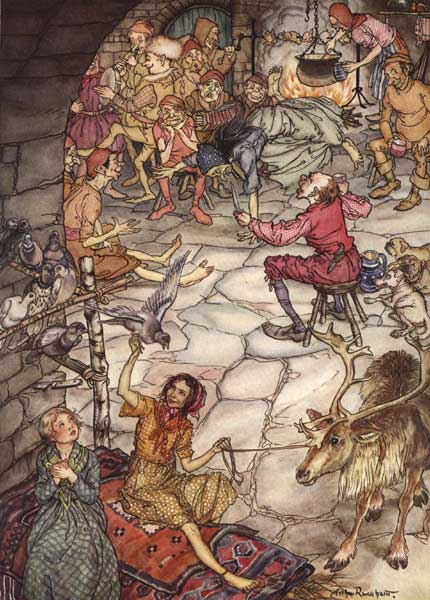
Then ‘Ala-ed-Din arose and fetched the Lamp, and rubbed it, and there appeared before him the Slave who had appeared to him before. And the Jinni said to him: “Command what thou wilt, O my master, for I am thy slave and the slave of him who possesseth the Lamp.” And ‘Ala-ed-Din answered: “My desire is that thou bring me a tray of food like unto that which thou didst bring me before, for I am starving.” Then, in the twinkling of an eye, the Slave brought him a tray, like the one he came with before; and on it were twelve plates of the richest, and on them the proper viands; and on the tray were also bottles of clear wine and white bread. Now ‘Ala-ed-Din’s mother had gone forth when she knew that her son intended to rub the Lamp, that she might not look a second time upon the Jinni; and presently she came home and perceived this tray, covered with dishes of silver, and the odour of rich viands permeating her house; and she wondered and rejoiced. And ‘Ala-ed-Din said to her: “See, O my mother, thou didst tell me to cast away the Lamp; behold now its advantages!” And she answered: “O my son, may Allah multiply his weal! but I would not look upon him.” Then ‘Ala-ed-Din and his mother sat down to the tray, and ate and drank till they were satisfied; and they put aside what was left for the morrow. And when the food they had was finished, ‘Ala-ed-Din arose and took a plate of the plates of the tray under his garment and sallied forth in quest of the Jew to sell it to him; but by the decrees of destiny he passed by the shop of an honest jeweller, a sheykh, who was a just man and feared Allah. And when the sheykh saw ‘Ala-ed-Din he questioned him, saying: “O my son, what dost thou want? for I have seen thee often passing by, and thou wast dealing with a Jewish man, and I have seen thee making over to him various things, and I am thinking that thou hast something with thee now, and thou seekest him to buy it. But thou dost not know, O my son, that the property of the Muslims, who profess the Unity of Allah Most High, is fair spoil to the Jews, who always defraud them, and worst of all this damned Jew with whom thou hast dealt and into whose hands thou hast fallen. So if thou hast with thee, O my son, anything thou wishest to sell, shew it me, and fear not at all, for I will give thee its value by the truth of the Most High God, Allah.” So ‘Ala-ed-Din produced the plate before the sheykh, who when he had looked upon it, took it and weighed it in his balance, and questioned ‘Ala-ed-Din and said: “Didst thou sell the like of this to the Jew?” And he answered, “Yes, its like and its brother.” And the other said: “How much did he give thee for its price?” And he answered, “He gave me a dinar.” And when the sheykh heard from ‘Ala-ed-Din that the Jew had given him only a single dinar for the price of the plate, he exclaimed: “Woe to this accursed who cheats the servants of the Most High Allah!” And looking at ‘Ala-ed-Din he said: “O my son, verily this rascally Jew hath cheated thee and mocked at thee; for thy plate is of fine virgin silver; and I have weighed it and found its value to be seventy dinars. So if thou wilt take its price, take it.” And the jeweller sheykh counted out to him seventy dinars, and ‘Ala-ed-Din took them, and thanked him for his kindness in shewing him the Jew’s fraud. And whenever the price of a plate was gone, he went and brought another, so that he and his mother became well to do, though they ceased not to live as of old, as middle-class people, without excess or waste.
------------------------------------------------------------------------
3) POST SCRIPTUM IN JULY 2018:
Oscar Wilde's old Jews weighing out money in Hebrew translation - Or, When Jews become, simply, merchants of indeterminate creed (who may be standing in prayer and blessing the Moon!)
(analysis by Dalia Cohen-Gross):
Despite the large number of translations of The Happy Prince into Hebrew, to date,
these translations have not been compared. This article will discuss Wilde’s attitudes toward
social minorities. Such attitudes are expressed twice in the story: [···] second, in the description
of the Jews in the Ghetto. The focus on the attitude toward minorities will serve our attempt to
anchor the linguistic and cultural points of departure of the various translators' relation to the
source text, and examine the degree to which the translators' language reflects the period and
linguistic community to which they belonged and within which they operated. (See the
Appendix for basic biographical information on the translators.) Furthermore, the examination
may help us to shed light on the various registers in the new, written Hebrew against the
background of the changes in norms of translation in Israel following the change from a purist
approach to a more adapted language, more faithful to the source (Toury 1977, 1998, 2000;
Zoran 1979; Ben-Ari 1992; Weissbrod 1992; Ben-Shahar 1994, 1998; Even-Zohar 2006).
Description of the Jews
The Third Lateran Council (1179) decreed that Jews should be confined to their own living
areas and their occupational possibilities limited. However, the Council did not act upon the
idea of relocation (Melson 1992: 83-84). In 1516, the Serenissima designated a
walled area, surrounded by canals, as the Jewish living space. The area was in the vicinity of
the new foundry – il ghetto nuovo –, and the shortened name of the foundry became the name of
the Jewish area, eventually turning into the name for all Jewish quarters or Jewries in Europe (Gutman
1990: 'Ghetto'). In the eighteenth century, Jews began receiving equal rights in Western and
Central Europe. This process culminated in the Emancipation of the nineteenth century, part
of which was the gradual opening of the ghettos or Jewries. The Rome ghetto was the last to be opened,
in 1870, and its walls came down in 1885 (Lerner 2002). However, prejudices did not
disappear with the walls, and the European attitude toward Jews, especially their perception
as conniving and dishonest merchants prevailed. A clear indication of this attitude is the
twelfth-century expression 'to jew down' – to bargain sharply and beat down in price (Costello
1992: 'jew').
Wilde's writings, too, contain stereotypical references to Jews (for a comprehensive
survey of the Jew's image in the Victorian period and in Victorian literature see: Fox 1991;
Valman 2001, 2003; Cheyette & Valman 2004: 1-26.) Thus, some view Wilde's depiction of
Salome (in the play of the same title) as wanton and corrupt to be an expression of racism. In
The Picture of Dorian Gray Wilde points out the fact that the doctor, who injects the blood of
three lads to one of his patients, is Jewish. Dorian Gray (1992) contains other specific
negative references to Jews: "A hideous Jew (55); The horrid old Jew (59); Then we must get
her out of the Jew's hands (62); The fat Jew manager… was beaming from ear to ear with an
oily, tremulous smile (91); The Jew manager, who was standing at the back of the dresscircle,
stamped and swore with rage" (95). However, the research literature does not tend to
accuse Wilde of declared anti-Semitism, rather seeing him as a faithful product of his times
(Nassaar 2003). Furthermore, while he was in college, Wilde befriended the Jewish Leonard
Montefiore, who was the son of Nathaniel Montefiore and the nephew of the well-known Sir
Moses (Moshe) Montefiore. At a later date Wilde heeded his mother's advice to improve his financial position by marriage (Ellmann 1987: 220), and proposed to Charlotte, Leonard's
sister. When she rejected his proposal he wrote her, "'Charlotte, I am so sorry about your
decision.With your money and my brain we could have gone so far" (Ellmann 1987: 221).
In The Happy Prince the Jewish issue reappears. This short story (about 3500 words)
takes place in an unidentified northern European country. Despite the paucity of
descriptions of the town, Wilde does not skip mentioning the Jewish ghetto and its inhabitants
as seen flying overhead: "[···] and saw the old Jews
bargaining with each other, and weighing out money in copper scales." This sentence received
various treatments in translation (see Table 2).
Table 2 Descriptions of the Jews
- Wilde, 1888 (SOURCE TEXT): … saw the old Jews bargaining with each other,
and weighing out money in copper scales.
- Ben-Avram, 1921: --- (Omission)
- Halpern, 1923: ... saw the merchants negotiating amongst
themselves and weighing the gold with copper scales.
- Ben-Eliezer, 1924: ... heard two old Jews discussing matters with
each other.
- Maximon, 1924: ...saw old Jews buying and selling, and earning a
living off each other.
- Orland, 1947: ... saw the old Jews trading with each other and
weighing money on scales.
- Skulsky, 1949: ... saw the old Jews standing in prayer and blessing the
moon.
- Uriel, 1954, 1979: --- (Omission)
- Tarsi, 1954, 1974: And there ... saw Jews, well stricken in age, bargaining
with each other and weighing for each other silver coins on copper
scales.
- Yoram, 1959: --- (Omission)
- Elgad, 1971: ... saw the old Jews trading with each other and
weighing gold bullions on scales made of copper.
- Bason, 1984: ... saw the old Jews bargaining with each other
and weighing coins on copper scales.
- Bar, 1988: ... saw the old Jews bargaining with one another
and weighing money on copper scales.
- Ofek, 1989: ... saw the old Jews trading with each other and
weighing gold coins on copper scales.
- Ben-Moshe, 1999: ... saw old Jews who were negotiating with each
other, and weighing money on copper scales.
- Adler, 2008: ... saw elderly Jews bargaining with each other and
weighing merchandise on copper scales.
Table 2 Descriptions of the Jews
(Underlined passages are Dermark's, to notice the starkest differences in translation, which will be detailed)
The findings reveal that this sentence clearly discomfited translators into Hebrew who
were not native Israelis (Dermark notes: And also who translated before and during the Second World War). However, quite possibly the reason is not related entirely to the
geography of the translation, but also to Zionist negativism toward the Diaspora and the Jews
of the Diaspora, and to a certain degree of tolerance of anti-Semitism in world literature
(Weissbrod, 2007). In addition, until recently children’s literature was especially dominated by a protective approach, and to this day stories with an anti-Semitic tone are not published in
Israel (Weissbrod 2005). Indeed, some of the translators (Ben-Avram, 1921; Uriel, 1954, 1979; Yoram, 1959)
preferred to omit this sentence altogether and those who kept it found ways to cushion it
(Table 3, Translations strategies: Description of the Jews):
Strategy:
- Wilde, 1888: Bargaining with each other and
weighing out money in copper
scales.
Avoidance:
- Ben-Avram, 1921.
- Uriel, 1954, 1979.
- Yoram, 1959.
Evasion:
- Halpern, 1923: ... (the merchants) negotiating amongst themselves and weighing the gold with copper scales.
- Ben-Eliezer, 1924: discussing matters with each other.
- Maximon, 1924: buying and selling, and earning a living off each other.
- Skulsky, 1949: standing in prayer and blessing the moon.
- Adler, 2008: bargaining with each other and weighing merchandise on copper scales.
Faithfulness to source:
- Orland, 1947: trading with each other and weighing money on scales.
- Tarsi, 1954, 1974: (Jews, well stricken in age), bargaining with each other and weighing for each other silver coins on copper scales.
- Elgad, 1971: trading with each other and weighing gold bullions on scales made of copper.
- Bason, 1984: bargaining with each other and weighing coins on copper scales.
- Bar, 1988: bargaining with one another and weighing money on copper scales.
- Ofek, 1989: trading with each other and weighing gold coins on copper scales.
- Ben-Moshe, 1999: (who were) negotiating with each other, and weighing money on copper scales.
Table 3 Translations strategies: Description of the Jews
(More on coping of Hebrew translations with racist or anti-Semitic references see: Ben-Ari 1992,
2000; Bassok 1995; Gordon 2002; Regev 2003; Muchnik 2005.)
Thus, we find three distinct ways in which translators dealt with this sentence (Table
3): (1) Avoidance – total omission; (2) Evasion – faithfulness to the original in the beginning
of the sentence and changing the end, and vice versa; (3) Faithfulness to source. The methods
of tacking this issue were:
- * Avoiding any reference of the ethnic origin of the ghetto's residents, rather than treating
them as a nation or a people: "merchants" (Halpern, 1923);
- * Minimizing the description by referring to two individuals only: "two old Jews" (Ben-Eliezer,
1924);
- * Describing the Jews as just talking, or using words that soften the racist connotation of
Wilde's text: "discussing with each other" (Ben-Eliezer, 1924), "buying and selling and
earning a living off of each other" (Maximon, 1924); "weighing merchandise on copper
scales" (Adler, 2008);
- * "Converting" the text while introducing a Jewish ritual element that did not appear in the
original: "The old Jews standing in prayer and blessing the moon" (Skulsky, 1949).
Furthermore, the translators who were careful to preserve the ghetto's original identity
as the Jews' residence always used the word zkenim to translate the word 'old' when referring
to 'old Jews'. Only two translators did not follow suit – Tarsi (in both translations) chooses the
Biblical locution ba bayamim translated in Table 2 as 'well stricken in age'. Adler preferred
the Aramaic kshishim, the Hebrew plural of kashish – a word used regularly in Modern
Hebrew as an unbiased word for 'old' – as oppsed to its original meaning 'older than'.
Almagor-Ramon says (2007) that in Modern Hebrew "kashish, too, is a person of age.
However, for some reason the old person, the zaken, has lost his glory in our everyday
Hebrew, and instead of zkenim we began saying kshishim." (For an expanded discussion on
zaken as a taboo word in Israeli Hebrew: See Kantor, 1997)
Conclusion
In this article we focused on the various ways translators dealt with Wilde’s attitude toward
social minorities (Jews), examining the translators’ work against their
historical period, personal background, and the linguistic communities they inhabited and in
which they worked. It was also found that in the description of the Jews
in the ghetto, just about half of the translations (8 out of 17, 47%) remained faithful to the
source, despite the racist slur. This finding can be indicative both of changes that have taken
place in translation norms as well as of rejection of the Diaspora and the exclusion of
Diaspora Jews from a Zionist affiliation and the image of "the new Jew."
LitCharts on "the old Jews bargaining with each other, and weighing out money in copper scales:"
The observation of Jews bargaining betrays a more negative aspect of the story’s Christian roots, as it depicts a very stereotypical and anti-Semitic picture of Jewish individuals.
| |