Mostrando entradas con la etiqueta human weakness. Mostrar todas las entradas

martes, 27 de enero de 2026

Cool Strategies / Reframing for Impulse Control (VERY IMPORTANT!)

In follow-up experiments of the Marshmallow Test, Mischel found that children were able to wait longer if they changed the way they thought about the marshmallow (focusing on its similarity to a cotton ball --tasteless, inedible--, rather than on its gooey, delectable taste).

You can chill a hot object of desire by representing it to yourself in Cool, abstract terms. Don’t think of the marshmallow as yummy and chewy; imagine it as round and white like a cotton ball. Or that it is literally a cotton ball. One little girl became patient by pretending she was looking at a picture of a marshmallow and “put a frame around it” in her head. “You can’t eat a picture,” she explained.

While coolly defusing a temptation, you can also make Hot the delayed consequences of yielding to it. Mischel was a three-pack-a-day smoker ignoring all warnings about cancer until one day he saw a cancer patient on a gurney in Stanford Hospital. “His head was shaved, with little green X’s, and his chest was bare, with little green X’s.” A nurse told him the X’s were for where the radiation for the patient's cancer would be targeted. “I couldn’t shake the image. It made hot the delayed consequences of my smoking.” Mischel kept that image alive in his mind while reframing his cigarettes as sources of poison instead of relief, and he quit. 

In one segment, Cookie Monster appears as a contestant on a game show and is presented with a single cookie on a plate. “This is The Waiting Game,” shouts the lantern-jawed Muppet host, “and if you wait to eat the cookie until I get back, you get two cookies.” As the host dashes away, Cookie Monster’s ordeal begins. He tries singing to himself. Then he pretends the cookie is only a picture. Next he distracts himself by playing with a toy, and finally imagines that the cookie is a smelly fish. “Me need new strategy,” he says as one mental trick gives out to another. A pair of back-up singers pops up every few seconds to croon that “good things come to those who wait.” Finally, the host returns with the second cookie. The exhausted monster’s patience has paid off.

Mischel himself served as a consultant to Sesame Street for last year’s season, and Cookie Monster’s self-mastering strategies bear the clear imprint of his thinking on this question. In Mischel’s view, emotions are the bane of self-control: These “hot” responses make us impatient and cloud our logical judgment of what’s valuable. And so in his experiments, Mischel had children try to override their emotional responses to the marshmallow by having them use “cool” strategies like singing to distract themselves, focusing solely on the treat’s colour, or pretending it was a cotton ball. When children tried these approaches, they demonstrated more willpower in resisting temptation.

Mischel is hardly alone in thinking of emotion as the villain in these scenarios. More than three centuries ago, the Jewish Dutch philosopher Spinoza (17th century) pretty well encapsulated what is still the conventional wisdom about emotions in human affairs: that “in their desires and judgments of what is beneficial, people are carried away by their passions, which take no account of the future or anything else.” As Ethan Kross, the director of the Emotion and Self-Control Lab at the University of Michigan, recently told me, suppressing emotion has pretty much always been advocated as a primary tool for resisting temptation. 

If people don’t rest between temptations, it puts them in something of a death spiral in which each willpower success perversely increases the likelihood of willpower failure when facing the next temptation. In fact, Vohs’s most recent work shows that the people who appear the best at maintaining self-control succeed not because their willpower is actually greater, but because they employ the simple strategy of avoiding coming into contact with temptation in the first place (precommitment).

Yes, there are emotions that can lead to vice (envy, lust, anger). But there are also emotions associated with virtue (gratitude, compassion, love). At the same time, while it’s true that reason and willpower can engender virtuous action—as when people adhere to a code of ethics or a long-range plan—they can just as easily be used to motivate and justify quite impulsive behavior. (More on this later.) The first step in understanding how self-control really works, then, is to give up the idea that emotions necessarily lead to impatience.

Here, to my mind, lies the key to understanding self-control’s true raison d’être. Evolutionarily speaking, the capacity for self-control didn’t arise because it increased success on standardized tests, dieting, or saving for retirement. None of those were relevant concerns for our progenitors. What did matter to one’s well-being for all of human history was the ability to navigate the social world successfully—the ability to be viewed as a virtuous, and therefore, desirable partner. A predilection to be fair, to be honest, to share, to be other-oriented to some degree, is what builds social capital. Avoid cheating on your spouse with a lover, and you will ensure long-term gains at the cost of immediate pleasure. These are the qualities people look for in friends and leaders; they’re also ones that require an ability to resist temptation.

With this view in mind, I began to design and conduct empirical research related to decision-making and impulse control about eight years ago. At the time, I was specifically interested in the dynamics of trust and cooperation, and my lab group had been accruing finding after finding showing that manipulations of specific morally toned emotions enhanced both these behaviors—behaviors that themselves directly involve delays of gratification. Take trustworthiness, for example. At heart, any decision to behave in a trustworthy manner usually pits a desire to ensure long-term cooperation against a desire for immediate selfish gain. If you loan me $200 for rent and I don’t pay you back, I’m ahead in the short term. Long term, though, I’m likely to lose much more. You probably won’t help me again, and if I were to aggregate the losses over the years from not having you as a supportive friend, the $200 I kept today will look small in comparison. Being trustworthy, then, requires that I don’t give in to a desire to keep money that wasn’t mine, but rather that I repay you at immediate cost to myself.

How did feelings of gratitude alter greedy, untrustworthy behavior? As we reported in an article published in the journal Emotion, the results were quite clear. On average, the people who received help—and expressed gratitude for it—following their computer crash gave 25 percent more tokens to their partners. Put simply, feelings of gratitude nudged people to restrain their greed; the more grateful they felt, the less selfishly they acted, and the more willing they were to cooperate with people they didn’t know from Adam and Eve. 

First, we asked participants to describe in writing one of three types of events: something that made them feel grateful, something that made them feel happy and laugh, or the events of their typical day. As you might guess, this task, which was couched as a memory experiment, really served to induce one of three emotional states: gratitude, happiness, or a relatively neutral feeling. Then, using what has become a standard method for assessing financial impulsivity, we had participants answer a series of 27 questions. Each question took the form, “Would you rather have $X now, or $Y in Z days?” In all 27 variations, Y was greater than X. So, for example, a participant might be asked if she’d rather have $55 now or $75 in 61 days—the adult analogue of one marshmallow now or two later. And just to ensure that people were motivated to tell us what they really desired, these weren’t hypothetical questions. The stakes were real. We told participants that, for some of them, one of the questions would be picked at random—and their answer honored. So, if we picked the question that had asked “Would you rather receive $55 now or $75 in 61 days?” we’d immediately give the participant $55 if she’d chosen “now,” or, 61 days later, we’d mail her a check for $75. 

Here again, the impact of gratitude on self-control became apparent. People who were feeling happy were just as impatient as those who were feeling neutral. Both groups significantly discounted the value of future rewards—meaning they sold their future selves short. On average, they exhibited an annual discount factor of 0.18, meaning that they’d give up the chance to receive $100 a year from now in order to receive $18 immediately. Those who had been induced to feel grateful, however, were significantly more future-oriented. They required $30 now before forgoing the future $100 reward—a 12 percent increase, resulting only from a simple and fleeting nudge toward feeling grateful.

AT THIS POINT, YOU might be wondering what’s so special about gratitude. In reality, it’s not gratitude per se that’s important, but rather the class of emotions to which it belongs. Much as Robert Frank theorized in the 1980s, the emotions that enhance self-control are indeed the ones that are positively related to social life, whose purpose is to grease the wheels of social interaction by fostering moral behavior. While you might feel disgusted at the sight of carrion, or happy in response to a sunny day, you feel grateful when someone does something for you. You feel shame when you’re worried someone will think less of you. You feel pride when you believe you’ve succeeded in a way people will value. These and similar emotions are the ones that have helped us build social relationships for millennia, by combating impulses to be self-centered or lazy through increasing the value we attach to long-term rewards.

A quick look at the published work coming from my research group over the past decade makes the point. Our work, for example, clearly shows that pride leads people to persevere on difficult tasks. When we give participants acclaim for their performance on any type of test, they’ll work longer and harder to hone the relevant skill, with the length of time they persevere deriving directly from the amount of pride they felt when receiving acclaim from those around them. Compassion—another morally toned emotion—also leads to behaviours that go against immediate gratification. For instance, when we increase the compassion individuals feel for another by highlighting the similarities they share with him or her, they’ll expend considerably more effort to help that other person when needed, even at immediate cost to themselves. In these and similar cases, socially oriented emotions automatically facilitate decisions and behaviours that foster the long-term gains that come from building bonds with others.

You might, for instance, resist the temptation to overeat by trying to cognitively re-frame treats as unhealthy rather than delicious. Alternatively, you can go the route of focusing on the pride you felt, or will feel, on losing those initial few pounds. You might prevent yourself from making an impulse purchase by placing your money in an account with stiff penalties for early withdrawal—a type of strategy known as precommitment, which, interestingly, in and of itself implicitly acknowledges the limits of willpower. Or you might do the same by taking a few minutes to stop and count your blessings.

Which route is the better one? For two reasons, I think the less frequently advocated path—the emotional one—might just prove superior for enhancing self-control.

The first is that, unlike strategies based on cultivating emotions, those based on cognitive mechanisms involving executive control are, as you’ll recall, easily exhausted. As work by Kathleen Vohs, Roy Baumeister, and their colleagues has demonstrated time and again, squelching desire quickly leaves willpower depleted. As if that were not problematic enough, the effects of relying on willpower to dampen emotional desires—a strategy recommended by many leading self-control theorists like Baumeister and Mischel—can be especially pernicious. Research by the Stanford psychologist James Gross, one of the nation’s leading experts on the science of emotion regulation, shows that suppressing emotions wreaks havoc on the mind and body. It hinders memory, increases physiological stress, and negatively impacts communication with others. Using this strategy, then, poses two hazards. Not only does it increase the odds that you’ll give in to temptation later; it can also debilitate thinking, learning, memory, social bonding, and communication.

SO WHAT’S THE ANSWER to the problem of self-control? Any strategy based solely on forcing adherence to a set of virtues through a bunch of cool-headed, cognitive strategies and a list of “thou shalt nots” is a fragile one. That’s not to say it won’t work at times, but it’s based on cognitive resources that can and do fail often. Of course, relying blindly on emotions would be just as foolish, as they, too, can certainly lead one astray. Rather, the answer is to cultivate the right emotions, the prosocial ones, in daily life. These emotions— gratitude, compassion, authentic pride, and even guilt—work from the bottom up, without requiring cognitive effort on our part, to shape decisions that favor the long-term. If we focus on instilling the capacity to experience these emotional states regularly, we’ll build resources that will automatically spring forth in reflexive and productive ways. In essence, we’ll be giving ourselves inoculations against temptation that, like antibodies in our bloodstream, will be ready and waiting to combat possible threats to our well-being.

We may also partially solve the question of how to instill grit. The concept of grit, which is sometimes defined as “perseverance and passion for long-term goals,” implicitly acknowledges that the capacity for self-control isn’t the only thing that matters when it comes to predicting success; the motivation to resist temptation and persist is equally important. As the University of Michigan’s Ethan Kross told me, “For self-control to work correctly, a person needs two things: ability and motivation.” One or the other alone just won’t cut it. Emotions, at base, are the motivating engines of behaviour. The beauty, then, of cultivating moral, socially oriented emotions is that they will serve not only to increase the value we attach to future gains, but also automatically and efficiently drive the behaviours in question. They provide the passion for success, irrespective of whether we consciously recognize it.

The lack of attention we as a society give to learning how to use emotions to reach goals is regrettable, because if we’re going to conquer the temptation to favor short-term pleasures—from relatively minor ones like overeating and cheating to global ones like favoring immediate profit over the long-term mitigation of climate change—we’re going to need every weapon at our disposal. And while willpower certainly offers assistance, we’ve been neglecting the weapon that comes straight from our nature as innately social beings, not just rational, calculating loners. We can’t just exert self-control by willing ourselves to resist the first marshmallow or averting our eyes from it; we have to be grateful that someone’s offering it to us in the first place.

If they focused on their abstract “cool” features (“The marshmallows are puffy and round like cotton balls”), they managed to wait longer than the researchers, watching them through a one-way observation window, could bear. And when they imagined that the treats facing them were “just a picture” and were cued to “put a frame around it in your head” they were able to wait for almost 18 minutes. When Mischel asked a child how she managed to wait so long, she replied: “well you can’t eat a picture.” 

A third way to boost self-control is to remove the emotional components (or the “hot” attributes) of the tempting object. This sounds way more complicated than it is! As a passionate tea collector, finding new flavors gives me thrills, and every addition to my tea cupboard is exciting. In order to strip tea (or any collector’s item) of its emotional component, try to think of it in an abstract way. At the end of the day, every tea is just a mix of dried leaves used to flavour water. What is so exciting about that? And you can apply the same analytic approach to other tempting items: What is wine but fermented grape juice? What is beer but fermented hop water? What are doughnuts but pieces of deep-fried dough? 

In a Japanese Zen story, a monk visits a politician who has a pretty wife, who wears fine silks and jewels, and the best perfume - moreover, the lady is rather frisky and makes advances on the monk: a serious temptation, considering his vow of chastity. That evening, while the politician is away, the wife makes advances on the monk, and nearly gets into bed with him - but then the monk imagines the lady as a corpse, foul-smelling, with brittle greenish skin full of bubbles, and maggots in her mouth and eye sockets. Obviously, this causes him to resist the temptation and preserve his chastity.

************************+

Treat desire as something temporary - don't act on it instantly. Set a timer (the New Personality Self-Portrait advises this exercise for the Mercurial personality - similar to the 7w6 or Sexual Seven) and distract yourself or "urge surf;" don't act on the urge, but watch it rise and fall and give way to disappointment if there is any - but NOT all desires lead to disappointment. The interesting thing is that desires are temporary and they change - what I want now, whether I get it or not, will be different to what I will want in another time.

THE MERCURIAL PERSONALITY - Exercise 7
To help prevent overindulging, time it. If you want one
cookie (or one sweater) but you usually eat the whole box
(or buy up the whole shop), carry a stopwatch or other
watch that has a timer. Take one cookie (purchase one
sweater). Now set your timer to go off in one hour (or half an hour, if you can't wait). 

You can have another cookie (make another purchase) one
hour/half an hour from now.
Usually the urge will have passed by that
time. If not, take one more cookie (make one more
purchase) and set the timer to go off in another hour...



martes, 29 de marzo de 2022

FLIPPING GENDER WITH SALMACIS

The story [...] is told in book 4 (of the Metamorphoses) by one of the Minyeides (sister princesses) as they while away the time spinning and weaving in defiance of Bacchus/Dionysus. It is followed by [...] Salmacis and Hermaphroditus (271-388), told by Alcithoe: [...]. Their crime has been in part to flee from the manly epic demands of Bacchic poetics (classical tragedy) into the female elegiac world of private emotion, and the stories they tell have connections of many levels with each other and with the surrounding narrative. Most obviously, the story of Salmacis and Hermaphroditus deals with attempts at union by sundered lovers, ending in that total fusion that has always been the goal of lovers and which had been so determinedly attacked in book 4 of Lucretius' De rerum natura. (See especially M. Labate, "Storie di instabilità: l'episodio di Ermafrodito nelle Metamorfosi di Ovidio", 1993).

The characters of the story, but especially the women, aspire to presence: Salmacis, who unlike her fellow nymphs has spent so much time looking at herself in the waters, gazes at Hermaphroditus like the sun reflected in a mirror, but cannot content herself with just looking but must seize the boy and join with him. In the final story union is achieved: what Pyramus, Thisbe, Helios, Leucothoe, and Clytie could not do, Salmacis achieves and finally two become one, neutrumque et utrumque, As many have observed, however, this final union does not have about it any sense of triumphal achievement. Hermaphroditus, when he realizes what has happened, describes it not as a uniting of male and female, but as a softening of his masculinity: he becomes a semivir (half-male), but the other half of the union is scarcely in evidence. The intertextual model is Catullus' Attis after he has castrated himself, and in the moment of realization when Hermaphroditus prays to his parents to make the pool a permanent testimony to his softening, it is as if the personality of Salmacis has completely disappeared: as Georgia Nugent remarks in her brilliant Irigarayan reading of the episode: "in the conclusion of the tale, Hermaphroditus remains, I believe, what he already is ---and that is a male subject, always fully conscious of himself as such." As she admits, however, that is not the whole story, and I shall return to the complexities of gender in this episode. (See Nugent, "This Sex Which Is Not One.")

As critics have found with the Salmacis episode, the engendering of these tales is a complex matter.

The reading I have given suggests [...] that Salmacis should have been satisfied with her contemplation of Hermaphroditus rather than attempting union with him. When she sees him, she brooks no delay: "vixque moram patitur, vix iam sua gaudia differt". Once more, if only she had attempted différence and deferred her pleasure, she would have been able to retain her identity, but instead she loses herself in the attempt to get close to her lover. However, Georgia Nugent has pointed out that there is another way to read Salmacis' desire to touch rather than to see her lover, in terms of the valuation of female touching over male gazing articulated by Irigaray in This Sex Which Is Not One. It is easy to place Salmacis' desire to touch and envelop Hermaphroditus as an inappropriate attempt to get beyond the proper distance that language imposes and which allows the sort of detached, playful contemplation with which she ought to have been satisfied, but Nugent's juxtaposition with modern conceptions of gender might make us hesitate in our evaluation of the episode.

For the deferral in "vix iam sua gaudia differt" cf. Amores 2.5.29, 3.6.87 (to the river which separates Ovid from the love interest), Heroides 19.3 (Hero and Leander), Metamorphoses 6. 514 (Tereus "vix animo suo gaudia differt"); Martial 10.44.5; and in the sermo amatorius Propertius 2.23.17)

The gendering of this story is, however, still more problematic and complex than even this would suggest, Salmacis' intolerance of delay, mora, and refusal to defer pleasure is hardly a female characteristic, but much more a mark of the male: one of the ironies of the Salmacis episode is of course that Hermaphroditus is already more than, or less than, a male, so Salmacis is throughout made parallel to all those male lovers in Ovid's rape scenes whose sight of the beloved is immediately and inappropriately translated into violent action. Her story is closely parallel to that of the Minyeides themselves, in that just as their revolt against the patriarchal order of Bacchus/Dionysus is figured as a virile insistence on continuing with women's needlework, so Salmacis refuses to live up to society's expectations that she go hunting with Artemis' retinue and spends all her time in the "bathroom" (actually, doing her vanity routines by her pond) combing/styling her hair and beautifying herself. But her whole attitude towards Hermaphroditus, and in particular her instantaneous move from spying to attempted possession, is one we can recognize as male.


lunes, 21 de marzo de 2022

FRIEDRICH NIETZSCHE - Ungeduld

  Ungeduld. – Es gibt einen Grad von Ungeduld bei Menschen der Tat und des Gedankens, welcher sie bei einem Mißerfolge, sofort in das entgegengesetzte Reich übertreten, sich dort passionieren und in Unternehmungen einlassen heißt, – bis auch von hier wieder ein Zögern des Erfolges sie vertreibt: so irren sie, abenteuernd und heftig, durch die Praxis vieler Reiche und Naturen und können zuletzt, durch die Allkenntnis von Menschen und Dingen, welche ihre ungeheuere Wanderung und Übung in ihnen zurückläßt, und bei einiger Milderung ihres Triebes – zu mächtigen Praktikern werden. So wird ein Fehler des Charakters zur Schule des Genies.

FRIEDRICH NIETZSCHE.

lunes, 29 de julio de 2019

Evening Routines that Will Set Up Each Day for Success

6 Evening Routines that Will Set Up Each Day for Success

You wake up an hour before work and rush to get ready. You shower at lightning speed and grab an energy bar and coffee before running out the door. Still, work leaves you feeling discombobulated and overwhelmed. Long before the week is over, you’re burned out and know you won't hit this week's goals.
How do you get out of this miserable rut? One word: Routines.
Actually, evening routines prime you for success. They help you achieve more, think clearly, and do work that actually matters. They keep you from stumbling through your day and make sure you get the most important things done.
All it takes is a bit of discipline, along with routines that will set you up for success. Here are the what and why of routines, along with six favourite evening routines you can implement to create more perfect days.

The Science of Habits and Creating Routines

First, let’s define what routine means: A routine is a sequence of actions that you do repeatedly.
Brushing your teeth nightly and getting ready for bed is a routine. Reading the news before you head to work or class every morning is a routine. Even eating your snacks while watching Netflix (or YouTube, if Netflix should be out of your reach) is a routine. They’re all actions that happen again and again, a rhythm in your daily life.
That doesn't make them all good routines—they're simply routines by virtue of being done regularly. Helpful or not, every routine is powerful.

Routines Create High Achievers

"We are what we repeatedly do. Excellence, then, is not an act, but a habit."- Aristotle
In his book Daily Rituals: How Artists Work, Mason Currey writes about the habits, routines, and rituals of hundreds of artists, including Fryderyk Chopin, Benjamin Franklin, Karl Marx, and others. Even though their routines varied wildly, each individual had steps they followed to put them in an optimal state of mind.
After studying the great artists, Currey came to this conclusion:
In the right hands, [a routine] can be a finely calibrated mechanism for taking advantage of a range of limited resources: time (the most limited resource of all) as well as willpower, self-discipline, optimism. A solid routine fosters a well-worn groove for one’s mental energies and helps stave off the tyranny of moods.
High achievers tend to find routines that work for them and then stick to them—it's typically something they credit as a core to their success.

Routines Put Our Brains on Autopilot

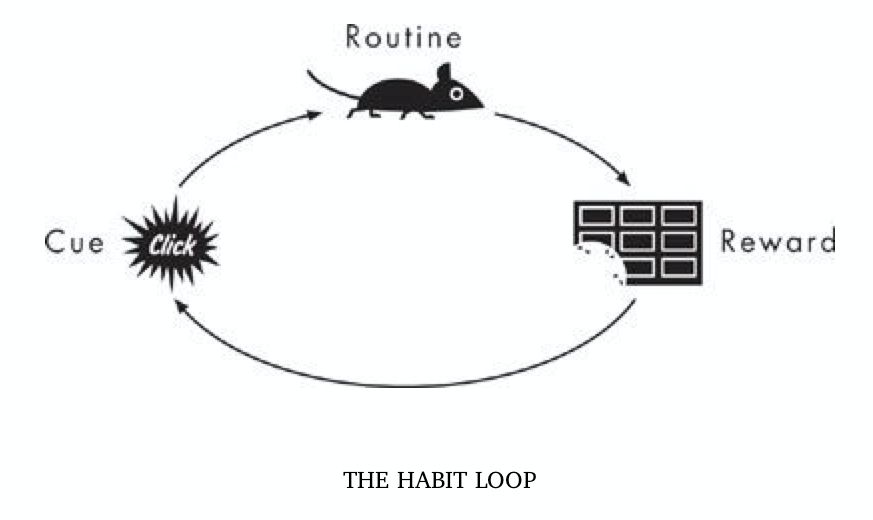
But what makes the routines of high achievers so powerful? As it turns out, we're creatures of habit and can use that to accomplish whatever we want. In The Power of Habit: Why We Do What We Do In Life and Business, Charles Duhigg details how habits put our brains into an automatic state where little or no willpower is required.
It works like this:
  • Step 1: Something happens that serves as a cue to your brain, putting it into "automatic" mode. A simple example is waking up. When I wake up, my brain immediately knows that it’s time to turn on the coffee machine. This habit has been ingrained in my brain over years.
  • Step 2: Execute the routine. This is where I actually turn on the kettle, wait for it to brew, pour it into my favorite mug, sit in a chair by the kitchen window, and finally drink the coffee.
  • Step #3: Reap the rewards of the routine. The delicious flavor and high-octane caffeine reinforce the routine so that the next morning I repeat it again.
The habit loop
Making coffee is just one small routine, but the daily consistency of it helps keep me going. Imagine if other, more powerful tasks that can empower you to accomplish big things came as easy as making coffee?
This is the power of routines. The small repeated actions can have an exponential effect. By implementing routines in the evening, you can prime yourself for maximum productivity each day.

Evening Routines That Set the Tone for the Next Day

Reading at night
The close of each day is just as important as the start. By implementing evening routines, you ready yourself for the next day, recharge with a restful night, and minimize the resistance you encounter in getting things done.

Prepare goals for the next day

Determining your objectives for the coming day does two things. First, it allows you to identify your most important tasks in advance—before all the pressures of the next day arrive on your doorstep. Ideally, the first few hours of each day should be spent conquering your most challenging task. This idea has been given various names, such as "eating the frog" and “slaying the dragon.” 
Second, it allows your brain to begin thinking about those tasks as you fall asleep. In their book Organize Tomorrow Today: 8 Ways to Retrain Your Mind to Optimize Performance at Work and in Life, authors Jason Selk, Tom Bartow, and Rudy Matthew say:
Identifying daily priorities might seem like an obvious or insignificant step to take, but writing your most important tasks down the previous night turns your subconscious mind loose while you sleep and frees you from worrying about being unprepared. You’ll probably find that you wake up with great ideas related to the tasks or conversations that you hadn’t even considered!

Reflect on the day's achievements

It can be easy to lose sight of victories after a long day. Taking just a few moments at the end of the day to reflect on and celebrate your wins puts things into the proper perspective and gives you encouragement for the coming day. It helps you overcome the discouragement that often comes with setbacks.
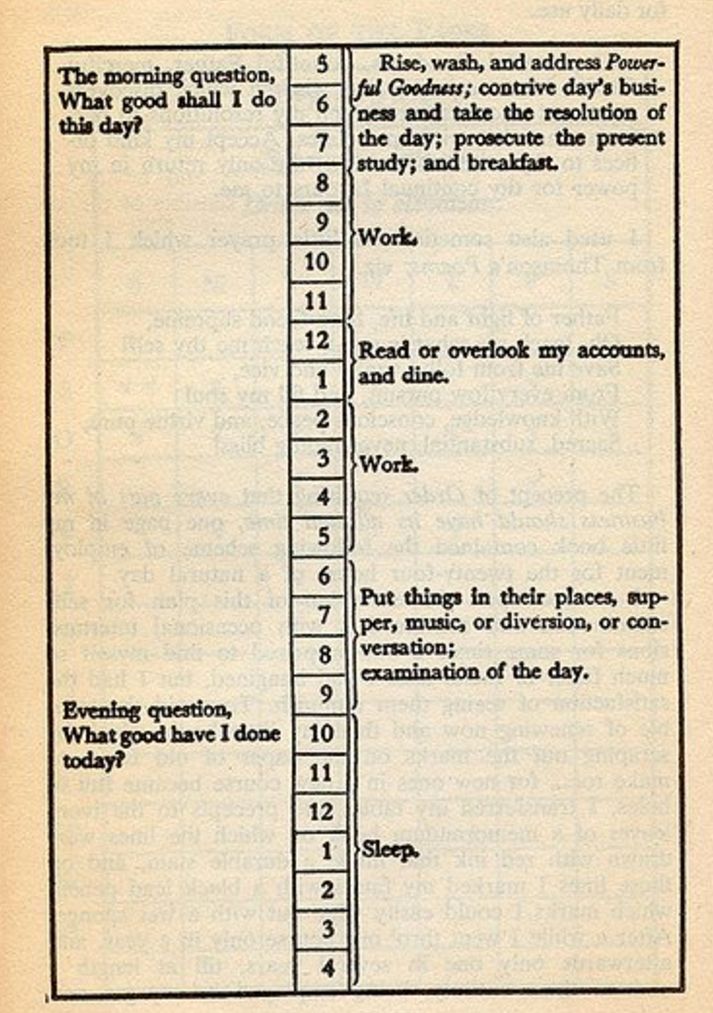
In addition to asking at the start of his day "What good shall I do this day?", Benjamin Franklin asked every evening "What good have I done today?".
Benjamin Frankline's routine
Benjamin Franklin's daily routine
Zen Habits author Leo Babauta puts it this way:
If you reflect on the things you did right, on your successes, that allows you to celebrate every little success. It allows you to realize how much you’ve done right, the good things you’ve done in your life.
You can do this in a variety of ways, including jotting things down in a blank notebook, a gratitude journal, or an app on your phone. You can automatically track your productivity with RescueTime as well:


Clear your head

It’s easy to take your work to bed, making it difficult to fall asleep as you mull over job- or study-related problems. Clearing your head before sleep allows you to put aside the challenges of the day and ready your mind to shut down. There are numerous ways to do this, including:
  • Meditation
  • Light reading
  • Playing Tetris or Emoji Blitz WITH THE NIGHT MODE ON (for productivity!)
  • Watching a peaceful television show (The Walking Dead or Game of Thrones probably isn’t your best bet)
  • Doing a "brain dump" of all the thoughts in your head in a journal before you go to bed
Buffer CEO Joel Gascoigne describes his disengagement this way:
For me, this is going for a 20-minute walk every evening at 9:30 p.m. This is a wind-down period, and allows me to evaluate the day’s work, think about the greater challenges, gradually stop thinking about work and reach a state of tiredness.
Your goal is to engage your mind in something completely non-work related.

Prepare for the next morning

In order to minimize the amount of thinking you need to do in the next morning, take time to prepare things. Pick out the clothes you’ll wear, prepare the food you’ll eat, prep the coffeemaker, and organize any work- or study-related materials you need to bring. If you’ll be going to the gym or burn some rubber, lay out your workout clothes, towels, soaps, and drinking water.
The less time and mental energy you expend on inconsequential things, the more you’ll have for the things that matter.

Tidy up

Waking up to a messy home isn't the most motivating way to start your day. Without regular sessions cleaning up and putting things away, you'll find your place quickly in disarray.
Thankfully, spending just 10 to 20 minutes a night tidying up will help reduce stress in the mornings and help you avoid marathon cleaning sessions on the weekends. If there's only one thing you do, clean and shine your bathroom sink. This one task will give you a sense of accomplishment. Housekeeping guru FlyLady says:
This is your first household chore. Many of you can’t understand why I want you to empty your sink and clean and shine it when there is so much more to do. It is so simple; I want you to have a sense of accomplishment! […] When you get up the next morning, your sink will greet you, and a smile will come across your lovely face. I can’t be there to give you a big hug, but I know how good it feels to see yourself in your bathroom or maybe even your kitchen sink. […]
Go shine your sink!
Also, if you have children or parents/guardians, you know the importance of setting up solid routines. They can help out too!

Practice proper sleep hygiene

Very few people practice proper sleep hygiene and their sleep suffers as a result. Generally speaking, you should:
It can be easy to minimize the importance of sleep, but it’s absolutely essential for optimum performance. In fact, sleep is so crucial that Arianna Huffington devoted an entire Ted Talk to it.

It can be really tough to build routines into your life. It takes intention and discipline. Sometimes it feels simpler to just get the day started and then after a long workday --or, now in summer, after a long pastime-day-- crash into bed.
But the good thing about routines and habits is that the more you do them, the easier they become. They become ingrained in your day to the point where you find it harder to not do them.
So stick with it. You may find it tedious at first, but you’ll find your days will flow much more smoothly when you've bookended them with quality evening routines.

To create your own evening routines, you can write up a checklist that you can walk through every day until it becomes ingrained in you or set up a schedule, à la Ben Franklin. For example:

6 pm sharp: dinner
7:30: tidy up
8 pm sharp: time with family, TV, or other form of relaxation and entertainment
9:30: journalling or meditation
10 pm sharp: bedtime
What's your daily routine like?

How to Create an Evening Routine
I am not perfect, and I make mistakes often! But the way I manage to have the success I have is by living intentionally in the evenings.
The key is to understand that you do have a morning routine and you can shape it to get anything done you want.

WHAT IS AN EVENING ROUTINE?

Your evening routine is what you do in between your work or studies and when you go to sleep. Your evening routine may include anything from cooking and eating dinner to reading a book or watching TV.
It’s easy to let your evening routine just happen. But the more you plan your evening routine, the more you will be in control of your time (which is something you probably wish you had more of).

HOW TO CREATE A BETTER EVENING ROUTINE

To get more time back and live intentionally (with meaning and purpose), you need to plan your morning and evening routines.
Here’s how you can plan your own evening routines.

1. Write down what your ideal evening would look like.

The first step to reworking your evening routines is to know what your “ideal” looks like.
Ask yourself important questions, like whether you want to use this time for 1) personal growth and development, 2) cleaning and doing house work, 3) rest and relaxation, 4) health and wellness (or something else).
Think hard about what you want out of this time. Decide what habits you would like in place that would make you happy to have done them. It’s up to you what you want to use this time for in the evening. The point is to be very intentional about it so the days don’t pass you by without you noticing. Also, make sure you actually write down these visions – it’s not enough to think about it alone.
I recommend using the following resources for this:

2. Evaluate what your current evenings look like now.

Write down what you do during your evening routines right now (summer makes your inner clock go out of joint). List your activities hour by hour (or in even small increments like half hour by half hour).
Once you know what you’re up against, you’ll have an easier time changing your current routine to match what your ideal routine is.

3. Create an outline of what you want your evenings to be like in the future.

Write out an ideal schedule for yourself. Humans work really well on a scheduled routine, so make it easy for yourself and plan it out ahead of time. This won’t be realistic for you to do every day, but it will keep you on track most days. It will also keep you away from easy temptations and time sucks like TV and social media! 🙂
For example, it might look something like this:
Evening routine:
  • 6:00pm: Get home, change, pack lunch for next day
  • 7:00pm: Eat dinner
  • 8:00pm: Clean and do other housework (if you are, like yours truly, not of the cleaning persuasion, at least clean your sinks!)
  • 9:00pm: Journal (or colouring in)
  • 10:00pm: Bed
Decide on a plan that works for you. Everyone will have different wants and needs. The key is to plan ahead of time so you’re prepared and following a schedule.
You can use Dream Year to figure out exactly how you want to set goals for your own morning and evening routine if you don’t know how to set goals yet.

4. Implement your plan and monitor how it’s going.

Once you know where you are now and where you want to be in the future, the key to successful habits is implementation. You planned, you prepared, now it’s time to implement. I like starting cold turkey and just going for it. Otherwise, you will fall into the “trying trap” of saying you’ll “try to do this tomorrow”. There is no try, there is only do and do not. So, don’t try it. Just do it! Also, it’s really important that you evaluate how it’s going for you after some time. Is it meeting the expectations that you set for yourself? Are you happier, more fulfilled, and better off? If not, then adjust your plan.
When you create a plan for your evening routines, you will accomplish more of your goals and live a life in line with what you want.

WHY PLANNING EVENING ROUTINES IS A GAME CHANGER

If you want to change your life, start by changing your day. It’s the little habits repeated over time that will be the difference between failure and success.
Your evening routines are perfect times for you to implement habits to promote your success.
For example, if you plan to read for 2 hours tomorrow night, you will be much more likely to do it if you plan it ahead of time. If you don’t plan it, you could easily get side tracked and end up watching two hours of T.V. instead.
No matter what stage in life you’re in, improving a small thing like your evening routines can be enough to reenergize you and help you accomplish your goals. I know you can do it!! 🙂

A FINAL NOTE!

Creating a solid evening routine, especially now in summer, can change the course of your life. You can become happier, less stressed, and live better.
It’s all about the plan!! 🙂

10 Evening Routines That Will Make You Productive at Work and Life

Kaye Ramos


The more you sweat in peace, the less you bleed in war.” Norman Schwarzkopf
The sound of the alarm fills the room. But the warmth of the blanket and comfort of the bed are so inviting.
You know you need to get up. Yet, the most satisfying decision to make is to hit up the snooze button and reward yourself with few more minutes of sleep.
There you go — wandering in the dreamland. Forgetting all the worries the day might bring. Ignoring all negativities that linger around. Dismissing all procrastination that might come next. Savoring every second of comfort that snooze can give.
Then, reality kicks in. You wait until the last second to get out of bed. You have no energy to start the day.
In turn, you missed having your breakfast. You forgot some important things at home as you rush to work or school. You procrastinate. You feel sick up to your stomach.
Stress starts to creep in. And before you knew it, your energy level depletes. You have no desire to continue the day. Therefore, affecting the quality of work you do.
You have tried setting up your morning routine. You experimented on all tips shared to you. Yet, you still find yourself struggling to get up and stop hitting the snooze button.
Maybe you are like me. Establishing a grand morning routine is unachievable for you. But tweaking some habits before you sleep creates a huge difference.


It’s Time to Get Real With Yourself

Humans are wired differently — what works for others may not work for you.
Some people wake up each morning without difficulties and seem to have the high level of energy to do things.
Then, there’s another side of the spectrum — those who struggle to find the energy needed to face the morning.
You are not like dolphins that could go without full sleep for 15 days but still stay alert.
Or unlike an albatross who can still perform their work such as flying thousands of miles while sleeping.
In fact, animal studies suggest that being a morning or evening person may be built into genes. It explains why some of us have difficulty tackling up tasks early next morning or perform best during evening.
If you have perfected nailing every hour of your early day, then this post is not for you.
But if you’ve been stuck trying to work on your morning routine, welcome to the club!
You are not alone. You probably belong to my tribe.
The key is taking some baby steps as you try to knock out every milestone you wish to accomplish.
You have to be honest with yourself and accept the truth that some things may not work for you.
The best thing is when you acknowledge that truth, you open yourself to more possibilities of other things that may work extremely best for you.
The following evening routines are based on examples given by people who performed well in their areas.
They recognize the need to take advantage of the energy they have at night. They embraced the opportunity that only night time can give. They took advantage of the power darkness can provide.
You too can benefit from it. Choose one or two that you want to implement.
In turn, a tremendous difference can help you the next day. You won’t feel guilty on not achieving the morning and daily routine others expect from you.
It might even lead to a greater productivity the next day.
So here you go:

1. Avoid Randomness

“We’re all part of one big machine, whether we are conscious of that or not. And if we can’t unplug from that machine, eventually we’re going to become mindless.”  Alan Lightman
Let me guess…you have so many activities lined up during the day. Therefore, your mind is overwhelmed on which one you should prioritize.
It even comes to the point that you bring them to sleep. This creates an even great deal of challenge to have a satisfying sleep.
Brendon Burchard encourages to avoid randomness when you are ready to wind down your day. This includes not getting stuck in front of screens, social media or even doing a marathon of our favorite show. He says that the brain is firing up dopamine when you have so many random things that run in your mind — in turn, causing you to struggle to sleep.
Arianna Huffington, the founder of Thrive Global, likewise shares the same view when she made a decision to keep her bedroom screen-free zone. She opts to leave her electronics outside her bedroom and keep the atmosphere a conducive place for sleeping. She is likewise an advocate of getting proper sleep after her fainting experience from exhaustion.
I know, I know. This can be quite challenging. Not ready for this yet?
Okay, give yourself some love and move on to the other ways below.


2. Eliminate Negativity

“Protect your enthusiasm from the negativity of others.” — H. Jackson Brown, Jr.
So you dread night time because of negative thoughts lingering in your mind?
The moment you hit the bed, they all start racing inside your minds. Thinking of the first debt to pay, the paper to submit, the meetings to attend, the pimples to eliminate, oh, and the list goes on and on.
It’s been increasingly difficult to sleep when you are stressed out. The brain is continuously working and getting confused whether it’s time to rest or work.
Negative emotions can lower your immunity.
It affects every part of your body. Carrying it up to sleep will all the more affect your health causing you to lack the necessary rest your body needs.
Shut off negativity from your system, at least during the time to rest. It has no space in your life and should never be given.
Doing something that lights you up can help shift the mood. Force your mind to think of good thoughts. Kill those unwanted thoughts that try to dominate your mind.
Michael Hyatt, a former CEO of Thomas Nelson Publisher, made a decision to eliminate negative inputs every night. He tries to filter his mind from negativities by avoiding negative news and conversations. He also gets to bed at a designated time which he claims to help him be productive the next day.

3. Do One Thing You Love

“A hobby a day keeps the doldrums away.” — Phyllis McGinley
Your brain relaxes when you do something that is delightful. The brain is stimulated when you are happy which improves your cognitive alertness and productivity.
It puts you in a safe zone where you can enjoy yourself for the time being. Doing it just before going to bed is the best time because it helps to seal the positive energy that will condition your mind the next day.
So why for pity’s sake you’re not giving it chance to enjoy?
Oprah Winfrey and other known people proudly confess their love for reading just before bed time. Oprah reads about whatever interest she has at the moment. Just a few minutes before she lands on the bed, she writes down things she is extremely grateful for.
I personally read fiction stories before bed time. I save serious readings during the day because I feel the need to take down notes. I unleash my imagination every night and revel in the beauty that fiction stories provide.
Oh, please don’t ask me how many times I have read Anne of Green Gables.
Malcolm Gladwell prefers having a long run or watching sports for his nighttime routine. He claims that he belongs to the fortunate tribe that does not struggle to sleep.
I must be reading inside the house when Heaven poured out that blessing.
So whether it’s crocheting, reading, listening to music, podcasts, colouring in, or whatever you like doing, take advantage doing it every night. Let yourself enjoy on things that bring the spark. Do something heroic for yourself and let time be your friend by allotting it to something that lets you escape the busy life.
Just make sure it doesn’t require too much cleaning so you can easily doze off when those eyelids feel heavy.


4. Plan Out the Next Day

“Failing to plan is planning to fail.” — Allan Lakein
Nothing can be so frustrating than welcoming a new day without a clear plan of action. It leads to more distractions and decrease in productivity.
Investor, Marcus Lemonis, shared one of his key secrets to success. Before going to bed every night, he makes a quick list of the things he will deal with the next day. He sets them up as his priorities before noon arrives the next day to make sure they will get done right away.
Jack Canfield, a personal coach on Success, provides two important reasons for doing this:
a. It gives you a clear idea of what you intend to do the next day.
It will also help you steer toward the things you need to accomplish instead of responding to everyone’s needs.
b. You can decide what time of the day you can do the activities.
It will give you a clear view of which one should you tackle first.
By planning the night before, the unconscious and subconscious mind will be working to generate ideas and solutions and pull information in the past memory to apply in the situation.

5. Read Goals Before Sleeping

“Review your goals twice every day in order to be focused on achieving them.” Les Brown
I’m sure you know the power of goals by now. I won’t deliberate them here. But in case you want me, another post will be allotted for that.
Just like travelling without knowing the exact destination, you wouldn’t know the right directions to go.
Power of Broke author and one of the Sharks, Daymond Johnread through his goals before going to sleep and the moment he wakes up. By doing so, it reminds him that he has things to fulfill and conditions his mind to be productive the next day.
Brian Tracy, a personal coach, shares the same principle because he believes that:
“You become what you think about most of the time. You achieve what you think about most of the time.”
So even in sleep, train your mind to think of the things you want to become. Thinking is free, so don’t limit yourself.


6. Allot a Moment of Reflection

“When it comes to life the critical thing is whether you take things for granted or take them with gratitude.” — Gilbert K. Chesterton
There are so many things to learn from Benjamin Franklin. My most favorite is his emphasis on moral virtues. He has a list of virtues he tries to adhere every day and evaluates whether he improves.
One notable thing he does every night before sleeping is asking himself: “What good have I done today?”
A question we should all be asking. Knowing that quality of life isn’t just all about us but what good have we all contributed to our friends in need.
Setting aside a moment for gratitude will help to set the mood right.
To be reminded that there are things to be thankful for the day you just had. To appreciate you arrived safely at home and enjoy the sweet atmosphere of the room. To know that you have a chance to enjoy the comfort you have that other people are longing for.

7. Set Things For Tomorrow

“The best preparation for tomorrow is doing your best today.” — H. Jackson Brown, Jr.
There’s nothing more stressing than rushing early morning. Finding out you missed your alarm. Hurrying to make up for the lost time. Missing out on breakfast. Whining on your self, spouse or children. Therefore, ruining the rest of your day.
A simple way to solve it is by preparing the night before. This takes time to develop but once you get used to it, it feels like a part of your system.
We come back home exhausted only to be welcomed by a chaotic room. Everyone complains but nobody has a desire to clean because it will still be the same scenario the next day. It gets fixed when one of us feels the guilt.
That’s the time I learned the importance of preparing the night before. One girly girl, for instance, takes around two hours to dress up and prepare herself. We could also prepare our breakfast the night before and just reheat it.
I know my weakness. I am not good at procrastinating. My sisters hate it when I cry if I don’t find something I need when it’s time for school (even when I was in college, but I’m a changed woman now :) ).
I am not definitely wired to work quickly the moment I wake up. I make adjustments the night before to make my morning a little smoother.
I prepare my clothes and things I need the next day. That only takes around 15 minutes as compared to the time I would be wasting the next day on searching for a pair of stockings only to find out they’re all dirty.
Agh, life! Oh please don’t judge me.
Making small adjustments during night time on your greatest struggle each morning can help you be more productive the next day. It can be preparing breakfast or lunch or deciding on your outfit — be kind and help yourself tonight.


8. Set Exclusive Family Ritual Routine

“The bond that links your true family is not one of blood, but of respect and joy in each other’s life.” — Richard Bach
You do want to travel down the memory lane looking back on the happy times, right?
After dinner is the perfect time to mellow down a little bit and share some quality time with the people you value. Taking advantage on the bonding time that will be remembered for decades.
Erin Freschi, a Californian mom, has replaced her storytelling time ritual with her son by watching and listening to TED talks. She reveals it strengthened the bond with her son while learning at the same time. Later on, her husband joins them too, so now, it is a family ritual they do before they end the night.
Former President Barack Obama and his wife have a different routine too that I think families or couples can relate. First Lady Michelle Obama reveals their family routine is tucking-in each other during bedtime. It is also the time they do their personal talk which strengthened their bond as a couple and as family parents.
Remember the very reason why you are working very hard. Share some precious time to people you value — whether it’s your spouse, kids, parents or even yourself.
Work can be done later. But the lost time you should be spending with people you love will never be able to replenish.
Nothing is definite tomorrow. Today they’re here and tomorrow is always unexpected.

9. Say Your Personal Evening Conviction

“It’s the repetition of affirmations that leads to belief. And once that belief becomes a deep conviction, things begin to happen.” — Muhammad Ali
Don’t ever try to sleep with those heavy thoughts in your mind. Please spare yourself of a headache.
Remind yourself of the positive thoughts before going to sleep to help you bid the day goodbye in a great shape.
Dr. Wayne Dyer likes to program himself by saying his personal declaration or daily reminder before going to sleep. He reiterates all his “I ams” statement to condition his mind of the positive things that will aid the subconscious to comply.
He has a huge sign hanging on his headboard to remind him of that mantra. A powerful trigger that helps him close the previous day positively.
Think of that powerful verse or quote you like. Repeat it in your mind, or out loud if you prefer. Own it. Feel it in your spirit. Let it settle in your brain. And leave it to the wonders of dreams and subconscious to convert them into positive things.

10. Unleash Your Imagination

“Imagination is the beginning of creation. You imagine what you desire, you will what you imagine and at last you create what you will.”  George Bernard Shaw
Darkness provides a melancholic effect to daydream. Coupled with an inspirational instrumental music, let your imagination explore. Let it wander on the possibilities daydreaming can give. Visit places and create stories inside your mind. Visualize the dream you secretly obsess.
Visualization is a mental exercise that has brought positive results to many people in history.
Research also shows that mental exercises are likewise as effective as physical exercise, and doing both at the same time increase the effectiveness.
In fact, Olympians use their imagination widely as a preparation to their incoming performance. They try to imagine the perfect routine by clearly imagining how it should turn out. They imagine the results they are aiming for, so they don’t feel as if they are starting in square one during the competition.
Nicole Detling, a sports psychologist, said:
“The more an athlete can imagine the entire package, the better it’s going to be.”
There are so many places to visit and dreams to see if only you let the scope of your imagination run wild.
And who knows? You will develop the determination to bring those to reality.

Conclusion

Implementing one or two of these can help you. It will save you from unnecessary stress that busy mornings give.
You won’t find yourself cramming. You won’t feel like your head is exploding. You won’t need to scream out loud to people you love.
You won’t feel sorry for not having the grandest routine.
Instead, you find yourself working on what’s best for you. You don’t pressure yourself to perform on the time your body is not wired to.
Your brain will rest positively at night. You have a clear direction of tomorrow. You are willing to embrace the new morning ahead.
You will see greater opportunities and productivity coming your way. You will feel more positive energy entering your system.
All because you prepared the night before.